 HYGO News
Kennedy Grills Biden Judicial Picks: Do Minorities 'Need Special Help to Succeed'? (September 6, 2023)
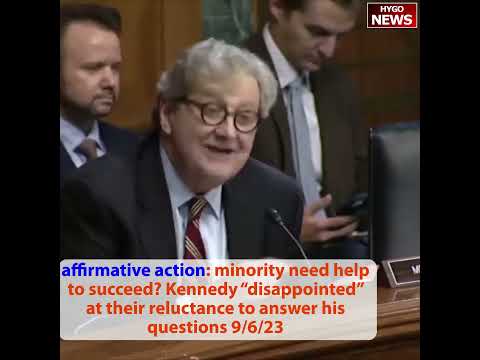
Sen. John Kennedy, R-La., asked two of President Joe Biden’s appeals court nominees a question he called “about as fundamental as you get”: Do minorities in America need special help to succeed? Neither one would give him a yes or a no.
“I just can’t believe neither one of you gentlemen will answer my question,” Kennedy said at the Sept. 6, 2023, Senate Judiciary Committee hearing. “And I really am disappointed.” The video above shows the end of the exchange, with Judge Joshua Kolar, a nominee for the 7th U.S. Circuit Court of Appeals. Quotes are from the official hearing transcript published by the Government Publishing Office [1].
Two Navy Men on the Hot Seat
Both nominees had served in uniform. Richard Federico, nominated to the 10th Circuit, was a senior litigator in the federal public defender’s office in Kansas and a captain in the Navy’s Judge Advocate General’s Corps [2]. Kolar, nominated to the 7th Circuit, was a federal magistrate judge in northern Indiana and a Navy Reserve lieutenant commander who had served in Kabul, Afghanistan [3].
They appeared alongside three other nominees before Chairman Dick Durbin, D-Ill. [1]. The hearing came about 10 weeks after the Supreme Court struck down race-based college admissions, and Kennedy wanted to know where the nominees stood [4][5].
”Do You Think the Navy Is Systemically Racist?”
Kennedy started with Kolar. Would he let his personal beliefs affect his judgment on the bench? “No, Senator,” Kolar said. Did he have personal beliefs? “Senator, I have personal beliefs like anyone,” he answered [1].
Then Kennedy asked: “Do you think the Navy is systemically racist?”
Kolar said he had served with people from all backgrounds and called the armed forces “one of the first institutions in this country that were desegregated.” When Kennedy pressed, he said: “I don’t think today … the Navy I’m serving in is systemically racist.”
“Okay. That’s all I wanted to know,” Kennedy said [1].
Federico later got the same question and gave a crisp answer: “Senator, the Navy I know is not. And in fact, its primary focus is to be the most lethal maritime fighting force in the world.”
“Thank you for a straightforward answer,” Kennedy said [1].
”It’s a ‘Yes’ or a ‘No.’ It’s Pretty Simple.”
The straight answers stopped there. After both nominees said they had personal beliefs (“I’m glad to hear that both of you have personal beliefs. You’ve thought about the world,” Kennedy quipped), he asked Federico: “Do you think minorities need special help to achieve?” [1]
“Senator, I think, as a country, we have come a long way,” Federico began, pointing to the affirmative action case “that the Supreme Court just decided last term.”
“Yes, sir, I’m familiar with the case,” Kennedy said. “Do you believe that minorities in America need special help to succeed?”
“Senator, I think all people should deserve equal opportunity to succeed,” Federico said. Asked again, he said he hoped “all persons in this country who work hard have an opportunity to succeed” [1].
Kennedy kept at it. “Let me try it again,” he said, and finally: “It’s a ‘yes’ or a ‘no.’ It’s pretty simple.”
“Well, I believe that is a complex question, in many ways, that it’s difficult to answer yes or no,” Federico replied.
“You’re not going to answer it, are you?” Kennedy asked. Moments later he moved on: “I think by not answering it, you have answered it” [1].
Sex: Biology or Social Construct?
Kennedy turned back to Kolar with another question at the center of the culture wars: “Do you think that a person’s sex is a biological reality, or do you think it’s a social construct?”
“Senator, there certainly is a biological reality of sex assigned at birth,” Kolar said, before adding that “there are, as you are well aware, issues that are before the courts” about “how … to define that” [1].
”I Really Am Disappointed”
That set up the moment in the video. “I can tell you’re reluctant to answer. And these are tough questions, but I want to know what you think,” Kennedy told Kolar. “Do you think, Judge, minorities in America today need special help to succeed?”
Kolar began, “Senator, I think it’s a question that the Supreme Court…”
“Yes, sir. But what do you believe? I know what the Supreme Court has said. What do you believe?” Kennedy pressed. When Kolar started to describe how he would handle an affirmative action case in court, Kennedy cut in: “What about you personally? Not on the bench. We stipulated that you’re not going to allow your personal judgment to affect your decisions on the bench, and I believe you. Do you think minorities need special help to succeed in America today? That’s a pretty basic question” [1].
“I think that question, Senator, is one that the courts will struggle with after…” Kolar said.
Kennedy, out of time, closed it out: “I just can’t believe neither one of you gentlemen will answer my question. I just can’t. And that’s about as fundamental as you get in terms of America today. And I really am disappointed. I thought you would hit it head on. You’re going to have tough questions on the bench now” [1].
What the Supreme Court Had Just Said
The case both nominees pointed to was Students for Fair Admissions v. Harvard, decided June 29, 2023. The Court struck down the race-conscious admissions programs at Harvard and the University of North Carolina. “Eliminating racial discrimination means eliminating all of it,” Chief Justice John Roberts wrote for the majority [5].
It was not the first time Kennedy pressed a Biden official on equal treatment. That May, he questioned the acting director of the National Institutes of Health about one of the agency’s hiring programs, in another exchange covered by HYGO News.
By the Numbers
- 2: Biden appeals court nominees Kennedy asked whether minorities need special help to succeed [1].
- 0: Yes-or-no answers he got.
- 13-8 and 16-5: The committee votes advancing Federico and Kolar on Sept. 28, 2023. Kennedy voted no on Federico and yes on Kolar [6].
- 61-29 and 66-25: The Senate votes confirming Federico and Kolar [7].
What Happened Next
Despite the dodge, Kennedy did not try to sink Kolar. When the committee voted on Sept. 28, 2023, he voted to advance Kolar, 16-5, and against Federico, who advanced 13-8 [6].
The Senate confirmed Federico to the 10th Circuit on Dec. 11, 2023 [2]. Biden renominated Kolar on Jan. 8, 2024, and the Senate confirmed him to the 7th Circuit on Jan. 30, 2024 [3]. The tallies were 61-29 for Federico and 66-25 for Kolar [7].
Washington’s answer to Kennedy’s question changed with the next administration. On Jan. 21, 2025, his second day back in office, President Donald Trump revoked Executive Order 11246, a 1965 equal employment order for federal contractors, and told the Labor Department to stop holding contractors responsible for taking “affirmative action.” He ordered agencies to end “discriminatory and illegal preferences” and declared it federal policy “to promote individual initiative, excellence, and hard work” [8].
The Supreme Court weighed in again the next year. On June 5, 2025, a unanimous Supreme Court threw out a rule that made members of a “majority group” meet a heavier burden to sue for job discrimination. Justice Ketanji Brown Jackson wrote the opinion [9].
Sources
- Government Publishing Office: S. Hrg. 118-29, Part 9, Confirmation Hearing on Federal Appointments (Sept. 6, 2023)
- Federal Judicial Center: Federico, Richard Edward Neel, Biographical Directory of Article III Federal Judges
- Federal Judicial Center: Kolar, Joshua Paul, Biographical Directory of Article III Federal Judges
- The Indiana Lawyer: Kolar fields 1st questions from Senate Judiciary Committee as 7th Circuit nominee (Sept. 7, 2023)
- Supreme Court of the United States: Students for Fair Admissions v. President and Fellows of Harvard College, opinion (June 29, 2023)
- Senate Judiciary Committee: Results of Executive Business Meeting (Sept. 28, 2023)
- Federal Judicial Center: Biographical Directory of Article III Federal Judges, data export (judges.csv)
- The White House: Ending Illegal Discrimination and Restoring Merit-Based Opportunity, executive order (Jan. 21, 2025)
- Supreme Court of the United States: Ames v. Ohio Department of Youth Services, opinion (June 5, 2025)