 HYGO News
 Kennedy: add to what? you haven't told me! Fiscal policy has nothing to do with inflation?
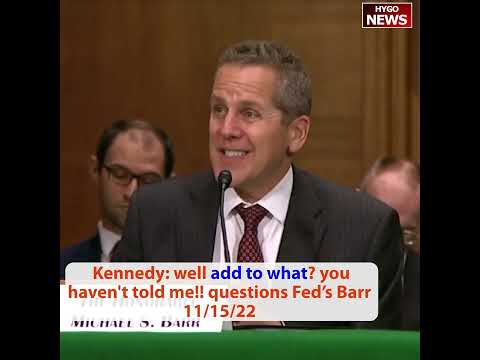
Senator Kennedy Grills Fed Vice Chair: “You’re Not Telling Me Fiscal Policy Has Nothing to Do With Inflation, Are You?” — Demands Moral Obligation to Speak Out
On 11/15/2022, Senator John Kennedy (R-LA) conducted a devastating cross-examination of a Federal Reserve vice chair during a Banking Committee hearing. Kennedy pressed the Fed official on whether congressional spending was contributing to inflation — and whether the Fed had a “moral obligation” to say so publicly. The Fed official repeatedly declined to comment on fiscal policy, prompting Kennedy’s incredulous response: “Add to what? You haven’t told me anything!” Kennedy warned that if Congress “cooperated and spent money like it was ditch water,” the Fed “wouldn’t have to raise rates as high.” The Fed official maintained that the central bank took fiscal policy as an input but refused to comment on whether it was contributing to the inflation the Fed was fighting.
”If Congress Cooperated”
Kennedy opened with a hypothetical that was really a direct accusation. “If Congress cooperated and spent money like it was ditch water, the Fed wouldn’t have to raise rates as high. Is that a fair statement? To get control of inflation, of course,” Kennedy said.
The framing was deliberately provocative. “Spent money like it was ditch water” characterized congressional spending as wasteful and excessive — a description that applied equally to both parties’ spending priorities but particularly resonated with Republican critiques of the Biden administration’s trillion-dollar spending bills.
The underlying economic point was well-established among economists: fiscal policy (government spending and taxing) and monetary policy (interest rates and money supply) interact to affect inflation. When the government spends aggressively, it increases demand in the economy, pushing prices up. To counteract that demand, the Fed typically raises interest rates, slowing economic activity. The more fiscal stimulus, the more monetary tightening required.
This relationship was widely recognized. Former Treasury Secretary Larry Summers had repeatedly warned that Biden’s $1.9 trillion American Rescue Plan would trigger inflation, and that the Fed would have to respond with aggressive rate hikes. His prediction proved accurate. By November 2022, the Fed had raised rates by 375 basis points in just eight months — the fastest tightening since the Volcker era.
Kennedy’s question asked the Fed official to acknowledge this fiscal-monetary relationship publicly. The Fed official declined.
”I Really Won’t Have Any Comment”
The Fed official’s response was standard central bank deflection. “I really won’t have any comment on fiscal policy. We take the — you think fiscal policy is irrelevant? We take the fiscal policy that elected members of Congress and the president enact, and we calculate those in our decision making, but I don’t have a comment on fiscal policy,” the official said.
The careful phrasing revealed the tension. The Fed explicitly acknowledged that it “calculated” fiscal policy into its decision-making — meaning the Fed recognized that congressional spending affected inflation and therefore affected the monetary policy the Fed deployed to fight inflation. But the official refused to say this publicly beyond the narrow “we take it as an input” framing.
The reason for the deflection was political and institutional. The Federal Reserve is nominally independent from the political branches. Fed officials traditionally avoid commenting on fiscal policy to maintain the appearance of separation from political decision-making. Saying that congressional spending was causing inflation would be interpreted as a political statement, even if it was analytically accurate.
But the institutional caution had limits. There was a difference between avoiding partisan political statements and refusing to acknowledge economic reality. The Fed’s refusal to publicly acknowledge the fiscal-monetary relationship left the public with a misleading picture: that the central bank was fighting inflation while the cause of inflation remained mysterious.
”Add to What? You Haven’t Told Me Anything!”
The exchange’s defining moment came when Kennedy pressed further. “You don’t have any comment on the contribution that fiscal policy makes to inflation?” Kennedy asked.
“I really don’t have anything to add about that,” the Fed official responded.
Kennedy’s incredulous follow-up was devastating: “Add to what? You haven’t told me anything. Add to what I said before we go.”
The logical trap was elegant. “I don’t have anything to add” implied that something had already been said that Kennedy was asking the official to supplement. But the official hadn’t said anything substantive — he had only deflected. There was nothing to add to because there was nothing to supplement. Kennedy was calling out the verbal dodge by pointing out that the underlying statement it was based on didn’t exist.
“You’re not telling me that fiscal policy has nothing to do with inflation, are you?” Kennedy pressed.
The Fed official tried to deflect again. “I’m telling you that at the Fed we take our monetary policy responsibilities as ours and we leave to the elected…” the official began.
Kennedy cut him off: “Well, don’t you think you have a moral obligation, if not a legal obligation, if you think fiscal policy is contributing to the inflation to say something for God’s sakes?"
"Moral Obligation”
Kennedy’s “moral obligation” framing elevated the exchange from a policy debate to an ethics discussion. The argument ran: if the Fed knew that fiscal policy was causing inflation, and the Fed was forced to impose painful rate hikes to counteract that inflation, did the Fed have an ethical duty to publicly identify the cause?
The question had real stakes. The Fed’s rate hikes were causing genuine suffering — mortgage rates doubled, housing affordability collapsed, first-time buyers were priced out, businesses faced higher borrowing costs, the stock market fell 25%, and recession risk climbed toward 100%. These costs were being imposed on Americans because the Fed had to fight inflation with blunt tools.
If the root cause was excessive fiscal spending, then the American public deserved to know. Voters needed this information to hold their elected officials accountable. By refusing to say what everyone at the Fed privately understood, the central bank was allowing policymakers to escape responsibility for the inflation their spending had caused.
The Political Context
Kennedy’s questioning came in a specific political moment. The Biden administration had just celebrated better-than-expected midterm results. The administration was claiming economic success and dismissing the inflation crisis with minimization language.
In this environment, having the Fed publicly acknowledge that Biden’s spending was causing inflation would have been politically devastating for the administration. The Fed’s institutional caution served, whether intentionally or not, as cover for the administration. By refusing to name the cause of inflation, the Fed allowed the White House to deflect blame onto external factors (Putin, OPEC, supply chains, corporate greed) without facing contradiction from the central bank.
Kennedy understood this dynamic. His questioning was designed to force the Fed official to either corroborate the administration’s narrative (which would have been intellectually dishonest) or publicly break with it (which would have been institutionally difficult). The Fed official chose a third option: saying nothing at all, which preserved institutional norms while effectively providing the administration political cover.
Key Takeaways
- Senator John Kennedy pressed a Fed vice chair on whether congressional spending was contributing to inflation; the official repeatedly declined to comment.
- Kennedy’s line “Add to what? You haven’t told me anything!” exposed the Fed’s verbal dodges.
- Kennedy argued the Fed had a “moral obligation” to publicly identify fiscal policy as an inflation driver if that was what they believed.
- The Fed’s institutional caution effectively provided political cover for the Biden administration’s spending decisions.
- By November 2022, the Fed had raised rates 375 basis points in 8 months — the fastest tightening since the Volcker era of the early 1980s.
Transcript Highlights
The following is transcribed from the video audio (unverified — AI-generated from audio).
- If Congress cooperated and spent money like it was ditch water, the Fed wouldn’t have to raise rates as high.
- I really won’t have any comment on fiscal policy.
- You don’t have any comment on the contribution that fiscal policy makes to inflation?
- Add to what? You haven’t told me anything. Add to what I said before we go.
- You’re not telling me that fiscal policy has nothing to do with inflation, are you?
- Don’t you think you have a moral obligation, if not a legal obligation, to say something for God’s sakes?
Full transcript: 186 words transcribed via Whisper AI.