 HYGO News
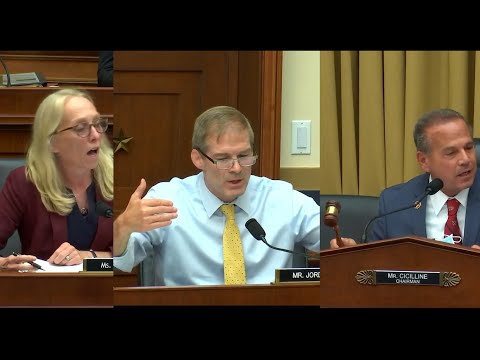
 7/29/2020 Jim Jordan screaming match with Cicilline at Antitrust Hearing
7/29/2020 Jim Jordan screaming match with Cicilline at Antitrust Hearing
On July 29, 2020, Rep. Jim Jordan, R-Ohio, turned the House Judiciary Committee’s landmark Big Tech antitrust hearing into a fiery confrontation on two fronts: a procedural screaming match with subcommittee chairman David Cicilline and a sustained interrogation of Google CEO Sundar Pichai over allegations that the company had used its platform features to help the Clinton campaign in 2016. Jordan opened the hearing by declaring “Big Tech is out to get conservatives” and warned that “if it doesn’t end, there has to be consequences.”
The Screaming Match with Cicilline
Before the four tech CEOs even began their testimony, Jordan ignited a procedural clash that became one of the most-viewed moments of the hearing. Jordan requested unanimous consent to allow Rep. Mike Johnson, the ranking member of the Constitution subcommittee, to participate in the hearing, calling it “customary practice for subcommittee hearings.”
Cicilline, who was chairing the proceedings, allowed the request but Rep. David Raskin objected. “Objection is heard,” Cicilline ruled, and moved to introduce the witnesses.
Jordan erupted. “Why are we not allowing — it is customary!” he bellowed. Cicilline attempted to regain control: “Mr. Jordan, there was a unanimous consent request. Objection was heard. Those are our rules.”
“This has never happened!” Jordan shouted. “We’re talking about people’s liberties here. We have the ranking member of the Constitution subcommittee.”
The exchange escalated further when another member interjected, telling Jordan to “put your mask on” — a reference to the mask-wearing protocols that had become politically charged during the pandemic. The moment captured the broader tensions of the hearing, where the ostensible subject of antitrust regulation clashed repeatedly with partisan battles over censorship, election interference, and pandemic politics.
Jordan’s Opening: “Big Tech Is Out to Get Conservatives”
In his opening statement, Jordan shifted the hearing’s focus away from the antitrust issues that Democrats had spent 13 months investigating. Instead, he made conservative censorship his central theme.
“We all think the free market is great. We think competition is great. We love the fact that these are American companies,” Jordan said. “But what’s not great is censoring people, censoring conservatives and trying to impact elections.” He then read aloud specific examples of conservative publications and voices that he argued had been suppressed or censored on Facebook and Google.
Jordan closed his opening with a direct warning to the executives: “If it doesn’t end, there has to be consequences.”
Pressing Pichai on the 2016 Election
Jordan’s most sustained line of questioning targeted Pichai over a 2016 internal Google email that had become public. The email, written by Eliana Murillo, Google’s head of multicultural marketing, discussed the company’s efforts to increase Latino voter turnout.
“Mr. Pichai, is Google going to tailor its features to help Joe Biden in the 2020 election?” Jordan asked directly. Pichai responded that Google “approaches our work in a nonpartisan way” and supports political advertising as “an important part of free speech in democratic societies.”
Jordan pressed harder: “Can you today assure Americans you will not tailor your features in any way to help, specifically help one candidate over other?” Pichai replied: “We won’t do any work to politically tilt anything one way or the other. It’s against our core values.”
“But you did it in 2016,” Jordan shot back. He then read from the Murillo email, which referenced what she called “the silent donation Google made to the Clinton campaign.” Jordan highlighted the specific language: “We pushed to get out the Latino vote with our features in key states.”
Jordan zeroed in on the phrase “in key states,” arguing it was the most revealing detail. “It’s one thing if you’re going to increase the Latino vote around the country. If you’re just a good corporate citizen, you’re urging people to vote,” Jordan said. “It’s quite another when you’re focusing on key states. And you know what those key states were? Nevada and Florida, the swing states.”
Pichai’s Response and Jordan’s Skepticism
Pichai acknowledged the conversation: “Congressman, I recall our conversation at that time and I appreciate your concern.” He said Google “didn’t find any evidence of such activity” and that he had reinforced internally that “even an appearance could be improper.”
Pichai added that Google had “clearly communicated to our employees any personal political activity, while that’s their right, needs to happen on their own time and resources and should avoid any use of company” resources.
Jordan remained unconvinced: “Well, of course, everyone’s got their First Amendment rights to campaign for who they want. What they can’t do is configure your features to help one candidate over the other. So you might have not found any evidence, but here’s what she wrote.”
Additional Context from Full Remarks
The full hearing recording reveals that Jordan’s confrontational approach served a dual purpose within Republican strategy. While the Democrats on the committee focused their questions on market dominance, acquisitions, and anticompetitive practices, Jordan and other Republicans used their time almost exclusively to press the CEOs on censorship and political bias.
Jordan’s line of questioning about the 2016 email put Pichai in a particularly difficult position. The email existed, its language about “key states” was specific, and Pichai’s internal investigation had not produced a satisfying explanation for why a Google executive was discussing voter turnout efforts in swing states on company email.
The screaming match with Cicilline, meanwhile, highlighted the procedural tensions that had been building between the parties throughout the hearing’s preparation. Democrats viewed the hearing as the culmination of a serious antitrust investigation; Republicans saw it as an opportunity to put Big Tech on record about conservative censorship before the November election.
Key Takeaways
- Jordan ignited a screaming match with Cicilline before testimony even began by demanding that a Constitution subcommittee ranking member be allowed to participate, bellowing “we’re talking about people’s liberties here” before being told to “put your mask on.”
- He pressed Pichai on a 2016 internal email where a Google executive wrote about pushing “to get out the Latino vote with our features in key states,” which Jordan characterized as election interference targeting swing states Nevada and Florida.
- Jordan declared “Big Tech is out to get conservatives” in his opening statement and warned that censorship of conservative voices would face “consequences,” framing the antitrust hearing primarily as a platform for addressing political bias rather than market competition.