 HYGO News
'I Disagree With the Intellectually Dishonest': Jean-Pierre on Refusing to Negotiate the Debt Limit (April 27, 2023)
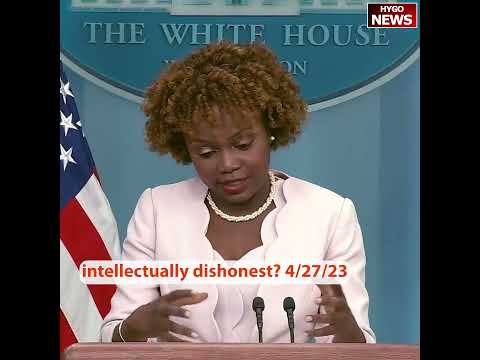
On April 26, 2023, the Republican-led House voted 217 to 215 to pass the Limit, Save, Grow Act. The bill would have raised the debt ceiling by $1.5 trillion or until the end of March 2024, whichever came first, and cut spending by what CBS News put at $4.5 trillion; President Biden had vowed to veto it [2]. Speaker Kevin McCarthy’s strategy was to force Biden back to the negotiating table, and the two had not had an extended discussion of the issue since February 1 [3]. At the White House briefing the next day, a reporter asked Press Secretary Karine Jean-Pierre how long the president could keep saying Republicans were holding the economy hostage when they had passed a bill that raised the debt ceiling. This video shows that exchange. Quotes are from the official transcript published by the American Presidency Project [1].
Key Moments
The “cheat sheet”
The same reporter, identified in the transcript as Jacqui, began with the president’s news conference the day before with South Korean President Yoon Suk Yeol. A photographer there had captured a card in Biden’s hand showing a picture of Los Angeles Times reporter Courtney Subramanian, the pronunciation of her last name, “Question #1” written at the top, and a summary of a question; she was called on first [4]. Jean-Pierre said the White House reaches out “to a number of reporters who — who we know are going to be at the press conference,” and tries to pick reporters who have not had a question “in a while.” Asked whether the president had similar talking points in case he was asked about other topics, she said: “as someone who is part of his — of the prep briefing with the President for these press conferences, as his Press Secretary, we talk about an array of — of topics that could potentially come up” [1].
”Intellectually dishonest”
The reporter then turned to the debt ceiling. “You know, how long can this posture from the President last before it feels like intellectually dishonest to say, you know, they’re holding the economy hostage and not raising the debt ceiling when they did pass a bill to raise the debt ceiling, and the — the argument is really about the — the budget cuts, the spending cuts, and not about whether or not the debt ceiling gets raised?” Jean-Pierre answered: “So, I have to say, Jacqui, I disagree with the ‘intellectually dishonest.’ That is certainly not how we see ourselves here because we’ve been very, very clear that they need to deal with the debt ceiling. They need to not default. It is a constitutional duty” [1].
”We will not negotiate”
“So they won’t talk unless it’s without conditions?” the reporter asked. “Like, unless it’s a clean bill, they won’t talk.” “I mean, I’ve been very clear: Without conditions we’ll — we will not negotiate. There’s not — there’s nothing new there,” Jean-Pierre said. She described the Republican position this way: “Unless the President and the Senate agree to an extreme MAGA wish list slashing — slashing education, veterans’ healthcare, Meals on Wheels; taking away healthcare for millions of American; and sending manufacturing jobs overseas, they’re going to default and crash the economy.” She added: “We cannot be dead- — a deadbeat nation.” Asked once more, “So no meeting unless it’s a clean debt bill,” she said: “we’ve been very clear about this. We’ve been very, very clear. I appreciate — I appreciate the merit of the question” [1].
A week earlier: “We do not want to negotiate on this”
The position was not new. On April 21, a reporter noted that the speaker had “now put out what appears to be the closest thing he’s going to get to putting out a budget” and asked: “So what are you waiting for?” “So, what we’re waiting for is for them to avoid default,” Jean-Pierre said. Asked whether there would be no conversation until Republicans passed a clean debt bill, she said: “We’ve been very clear about that. We do not want to negotiate on this. We want to make sure that they do what they did the last three times and avoid default.” “And no talking until then?” “Look, they need to do that, and then we can go ahead and have a conversation about the budget” [11].
Background: What the Debt Limit Is
The debt limit “is the total amount of money that the United States government is authorized to borrow to meet its existing legal obligations, including Social Security and Medicare benefits, military salaries, interest on the national debt, tax refunds, and other payments,” according to the Treasury Department. “The debt limit does not authorize new spending commitments” [5]. The White House argued that raising it should not be tied to spending cuts; McCarthy’s strategy, NPR reported, was to use the deadline to force negotiations [3].
Fact Check
- “They did pass a bill to raise the debt ceiling.” Accurate. The House-passed bill would have raised it by $1.5 trillion or through March 2024, together with its spending cuts [2].
- “Slashing … veterans’ healthcare.” Disputed at the time. The bill required a return to fiscal 2022 levels of discretionary spending. “Democrats say that would result in a 22% cut across all programs, while Republicans say they would tailor the cuts through the appropriations process,” CBS News reported. “The GOP plan to raise the debt limit does not explicitly cut veterans programs — but it does not exempt them from cuts either” [6].
- “Without conditions … we will not negotiate.” Overtaken by events. The standoff “was not resolved until weeks of intense negotiations between the White House and House Speaker Kevin McCarthy,” the AP reported, and the final agreement raised the debt limit together with limits on spending [7].
- The cheat sheet. The Los Angeles Times said its reporter “did not submit any questions in advance of the Q&A with President Biden,” noting that she is in regular contact with the White House press office, and her question was not identical to the wording on the card [8].
For other statements by Jean-Pierre that the record contradicted, see our article on her “$70 per gallon” mistake and other statements of hers that proved wrong.
What Happened Next
- The deal: On Saturday, June 3, 2023, two days before the deadline, Biden signed the Fiscal Responsibility Act, which “suspends the debt limit until 2025 — after the next presidential election — and restricts government spending.” The House passed it 314 to 117 and the Senate 63 to 36 [7].
- Its cost: The Congressional Budget Office estimated that the law would reduce projected deficits by $1.5 trillion over 10 years [9].
- The next increase: In July 2025, Congress raised the debt ceiling by $5 trillion as part of President Trump’s “big, beautiful bill,” which he signed on July 4 [10].
Sources
- The American Presidency Project: Press Briefing by Press Secretary Karine Jean-Pierre (April 27, 2023)
- CBS News: Debt ceiling: House passes bill with spending cuts in test of GOP unity (April 26, 2023)
- NPR: House Republicans overcome internal divisions to pass debt ceiling bill (April 26, 2023)
- Fox News: Biden caught with crib notes detailing reporter’s question prior to calling on her during press conference (April 26, 2023)
- U.S. Department of the Treasury: Debt Limit
- CBS News: Accusations about cuts to veterans’ programs adds new volatility to debt ceiling standoff (May 1, 2023)
- AP via PBS NewsHour: Biden signs bipartisan bill that suspends debt limit until 2025, cuts spending (June 3, 2023)
- Fox News: LA Times denies submitting questions to the White House ahead of press conference (April 27, 2023)
- Congressional Budget Office: How the Fiscal Responsibility Act of 2023 Affects CBO’s Projections of Federal Debt (June 9, 2023)
- CBS News: Here’s what’s in Trump’s “big, beautiful bill” passed by Congress (July 4, 2025)
- The American Presidency Project: Press Briefing by Press Secretary Karine Jean-Pierre (April 21, 2023)