 HYGO News
Hawley to Judicial Nominee Michael Delaney: 'I'm Astounded You've Been Nominated' (February 15, 2023)
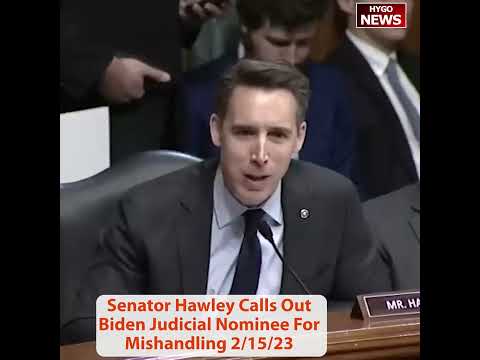
On February 15, 2023, the Senate Judiciary Committee held a confirmation hearing for six of President Biden’s judicial nominees. The most contested was Michael Delaney, a former New Hampshire attorney general nominated to the U.S. Court of Appeals for the First Circuit. The committee’s chairman, Sen. Dick Durbin, noted that the American Bar Association had rated him unanimously “well qualified,” and both of New Hampshire’s Democratic senators introduced him [1][2]. But most of the questions concerned his work years earlier as a lawyer for St. Paul’s School, an elite boarding school in Concord, New Hampshire, in a lawsuit brought by the family of Chessy Prout, who had been sexually assaulted by an older student when she was 15. Prout wrote to the committee opposing the nomination, and her family attended the hearing. This video shows the end of Sen. Josh Hawley’s questioning. All quotes below are from the official hearing record, Senate Hearing 118-29, Part 2 [1].
Key Moments
”Her family’s sitting here today”
Hawley said Delaney’s effort to remove Prout’s anonymity was itself an attempt to try the case in the media. “How can you say that when you knew full well that a 16-year-old girl would have her name published, would have reporters no doubt in her front lawn, would have people following her around with cameras everywhere,” he said. “Her family’s sitting here today. They’ve already been through hell. Your motion was an attempt to put them through further hell in order to defend your client. Right?”
“Senator, I was an advocate for the school in that case,” Delaney began. Hawley cut in: “As advocates, we make decisions, but we’re responsible for those decisions. You made a decision here. You made a decision to try to strip a young girl of her anonymity and you effectively succeeded because you bullied her into it.” Prout, he said, “unwilling to be intimidated by you, went forward and revealed her own name, which took, by the way, tremendous courage.”
Prout’s letter
Hawley then read from the letter Prout had sent the committee: “I remember so clearly reading Michael Delaney’s motion from front to back when I came home from my new high school one day, processing what it meant, and then defiantly stating to my parents that after everything I’d been dragged through … I wasn’t going to let Michael Delaney’s dirty tactics bully me, then 16 years old, into shame and silence.” In the same letter, Prout wrote: “Michael Delaney is not ethically qualified to sit on the bench” [2].
Delaney answered: “I respectfully disagree with that characterization of the role I played as an advocate in the case. The school agreed to allow the case to proceed with anonymity.” “No, you didn’t,” Hawley said, adding that he had the motion “right here.” He said the school’s stated grievance was the timing of the family’s filing, minutes before the court clerk’s office closed: “I don’t understand why your inconvenience about the time should mean that this young woman should have to surrender her anonymity."
"I’m astounded you’ve been nominated”
“So, you made the decision. You forced her to come forward. She was brave and did it. And now you’re accountable for that,” Hawley concluded. “And quite frankly, I’m astounded you’ve been nominated. I can’t believe we’re sitting here having this conversation today. And I, for one, will not support your nomination for these reasons. People who put sexual assault victims through this kind of torture shouldn’t sit on the bench.”
Delaney’s Account and the Rest of the Hearing
Delaney gave the same explanation to several senators. When Prout’s family asked to proceed anonymously, he told Durbin, “the school agreed to allow the family to proceed anonymously, provided that the court entered relief to ensure that the lawyers would try the case in a court of law and not in the media.” He added that, as a judge, “my role will be very different” [1].
Sen. John Kennedy of Louisiana walked through the sequence with him. The family had filed the motion to proceed anonymously; the school responded with its condition; and the judge never ruled, because the family withdrew its motion; the parents agreed to be named, and their daughter was identified in court papers by her initials [1][4]. “So, the controversy then is about a motion that the plaintiffs filed, that you responded to on behalf of your client, and the motion was never resolved,” Kennedy said. “I believe that’s correct, Senator,” Delaney replied [1].
Other Republicans were blunt. Sen. John Cornyn of Texas established that Delaney had not listed the case among the 10 most significant cases in his committee questionnaire; Delaney cited the confidential settlement and said there was little courtroom work after the first motion. Sen. Ted Cruz of Texas told him: “Your response to Senator Hawley was, ‘I was just representing my clients.’ Well, I’ll tell you, Mr. Delaney, you represented your clients very poorly” [1]. Sen. Marsha Blackburn of Tennessee asked: “What kind of message do you think your conduct sends to survivors of sexual assault?” [2]. Later that day, the five district court nominees on the second panel faced a different kind of test: a rapid legal quiz from Sen. John Kennedy.
Background: The St. Paul’s Case
In May 2014, Owen Labrie, an older student at St. Paul’s, sexually assaulted Prout, a 15-year-old freshman, as part of a school tradition known as the “senior salute” [4]. In 2015, a jury convicted Labrie of misdemeanor sexual assault, endangering the welfare of a child and a felony charge of using a computer service to lure a minor, and acquitted him of felony rape charges [3]. In June 2016, Prout’s parents sued the school in federal court as “John and Jane Doe,” identifying their daughter only as “J.D.” [3]. Weeks later, the school, represented by Delaney, asked the court to deny the family’s use of pseudonyms and to identify the girl if the case went to trial, arguing that it was unfair for the family to remain anonymous while using the media to attack the school’s “character, credibility, and reputation” [3][4]. Prout went public with her name in August 2016 [5]. The family’s lawsuit was settled confidentially in January 2018 [6].
The Record
- “You filed a motion that sought to strip her anonymity.” Fox News described the fight the same way on the day of the hearing: a motion Delaney filed “that could have required Prout, who was a minor at the time, to have her anonymity lifted” [10]. Contemporary reports said the school asked the court to deny the family’s pseudonyms and to identify Prout if the case went to trial [3][4].
- “You effectively succeeded because you bullied her into it.” Prout went public with her name in August 2016, weeks after the school’s filing [5]. Her family said at the time that the school’s objection was part of an effort to undermine her credibility [4].
- The questionnaire. Delaney acknowledged that he did not list the case among the 10 most significant cases in his committee questionnaire [1].
- “Biden’s latest troubled nominee.” That was Fox News’ headline that day. It reported that Delaney faced “brutal questioning” over a role “that could scuttle his nomination” [10]. It did.
What Happened Next
- The nomination stalled: The committee, on which Democrats held a one-vote margin, never voted on Delaney. He also lost Democratic support over a 2005 brief defending New Hampshire’s parental notification law for abortion, which he signed as deputy attorney general. Delaney told senators he did not write the brief and had “extremely limited involvement” in the case [7].
- Withdrawal: On May 18, 2023, Delaney asked the White House to withdraw his name. “At this time, I believe it is appropriate for me to withdraw my name from consideration for this position to advance the important work of the federal judiciary,” he wrote [7].
- His replacement: In October 2023, Biden nominated Seth Aframe, a federal prosecutor in Concord, to the seat [8]. The Senate confirmed him on May 20, 2024, by a vote of 49–40 [9].
Sources
- GovInfo: Senate Hearing 118-29, Part 2, Confirmation Hearing on Federal Appointments (February 15, 2023)
- New Hampshire Public Radio: US appeals court nominee’s role in NH sexual assault case scrutinized at Senate hearing (February 20, 2023)
- New Hampshire Public Radio: St. Paul’s asks court to release ID of Labrie’s sexual assault victim (2016)
- Concord Monitor: Parents of Owen Labrie sexual assault victim agree to be named in lawsuit (2016)
- Concord Monitor: Attorneys mediate civil lawsuit against St. Paul’s School (December 19, 2017)
- Concord Monitor: New suit by former student echoes accusations against St. Paul’s School (May 11, 2018)
- New Hampshire Public Radio: White House expected to withdraw Michael Delaney nomination (May 18, 2023)
- New Hampshire Public Radio: Biden taps NH federal prosecutor for seat on First Circuit Court (October 4, 2023)
- U.S. Senate: Roll call vote on the Aframe nomination (May 20, 2024)
- Fox News: Prep school rape case from 2014 comes back to haunt Biden’s latest troubled nominee