 HYGO News
 If we spend $50T to make USA carbon neutral by 2050, how much will that lower World temperatures?
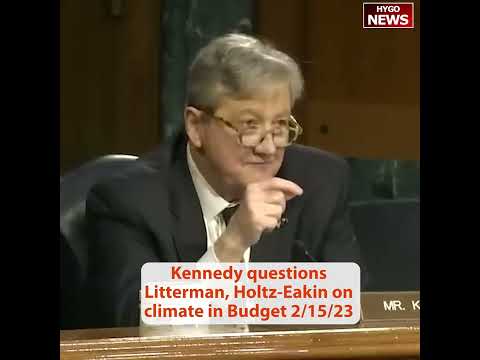
Kennedy: $50T To Make USA Carbon Neutral, How Much Will It Lower World Temperatures? Witnesses Can’t Say
In February 2023, Senator John Kennedy continued budget hearing questioning on climate policy economics, asking pointed follow-up on the benefit side of cost-benefit analysis. “If we spend $50 trillion to make the United States of America carbon neutral by 2050, how much will that lower world temperatures?” Kennedy asked. The witness responded: “I can’t understand because we don’t know what China and India and the rest of the globe has done.” Kennedy continued: “Have you heard anybody from the Biden administration say how much it will lower world temperatures?” Witness: “No.” Kennedy: “Does anybody know how much it will lower world temperatures?” Witness: “No. No one can know for sure.” Kennedy then turned to Dr. Litterman: “If we spend $50 trillion or however much it takes to make the United States carbon neutral by 2050, how much will it lower world temperatures?” Litterman: “Senator, that depends on the rest of the world. We have to work with the rest of the world. We’re in this together. It’s one world. We can’t go to the wall around the United States and see.” Kennedy pressed: “What if we spend $50 trillion? Europe cooperates. Most Western democracies cooperate, but India and China don’t.”
The Kennedy Follow-up Strategy
Strategy:
Cost established — $50T.
Benefit question — Next.
Full analysis — Sought.
Substantive — Framework.
Logical — Progression.
Kennedy’s follow-up strategy after establishing cost at $50T moved to benefit question seeking full analysis. Substantive framework for cost-benefit analysis. Logical progression building political narrative.
The Temperature Reduction Question
Question:
Specific — Metric.
Global — Framework.
Measurable — Impact.
Scientific — Question.
Substantive — Inquiry.
Kennedy’s temperature reduction question had specific metric framework on global measurable impact. Scientific question seeking substantive inquiry into actual climate policy effectiveness.
”Can’t Understand” Response
Response:
Witness uncertainty — Admitted.
China/India factor — Cited.
Limited — Knowledge.
Honest — Element.
Political — Problematic.
First witness’s “can’t understand” response admitted uncertainty while citing China/India factor. Limited knowledge honest element. Politically problematic for climate policy advocacy without benefit estimates.
The China/India Factor
Factor:
Major emitters — Yes.
Growing emissions — Both.
US action alone — Insufficient.
Cooperation — Required.
Reality — Global.
The China/India factor as major growing emitters meant US action alone was insufficient. Cooperation required. Global reality of climate policy depending on non-US actions affecting benefit calculations.
”Biden Administration Say How Much”
Kennedy question:
Administration source — Sought.
Benefit articulation — Required.
Policy advocacy — Basis.
Accountability — Through questioning.
Substantive — Challenge.
Kennedy’s “heard anybody from the Biden administration say how much it will lower world temperatures” sought administration source for benefit articulation as policy advocacy basis. Substantive accountability challenge.
”No” Responses
Responses:
Consistent — No from all.
Administration — Silent.
Experts — Unable.
Substantive — Gap.
Political — Impact.
Consistent “No” responses from administration silence and expert inability revealed substantive gap between cost and benefit knowledge. Significant political impact of the lack of benefit articulation.
”No One Can Know For Sure”
Uncertainty:
Honest — Acknowledgment.
Scientific — Reality.
Models — Imprecise.
Variables — Too many.
Complex — System.
“No one can know for sure” honest uncertainty acknowledgment reflected scientific reality with imprecise models due to too many variables in complex global climate system.
The Dr. Litterman Response
Litterman:
Senator addressed — Respectfully.
Global — Framing.
“One world” — Language.
Cooperation — Emphasized.
Scientific — Framing.
Dr. Litterman’s respectful “Senator” addressing with global “one world” framing emphasizing cooperation used scientific framing about interconnected climate challenge requiring global action.
”Depends on the Rest of the World”
Depends:
Global dependency — Real.
US alone insufficient — Admitted.
Cooperation — Required.
Substantive — Reality.
Complex — Diplomacy.
“Depends on the rest of the world” global dependency admission that US alone was insufficient requiring cooperation was substantive reality. Complex diplomacy dimension of climate policy.
”We Have to Work With the Rest of the World”
Cooperation:
International — Dimension.
Diplomacy — Required.
Treaties — Paris etc.
Coordination — Complex.
Standard — Framework.
Litterman’s “we have to work with the rest of the world” framing cooperation through international diplomacy, treaties like Paris, complex coordination. Standard climate policy framework.
”One World” Philosophy
Philosophy:
Interconnection — Acknowledged.
Shared fate — Climate.
Cooperative — Approach.
Idealistic — Element.
Framework — Standard.
“One world” philosophy acknowledged interconnection through shared climate fate with cooperative approach. Somewhat idealistic element in standard climate framework about global solutions.
”Wall Around the United States”
Metaphor:
Isolation impossible — Climate.
Global scale — Required.
US alone — Insufficient.
Cooperation — Only way.
Standard — Argument.
Litterman’s “can’t go to the wall around the United States and see” metaphor made isolation impossible argument for climate requiring global scale cooperation as only effective way.
Kennedy’s Hypothetical
Hypothetical:
“$50T spend” — Framework.
Europe cooperates — Scenario.
India/China don’t — Counter.
Specific — Inquiry.
Substantive — Question.
Kennedy’s hypothetical framework with $50T spent, Europe cooperating but India and China not cooperating was specific substantive inquiry into partial cooperation scenario.
The India/China Reality
Reality:
Coal use — Continuing.
Emissions growing — Rapidly.
Economic development — Priority.
Climate commitments — Limited.
Substantive — Problem.
India/China reality with continuing coal use and rapidly growing emissions prioritizing economic development over climate commitments created substantive problem for global climate goals regardless of US action.
The Free Rider Problem
Free rider:
Climate benefits — Public good.
Costs — Localized.
Incentive — To not contribute.
Classic — Economic.
Substantive — Challenge.
Free rider problem had climate benefits as public good with localized costs creating incentive to not contribute. Classic economics challenge. Substantive political economy problem for climate policy.
The US Leadership Argument
Leadership:
Moral — Framing.
Example setting — Priority.
Even without cooperation — Value.
Democratic — Values.
Standard — Argument.
US leadership argument with moral framing, example-setting priority, value even without cooperation reflected democratic values. Standard argument for US climate action regardless of other nations.
The Benefits vs. Costs Gap
Gap:
Costs concrete — $50T.
Benefits uncertain — Temperature.
Imbalance — Epistemic.
Political — Impact.
Substantive — Challenge.
Benefits vs. costs gap had concrete $50T costs vs. uncertain temperature benefits creating epistemic imbalance. Political impact through framing imbalance. Substantive challenge to simple advocacy.
The Climate Model Limitations
Limitations:
Complexity — Real.
Variables many — Interacting.
Predictions — Uncertain.
Ranges — Wide.
Scientific — Reality.
Climate model limitations due to real complexity with many interacting variables produced uncertain predictions within wide ranges. Scientific reality constraining certainty in benefit projections.
The IPCC Reports Context
IPCC:
Scientific — Authority.
Global assessments — Provided.
Ranges reported — Typically.
Political process — Also.
Best available — Science.
Intergovernmental Panel on Climate Change reports provided scientific authority through global assessments with ranges reported in political process. Best available science despite uncertainties.
The Policy Effectiveness Questions
Questions:
Marginal benefit — US action.
Without China/India — Limited.
Cost efficiency — Questionable.
Alternative uses — $50T.
Substantive — Policy questions.
Policy effectiveness questions included marginal benefit of US action without China/India being limited, questionable cost efficiency, alternative uses of $50T. Substantive policy questions beyond simple framing.
The Climate Policy Opportunity Costs
Costs:
$50T alternative — Uses.
Education — Healthcare.
Poverty reduction — Direct.
Other priorities — Multiple.
Policy choice — Fundamental.
Climate policy opportunity costs of $50T alternative uses in education, healthcare, poverty reduction and other priorities raised fundamental policy choice questions about resource allocation.
The Kennedy Cost-Benefit Framework
Framework:
Complete analysis — Sought.
Both sides — Cost and benefit.
Honest accounting — Required.
Substantive — Inquiry.
Quality — Oversight.
Kennedy’s cost-benefit framework seeking complete analysis of both cost and benefit sides with required honest accounting was substantive inquiry demonstrating quality Congressional oversight function.
The Political Rhetorical Effectiveness
Effectiveness:
Simple framing — Potential.
Viral potential — Real.
Conservative media — Amplify.
Base mobilization — Likely.
Campaign material — Created.
Political rhetorical effectiveness through potential simple framing had real viral potential. Conservative media amplification likely. Base mobilization probable. Campaign material created through framework.
The Climate Advocate Challenge
Challenge:
Benefits hard — To quantify.
Costs easier — To estimate.
Political — Disadvantage.
Complex — Reality.
Messaging — Difficult.
Climate advocate challenge with benefits hard to quantify while costs were easier to estimate created political disadvantage. Complex reality making messaging difficult for climate policy advocacy.
The Substantive Policy Trade-offs
Trade-offs:
Climate investment — $50T.
Other priorities — Alternative.
Democratic choice — Required.
Informed citizens — Essential.
Complex — Decisions.
Substantive policy trade-offs between climate investment of $50T vs. other priorities required democratic choice with essential informed citizens. Complex decisions requiring full information.
The Witness Intellectual Honesty
Honesty:
Uncertainty admitted — Appropriately.
Limitations — Acknowledged.
Academic — Standard.
Professional — Response.
Scientific — Integrity.
Witness intellectual honesty through appropriately admitted uncertainty and acknowledged limitations was academic standard professional response with scientific integrity maintained despite political pressure.
The Political vs. Scientific Communication
Communication:
Simple — Political wants.
Complex — Scientific reality.
Tension — Permanent.
Translation — Difficult.
Substantive — Challenge.
Political vs. scientific communication tension between simple political wants and complex scientific reality created permanent translation difficulty. Substantive challenge requiring nuanced handling.
The Benefits Quantification Attempts
Quantification:
Some estimates — Exist.
Specific ranges — Provided.
IPCC — Reports.
But context — Dependent.
Not definitive — Singular answer.
Benefits quantification attempts through some existing estimates with specific ranges in IPCC reports but context-dependent produced no definitive singular answer Kennedy could extract from witnesses.
The Paris Agreement Framework
Framework:
Global commitment — Attempted.
Voluntary pledges — National.
Varying ambition — Real.
Enforcement — Limited.
Reality — Cooperation variable.
Paris Agreement framework attempted global commitment through voluntary national pledges with varying ambition. Limited enforcement mechanism. Reality of variable cooperation among nations.
The Climate Policy Implementation
Implementation:
Multiple approaches — Possible.
Various mechanisms — Available.
Effectiveness — Varied.
Costs — Vary.
Complex — Choices.
Climate policy implementation had multiple approaches with various mechanisms available and varied effectiveness at varied costs. Complex choices in implementation beyond simple spending framework.
The 2024 Political Framing
Framing:
Cost-benefit — Framework.
Conservative — Position.
Climate skepticism — Some.
Pragmatic — Conservative.
Campaign — Material.
2024 political framing through cost-benefit framework reflected conservative position with some climate skepticism. Pragmatic conservative approach. Campaign material built through such questioning.
The Republican Climate Policy Positions
Positions:
Market-based — Some.
Innovation focus — Preferred.
Regulation — Skeptical.
Cost concerns — Central.
Evolving — Positions.
Republican climate policy positions ranging from market-based approaches, innovation focus preference, skeptical of regulation, central cost concerns showed evolving party positions through internal debate.
The Democratic Defense Required
Defense:
Benefits articulation — Needed.
Urgency framing — Deployed.
Scientific consensus — Cited.
Moral framework — Used.
Complex — Messaging.
Democratic defense required benefits articulation, deployed urgency framing, cited scientific consensus, used moral framework. Complex messaging to counter cost-focused Republican framework.
The Long-Term Climate Reality
Reality:
Challenge real — Yes.
Action required — Eventually.
Political cycles — Slow.
Stakes high — Long-term.
Complex — Response.
Long-term climate reality was real challenge requiring eventual action despite slow political cycles. High long-term stakes. Complex response required adapting to political dynamics over time.
The Kennedy Hearing Legacy
Legacy:
Framework established — Political.
Questions remembered — Specific.
Numbers cited — $50T.
Benefits unclear — Established.
Impact — Political discussion.
Kennedy hearing legacy established political framework with remembered specific questions and cited $50T number. Benefits unclear established. Impact on political discussion of climate policy economics.
The Democratic Process Value
Value:
Accountability — Served.
Substantive — Engagement.
Public record — Created.
Democracy — Functioning.
Quality — Oversight.
Democratic process value through accountability served, substantive engagement, created public record demonstrated democracy functioning. Quality oversight through such substantive Congressional hearings.
Key Takeaways
- Senator Kennedy asked: “If we spend $50 trillion to make the United States of America carbon neutral by 2050, how much will that lower world temperatures?”
- First witness admitted uncertainty: “I can’t understand because we don’t know what China and India and the rest of the globe has done.”
- Kennedy pressed: “Have you heard anybody from the Biden administration say how much it will lower world temperatures?” — Answer: “No.”
- He confirmed with multiple witnesses: “Does anybody know how much it will lower world temperatures?” — “No. No one can know for sure.”
- Dr. Litterman deflected: “That depends on the rest of the world. We have to work with the rest of the world. We’re in this together.”
- Kennedy pressed hypothetical: “What if we spend $50 trillion? Europe cooperates. Most Western democracies cooperate, but India and China don’t.”
Transcript Highlights
The following is transcribed from the video audio (unverified — AI-generated from audio).
- If we spend $50 trillion to make the United States of America carbon neutral by 2050, how much will that lower world temperatures?
- I can’t understand because we don’t know what China and India and the rest of the globe has done.
- Have you had heard anybody from the Biden administration say how much it will lower world temperatures?
- Does anybody know how much it will lower world temperatures? No one can know for sure.
- Senator, that depends on the rest of the world. We have to work with the rest of the world. We’re in this together. It’s one world.
- What if we spend $50 trillion? Europe cooperates. Most Western democracies cooperate, but India and China don’t.
Full transcript: 163 words transcribed via Whisper AI.