 HYGO News
 Hawley Introduces Solicitor General Pick Sauer Over Cracker Barrel; Dhillon Commits to Religious Liberty
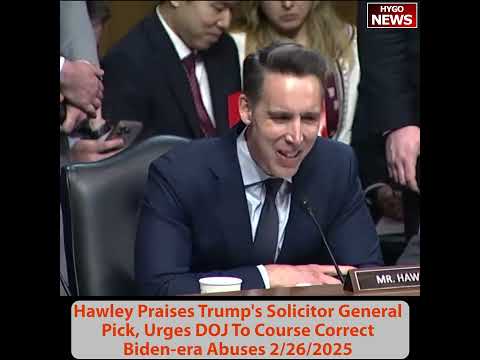
Hawley Introduces Solicitor General Pick Sauer Over Cracker Barrel; Dhillon Commits to Religious Liberty
At a February 26, 2025, Senate Judiciary Committee hearing, Senator Josh Hawley introduced fellow Missourian John Sauer as Trump’s nominee for Solicitor General — the nation’s top appellate attorney — with a personal story about recruiting Sauer over chicken fried steak at a Cracker Barrel. Hawley called Sauer “the best lawyer in this country” and noted his clerkship with Justice Antonin Scalia. The hearing also featured Harmeet Dhillon, nominee for Assistant Attorney General for Civil Rights, who committed to “defending people of faith equally” and rooting out campus antisemitism. Hawley posed a provocative question about whether public officials should comply with “morally abhorrent” court decisions like Korematsu and Dred Scott.
The Cracker Barrel Recruitment
Hawley opened his introduction with the kind of personal anecdote that humanized the confirmation process.
He first catalogued Sauer’s credentials: a bachelor of science from Duke University, a Rhodes Scholarship, an MA from Notre Dame, and a JD from Harvard Law School — which Hawley referred to as “Senator Cruz’s law school,” adding “we’ll try not to hold any of that against him.” Sauer had clerked for Judge Michael Luttig on the Fourth Circuit and then for Justice Antonin Scalia, whom Hawley called “the most influential associate justice of the Supreme Court of the 20th century.”
Then came the recruitment story. “I remember I went to John, and this may say something about my recruiting habits,” Hawley said. “You’ll like this, Senator Kennedy. I went to John and we met at a Cracker Barrel.”
The room responded with laughter as Hawley continued: “We sat down at a Cracker Barrel, and over chicken fried steak, I said to him, ‘John, you have the ability and the record to be Solicitor General of the United States. But would you at least consider coming to be Solicitor General of the State of Missouri?’”
Hawley described the result: “And to my great delight, and I think to the great benefit of the State of Missouri, he said yes and served as my Solicitor General for two years and also as my first assistant in the office.”
The Cracker Barrel story was effective because it painted a picture of two serious lawyers — a future senator and a future Solicitor General nominee — making consequential career decisions over comfort food at a chain restaurant. It was the kind of Midwestern authenticity that resonated with the public and contrasted with the Washington establishment’s preference for power lunches at expensive restaurants.
Hawley’s assessment of Sauer was unequivocal: “I do not know a better lawyer in private practice and public practice — federal prosecutor, name it, go down the line — I do not know a better lawyer in this country than John Sauer.”
He added a joke that was also a question preview: “Which of the attorneys general on this dais was your favorite, and why is it me? So you can be thinking on that.”
Religious Liberty: “Will You Commit?”
Hawley then turned to Harmeet Dhillon, Trump’s nominee to lead the DOJ Civil Rights Division, and asked the question that reflected one of his core priorities.
“My question to you is: will you commit to stopping the disparate treatment of Americans on the basis of religious faith that we have seen in the last four years?” Hawley asked. “Will you make sure that people of faith are protected in the religious expression of their most deeply held beliefs?”
Dhillon’s response was emphatic and grounded in her own career. “Thank you for that question, Senator Hawley. I believe my career and the disclosures made to the Senate would back up the fact that my entire career — 32 years — has included religious liberty litigation on the side of people of faith, of minority and majority faiths,” she said.
She cited her Supreme Court experience: “I have one case at the United States Supreme Court defending people of faith from government tyranny and obstruction.”
Dhillon made the commitment: “I would absolutely be committed as a top priority in the Civil Rights Division, if confirmed, to defending people of faith equally.”
The exchange reflected a fundamental shift in how the Civil Rights Division would operate under Trump compared to Biden. Under the Biden DOJ, the division had focused heavily on racial equity, voting rights enforcement, and LGBTQ protections. Under Trump, with Dhillon at the helm, the division would add religious liberty as a “top priority” — protecting churches, faith-based organizations, and individual believers from government overreach.
Antisemitism on Campus
Hawley followed up with a question about one of the most visible civil rights issues of the moment.
“Will you commit to vigorously enforcing, Ms. Dhillon, Title VI violations related to antisemitism — to make sure that we root out the scourge on America’s campus?” Hawley asked.
“Absolutely, Senator, I would certainly commit to that,” Dhillon said.
The Title VI question referred to the federal statute that prohibits discrimination on the basis of race, color, or national origin in programs receiving federal financial assistance. Following the October 7, 2023, Hamas attack and the subsequent anti-Israel protests on American college campuses, there had been widespread reports of Jewish students being harassed, intimidated, and excluded from campus activities. The Biden DOJ had been criticized for what many viewed as a tepid response to campus antisemitism.
Dhillon’s commitment to “vigorous” enforcement signaled that the Trump Civil Rights Division would treat antisemitism on campus with the same urgency as other forms of discrimination — a priority that aligned with the administration’s broader support for Israel and its Jewish-American constituency.
The Korematsu Question
Hawley closed with a philosophical question that connected the day’s hearing to the broader constitutional debate about judicial authority.
“I thought it sounded to me like my friend Senator Durbin was defending the Korematsu decision, which I think is one of the worst and most abhorrent decisions in the history of the United States,” Hawley said.
The Korematsu decision, issued in 1944, upheld the internment of Japanese Americans during World War II. It was formally repudiated by the Supreme Court in 2018 in Trump v. Hawaii but remained a symbol of judicial injustice.
Hawley posed the question to the nominees: “When we have a decision that is absolutely morally abhorrent — Korematsu, Dred Scott, we can go down the line — should officials who disagree with a morally abhorrent decision just blindly follow it? Or do they register their disagreements? I suppose if they have to, they resign and protest.”
He framed the stakes: “Is the United States of America better off if our public officials, in the face of grievous moral wrongs, say and do nothing?”
The question was relevant to the ongoing tension between the Trump administration and federal courts issuing injunctions against executive actions. While Senator Kennedy had told nominees they must always follow court orders, Hawley was asking a subtly different question: whether moral conscience required more than mere compliance when the legal system produced outcomes that were manifestly unjust.
Key Takeaways
- Hawley told the story of recruiting John Sauer for Missouri’s Solicitor General position “over chicken fried steak” at a Cracker Barrel, calling him “the best lawyer in this country.”
- Sauer clerked for Justice Antonin Scalia, was a Rhodes Scholar, and served as Missouri’s Solicitor General before being nominated as the nation’s top appellate attorney.
- Civil Rights Division nominee Harmeet Dhillon committed to making religious liberty “a top priority,” citing 32 years of faith-based litigation including a Supreme Court case.
- Dhillon pledged to “vigorously enforce” Title VI against campus antisemitism, a priority shift from the Biden-era Civil Rights Division.
- Hawley posed the philosophical question of whether officials should “blindly follow” morally abhorrent court decisions like Korematsu, or whether moral conscience required active dissent.