 HYGO News
 Hawley: Nationwide Injunctions -- Bush 6, Obama 12, Biden 14, Trump I 64, Trump II 15 in One Month; Calls for Congressional Ban
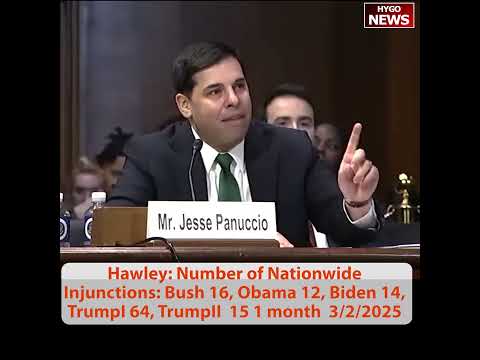
Hawley: Nationwide Injunctions — Bush 6, Obama 12, Biden 14, Trump I 64, Trump II 15 in One Month; Calls for Congressional Ban
Senator Josh Hawley presented a chart at an April 2025 Senate hearing that laid bare the explosion of nationwide injunctions: Bush 43 saw 6, Obama saw 12, Biden saw 14, Trump’s first term saw 64, and Trump’s second term had already accumulated 15 in a single month. He revealed that judges were now using temporary restraining orders (TROs) to evade appellate review, and cited Biden’s own solicitor general and Justice Elena Kagan opposing the practice. Hawley called for a statutory ban: “One rule across the board — a judge can only bind parties who are before her or him. No nationwide injunctions.”
The Chart: “An Explosion”
Hawley opened by establishing the historical timeline.
“In 1963, so the Republic is 200 years old almost by the time we get the first district court issuing a universal injunction binding parties who were not before it,” Hawley said. “And even then, there’s this period of quiet where they’re really not issued until the 21st century, until the 2000s.”
He walked through the chart displayed behind him: “In the Bush years, Bush 43, we have 6 universal injunctions binding non-parties. In the Obama years, we have 12.”
Then the spike: “And then under Trump in his first administration, 64 universal injunctions binding non-parties. 14 under Biden. And now 15 under the second Trump administration in one month alone.”
The numbers told the story with mathematical precision. For 200 years of the Republic, universal injunctions essentially did not exist. When they began appearing in the 21st century, they grew modestly — 6 under Bush, 12 under Obama. Then Trump took office and the number exploded to 64 in four years, fell back to 14 under Biden’s four years, and surged to 15 in Trump’s first month back.
The pattern was unmistakable: the judicial system deployed universal injunctions asymmetrically against Republican presidents, and specifically against Trump. The ratio was devastating — Trump received more universal injunctions in one month of his second term than Biden received in four years.
”Why Is This So Distortive?”
Hawley pressed a constitutional law expert to explain the structural danger.
“Tell us why this pattern that we’re seeing here — and there’s a clear partisan valence to it, but there’s even more of a recency valence,” Hawley said. “This is something that just did not happen until very, very recently. Why is this so distortive to our federal system?”
The expert explained the foundational principle: “We are a republic. Those who get to exercise policy-making power, like yourself, like this body, have to face the electorate — every six years, two years, four years, whatever it is. Judges do not.”
He explained the constitutional design: “We gave them life tenure so that they could be insulated and make decisions without fear or favor. But we limited the judicial power to cases and controversies — just the party before them.”
The witness cited Hamilton’s warning from the Federalist Papers: “Hamilton said it’s the least dangerous branch, but he had a caveat — only if they exercise the judicial power. If they range beyond it, then it can be the most dangerous branch. And the public’s confidence will be undermined because they have no chance to get rid of these judges because they have life tenure.”
The conclusion: “They don’t want to be ruled by kings. They want to be ruled in a republic where they have a vote.”
The TRO Escalation
Hawley then exposed a new tactic that judges were using to evade oversight.
“And here’s my concern,” he said. “This pattern of abuse, this pattern of out-of-control behavior that we’re seeing illustrated on the graph behind me, is not decelerating — it’s accelerating.”
He identified the new mechanism: “Now we’re seeing it not just with injunctive relief. We’re seeing it in other orders, other procedural forms that are deliberately designed to insulate the judges, the district courts, from appellate review — temporary restraining orders.”
Hawley asked: “All of a sudden, we’ve seen a huge uptick in just the last few weeks in district courts issuing what looks a heck of a lot like a nationwide non-party injunction, but it’s styled as a temporary restraining order. Why might a judge choose the TRO vehicle?”
The expert explained: “Under current precedent, TROs — temporary restraining orders — are not immediately reviewable, unlike a preliminary injunction. So if you are a judge who believes a policy is unlawful and you want to exert power nationwide and you don’t want anyone to review — the voters certainly won’t, the only people who can do it are appellate judges — you issue a TRO, then you extend it for another two weeks, and for at least a month, you can’t be touched by the appellate courts.”
Hawley confirmed: “Has this happened in the last few weeks?”
“It has been happening,” the expert said. “We’ve seen straying beyond the typical preliminary injunction to TROs and other what are being called ‘administrative stays,’ which also appear to be unreviewable.”
The TRO tactic was a deliberate evolution designed to circumvent the one check on judicial overreach: appellate review. When a judge issued a preliminary injunction, the government could immediately appeal. When a judge issued a TRO — theoretically a short-term emergency measure — no immediate appeal was available. By styling their orders as TROs and then extending them repeatedly, judges could block government policies for weeks without any possibility of higher court review.
Biden’s Own Solicitor General Agreed
Hawley cited the most devastating evidence for his position: the Biden administration’s own legal team had opposed universal injunctions.
“We’ve had multiple members of the last administration — for example, Joe Biden’s Solicitor General Elizabeth Prelogar,” Hawley said. “She herself said, in court, by the way — this wasn’t a statement to the press, this is her at the Supreme Court — ‘A court of equity may grant relief only to the parties before it. District courts violate this principle by issuing universal injunctions.’”
He added Justice Kagan’s opinion: “Elena Kagan, Justice Kagan: ‘It can’t be right that one district court judge can stop a nationwide policy in its tracks and leave it stopped for years while it goes through what is otherwise the normal process.’”
The bipartisan opposition to universal injunctions was the strongest argument for legislative action. When both Trump’s legal team and Biden’s solicitor general — representing opposite political poles — argued that the practice was unconstitutional, the case for congressional action was overwhelming.
”One Rule Across the Board”
Hawley delivered his conclusion.
“I would just say to my Democrat colleagues — it shouldn’t be one rule for Democrats, one rule for Republicans,” he said. “Let’s make it one rule across the board. No matter who appoints you, a judge can only bind parties who are before her or him. There are no nationwide non-party injunctions.”
He called for legislation: “Let’s make that the standard and let’s return these courts to the proper functioning of our constitutional system.”
Key Takeaways
- Hawley’s chart: universal injunctions went from 6 (Bush) to 12 (Obama) to 64 (Trump I) to 14 (Biden) to 15 (Trump II in one month) — a clear partisan pattern.
- Judges are now using TROs instead of injunctions to evade appellate review: “For at least a month, you can’t be touched by the appellate courts.”
- Biden’s own Solicitor General Prelogar told the Supreme Court: “District courts violate this principle by issuing universal injunctions.”
- Justice Kagan: “It can’t be right that one district court judge can stop a nationwide policy in its tracks for years.”
- Hawley’s solution: statutory ban on non-party injunctions — “One rule across the board, no matter who appoints you.”