 HYGO News
 Commentators blast GQ for naming Colin Kaepernick 'Citizen of the Year'
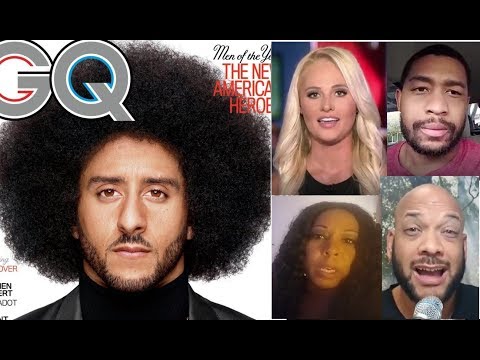
Commentators blast GQ for naming Colin Kaepernick ‘Citizen of the Year’
In November 2017, GQ magazine named former San Francisco 49ers quarterback Colin Kaepernick its “Citizen of the Year,” triggering a sharp backlash from conservative commentators. The video captures multiple critics questioning what Kaepernick had actually accomplished, while contrasting his award with the efforts of other public figures. As the video description noted, the critics asked: “nobody else they could find?” and pointed out that “JJ Watts raised over $37 MILLION for hurricane relief."
"What Did Colin Kaepernick Do?”
The first commentator set the tone: “Wouldn’t it be nice if some of these mainstream fashion magazines and lifestyle magazines look at the actual heroes we have? Law enforcement, military, everyday heroes like that as citizens of the year and not someone who simply disrespected the flag, the national anthem and the military.”
A second commentator was more blunt: “Colin Kaepernick, Man of the Year. For doing what? Somebody explain to me what did Colin Kaepernick do. Besides, become unemployed, ruin the NFL and race hustle. That’s it?” He challenged the premise of the award: “If a race hustling, unemployed, NFL killer can win Man of the Year, that means that there’s nobody else that they could find that did anything positive in this country besides Colin Kaepernick.”
He demanded specifics: “Somebody name me one accomplishment that he had done. In America, first of all, police shootings. No evidence of it being legitimate to start with. Then no evidence that it changed. None. Racial inequality. First of all, he has no evidence of what he’s talking about and no evidence that it changed.”
The “Division, Not Action” Argument
Multiple commentators argued that Kaepernick had created division without producing tangible results. One stated: “What kind of country are we gonna have when you reward people who do nothing but cause division? Not one time did he go to a police station. Not one time did he offer to pay for training. Not one time did I see him do a ride-along. I haven’t seen him do nothing to further the cause. I ain’t seen him in Chicago.”
Another commentator questioned GQ’s editorial judgment: “Weren’t these magazines used to be representative of being neutral or at least being pro-United States of America? How can they take somebody like Colin Kaepernick that would wear socks with a police uniform and a pig? He calls our police pigs.”
He continued: “He takes a knee during the most precious time that we should all be coming together for unity. Not for divisiveness, but a time where we should be coming together as a people united by a bond we call America. He chooses that time to try to display his disrespect, his just horrible attitude towards America. And then this magazine is gonna honor him. Are you kidding me?”
The Crime Statistics Counterargument
One of the commentators shifted the argument to data, presenting statistics he said undermined the entire premise of Kaepernick’s protest: “In 2016, there were 7,881 murders of black people. Guess how many of those were actually killed by cops? 233. 233 out of the 7,000 black people that were killed last year, 233 were killed by police.”
He drilled deeper: “How many of those 233 were probably justified? There were only 16 of those 233 that were not armed and considered dangerous. When you’ve got that disproportionate number compared to 16 killed by cops, compared to 7,600 — and here’s the gross thing, 93% of those blacks that were murdered were murdered by other black folks.”
His conclusion was direct: “There’s something wrong in this country when we’ve got a magazine that’s trying to prop up an individual who has taken a horrible stance at the worst possible time to take it.”
Additional Context
Kaepernick’s profile had only grown since leaving the 49ers. In addition to the GQ cover, he had landed a $1 million book deal with Random House imprint One World, headed by Chris Jackson, who also published Jay-Z and Ta-Nehisi Coates. He had also filed a collusion grievance against NFL owners, alleging they were colluding to keep him out of the league.
Critics pointed to J.J. Watt as an alternative choice for any “citizen” honor. The Houston Texans defensive end had raised over $37 million for hurricane relief after Hurricane Harvey devastated the Houston area, personally coordinating distribution efforts during the crisis.
One commentator also questioned Kaepernick’s cultural identity choices: “He wanna be Nation of Islam. Wearing dashikis, growing his hair out, braiding his hair, black power.” He saw the trajectory as counterproductive: “People still getting killed on the streets everyday. Black people still ain’t in no better position than they was last year.”
The GQ decision reflected a broader cultural divide in which Kaepernick had become less of a football player and more of a political symbol. Supporters saw him as a courageous voice for racial justice; critics saw him as a divisive figure who had accomplished nothing concrete while profiting from controversy.
Key Takeaways
- Conservative commentators challenged GQ’s decision to name Colin Kaepernick “Citizen of the Year,” asking what he had actually accomplished beyond creating division, while pointing to J.J. Watt’s $37 million hurricane relief effort as a more deserving choice.
- Critics argued Kaepernick had never visited a police station, funded training, or gone to Chicago, and that his protest was based on statistics that did not support the narrative of an epidemic of police killings of Black Americans.
- The GQ honor came alongside a $1 million book deal and a collusion grievance against the NFL, solidifying Kaepernick’s transition from athlete to political figure and deepening the cultural divide around his protest movement.