 HYGO News
 Linda McMahon at Confirmation Hearing: 'Spent Almost a Trillion Dollars and Performance Scores Continue to Go Down'
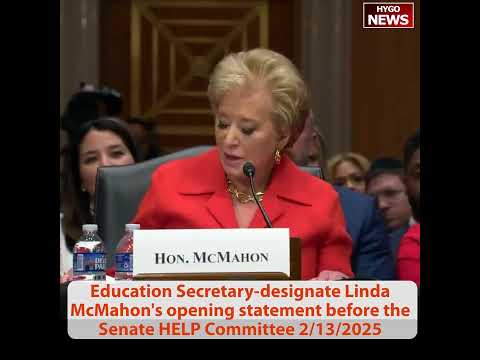
Linda McMahon at Confirmation Hearing: “Spent Almost a Trillion Dollars and Performance Scores Continue to Go Down”
On February 13, 2025, Education Secretary-designate Linda McMahon delivered her opening statement before the Senate HELP Committee, laying out a devastating indictment of the Department of Education she had been nominated to lead — and ultimately dismantle. “The Department of Education was set up in 1980, and since that time we have spent almost a trillion dollars, and we have watched our performance scores continue to go down,” McMahon told the committee. “The bottom line is because it’s not working.” She outlined a vision centered on school choice, state-level control, and the elimination of federal bureaucratic control over classrooms, while five protesters were removed from the hearing room during disruptions.
”It’s Not Working”
McMahon opened with the blunt assessment that became the defining soundbite of her confirmation hearing. The Department of Education, created in 1980 under President Jimmy Carter, had consumed nearly a trillion dollars in federal spending over its 45-year history while presiding over a steady decline in American students’ academic performance.
“The bottom line is because it’s not working,” McMahon said. “Department of Education was set up in 1980, and since that time we have spent almost a trillion dollars, and we have watched our performance scores continue to go down.”
The statement distilled the case for abolishing the department into its most essential form: enormous spending, declining results. McMahon did not blame individual teachers or students but rather the federal system that had centralized education policy in Washington at the expense of local control.
She argued that quality education remained a national imperative but that the delivery mechanism was the problem. “I do believe that it is a responsibility to make sure that our children do have equal access to excellent education,” McMahon said. “I think that that is best handled at the state level, closest to the states, working with state administrators, teachers, parents who should have input into their curriculum.”
Trump’s Education Vision
McMahon framed her nomination in terms of the mandate President Trump had received in the 2024 election. “I’d also like to thank President Trump for his confidence in me to lead a department whose mission and authority were a special focus of his campaign,” she said.
She outlined the three pillars of Trump’s education platform: “He pledged to make American education the best in the world, return education to the states where it belongs, and free American students from the education bureaucracy through school choice.”
McMahon then connected the platform directly to the election results: “November proved that Americans overwhelmingly support the President’s vision, and I am ready to enact it.”
The framing was deliberate. By linking education reform to Trump’s electoral mandate, McMahon was establishing that her mission to reduce and ultimately eliminate the Department of Education was not a fringe idea but a policy that voters had explicitly endorsed at the ballot box.
McMahon’s Education Background
McMahon pushed back against the narrative that she lacked education credentials by cataloguing her experience in the field. “I’ve been passionate about education since my earliest college days when I studied to earn a teaching certificate,” she said.
She then listed her relevant positions: “This has continued through my business career as a Connecticut State Board of Education member, as a university trustee, and as the chair of the America First Policy Institute, which advocates for workforce development, parental choice, and accountability in higher education.”
The résumé was designed to counter critics who dismissed McMahon as a businesswoman without education expertise. While she was best known for her career at WWE, McMahon had served on Connecticut’s State Board of Education and had spent years at the America First Policy Institute developing policy positions on school choice and workforce development.
McMahon’s family was also present at the hearing. “I’d like to introduce my daughter, Stephanie McMahon, Paula Vech, her husband, and my son, Shane McMahon,” she said. The presence of her high-profile children — both well-known public figures from the WWE world — added a personal dimension to the hearing.
The Remedy: Five Principles
McMahon articulated her reform agenda through five contrasting principles that drew sharp lines between the current system and her proposed alternative.
“So what’s the remedy?” she asked. “Fund education freedom, not government-run systems. Listen to parents, not politicians. Build up careers, not college debt. Empower states, not special interests. Invest in teachers, not Washington bureaucrats.”
Each principle was designed to resonate with specific constituencies. “Fund education freedom” appealed to school choice advocates. “Listen to parents” spoke to the movement that had emerged during COVID-era school closures when parents demanded more say in their children’s education. “Build up careers, not college debt” targeted the growing skepticism about the four-year college model. “Empower states” reflected the broader conservative principle of federalism. And “invest in teachers” was a direct response to critics who claimed that dismantling the department would hurt educators.
McMahon pledged to work with Congress rather than act unilaterally: “If confirmed as secretary, I will work with Congress to reorient the department toward helping educators, not controlling them.”
School Choice and the Frustration of Teachers
McMahon identified a constituency that supporters of the department often claimed as their own: teachers themselves. Rather than portraying educators as defenders of the federal education bureaucracy, McMahon argued that teachers were among its victims.
“Outstanding teachers are tired of political ideology in their curriculum and red tape on their desks,” she said. “And that’s why school choice is a growing movement across the nation. It offers teachers and parents an alternative to classrooms that are micromanaged from Washington, D.C.”
The argument that teachers were frustrated by federal mandates and paperwork was well-supported by surveys showing declining teacher satisfaction and rising attrition rates. By positioning school choice as a solution for teachers as well as parents and students, McMahon broadened the appeal of the reform agenda beyond its traditional conservative base.
Technology and Higher Education
McMahon also addressed the future of American education in the context of emerging technologies. “The United States is the world leader by far in emerging technologies like AI and blockchain,” she said. “And we need to invest in American students who want to become tech pioneers.”
She called for reform across the higher education landscape: “We should encourage innovative new institutions, develop smart accountability systems, and tear down barriers to entry so that students have real choice and universities are not saddling future families with insurmountable debt.”
The emphasis on AI and technology positioned McMahon’s vision as forward-looking rather than merely reductive. Critics had framed the plan to abolish the Department of Education as an act of destruction; McMahon was arguing that it was an act of modernization, replacing a 1980-vintage bureaucracy with a system capable of preparing students for the economy of the 2030s and beyond.
Disruptions During the Hearing
The confirmation hearing was punctuated by multiple disruptions from protesters. United States Capitol Police removed five people from the audience during McMahon’s opening statement and the subsequent questioning. The first protester stood and spoke about the Individuals with Disabilities Education Act, expressing concern that special education protections would be weakened or eliminated if the department were dismantled.
The disruptions reflected the intensity of the opposition to Trump’s education agenda. Advocates for students with disabilities, teachers’ unions, and supporters of federal education funding had all mobilized against McMahon’s nomination, viewing it as a direct threat to programs they considered essential.
Key Takeaways
- Education Secretary-designate Linda McMahon told the Senate HELP Committee that the Department of Education had spent “almost a trillion dollars” since 1980 while “performance scores continue to go down,” concluding: “It’s not working.”
- McMahon outlined five reform principles: fund education freedom, listen to parents, build careers not college debt, empower states, and invest in teachers — not Washington bureaucrats.
- She cited Trump’s three education pledges — making American education the best in the world, returning it to the states, and expanding school choice — and said the 2024 election proved “Americans overwhelmingly support the President’s vision.”
- McMahon called for investing in AI and technology education and tearing down barriers to entry in higher education so “universities are not saddling future families with insurmountable debt.”
- Five protesters were removed by Capitol Police during the hearing, including one who spoke about the Individuals with Disabilities Education Act.