 HYGO News
Hawley to Judge Loren AliKhan: 'Don't Make Me Do This' (June 7, 2023)
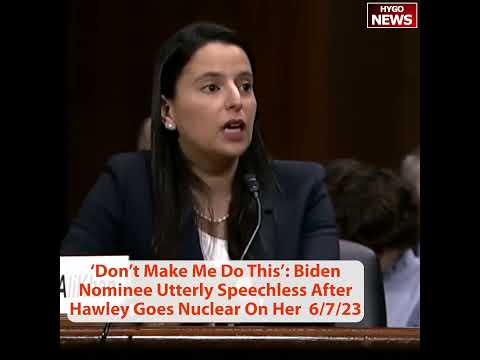
On June 7, 2023, the Senate Judiciary Committee held a confirmation hearing for Loren AliKhan, President Biden’s nominee for the U.S. District Court for the District of Columbia. AliKhan had joined the District’s attorney general’s office in 2013, served as its solicitor general from 2018, and had been confirmed to the D.C. Court of Appeals, the city’s highest court, in February 2022 [1]. Sen. Josh Hawley of Missouri said he asks every nominee whether they have ever litigated against a religious liberty claim. AliKhan had listed five cases, and Hawley focused on one from the pandemic: Capitol Hill Baptist Church v. Bowser. This video shows the exchange. All quotes below are from the official hearing record, Senate Hearing 118-29, Part 6 [1].
Key Moments
”Did it restrict mass protests in the District?”
AliKhan said the mayor’s COVID-19 orders “restricted all types of activity in the District.” “Did it restrict mass protests in the District?” Hawley asked. “I don’t believe it said anything, one way or another,” she answered, adding that the issue was likely not “contemplated by the mayor’s office.” Hawley pressed: “So, you think it’s fine to say to religious people that they are prohibited from gathering outside, wearing a mask, socially distanced? … But, if you want to come and protest, defund the police, if you want to support that, that’s fine.” “Senator, that is not my position,” AliKhan said. “I did not write these orders.” “You defended it in court,” Hawley replied.
”How did that case go for you?”
“What I was doing, in Capitol Hill Baptist Church, was defending the mayor, my client, against a constitutional challenge to one aspect of the COVID-19 restrictions,” AliKhan said. “How did that case go for you?” Hawley asked. “We lost that case.” Why? “It was found that the restrictions did not meet the standard of strict scrutiny.” “Meaning they were unconstitutional?” “Meaning that they did not survive strict scrutiny. And, it’s a matter of public record that the District of Columbia did not appeal that decision."
"Oh, come on, Judge, don’t make me do this”
Hawley asked again why the restrictions were struck down. AliKhan said the court had concluded they were “not neutral of general applicability,” then that they were “not narrowly tailored.” “Yes. Yes. Yes. Yes—that’s legalese,” Hawley said. “Why did you lose?” When she began another answer, he cut in: “Oh, come on, Judge, don’t make me do this. Do you want me to go through it for you? You lost because Mayor Bowser was going to mass protests, herself, personally, with thousands of people celebrating them—by the way, which is fine. We have a First Amendment in the United States.” At the same time, he said, “she was prohibiting churches, religious people from gathering, socially distanced, outside wearing masks.”
“Why are you fighting me on this? I can’t figure this out,” Hawley said. “I am not fighting you, Senator,” AliKhan replied. Asked whether the court got it right, she said the decision was “consistent with rulings that we got from the Supreme Court clarifying the application of the Religious Test to COVID-19 restrictions,” citing the Tandon and Brooklyn Archdiocese cases.
”I will not support your nomination”
Asked why she had argued that religious services posed a greater infection risk than protests, AliKhan said that “the nature of singing and other things” could, in the view of epidemiologists, “transmit COVID at a higher rate.” “You didn’t put any scientific evidence in the record for it,” Hawley said. “Senator, those were fast-moving cases,” she answered. Hawley concluded: “I’m disappointed you persisted in defending them, here today. And, for that reason, among others, I will not support your nomination.”
Background: The Church Case
Capitol Hill Baptist Church had met on Capitol Hill since 1878. It closed in March 2020 under Mayor Muriel Bowser’s orders, and “as the months passed by and the Mayor lifted other restrictions and welcomed mass protests to the city,” it asked to hold its weekly service outdoors, with congregants masked and distanced. The District said no: worship gatherings were capped at 50 percent of capacity or 100 people, indoors or out [2]. The church sued, and on October 9, 2020, Judge Trevor McFadden granted it a preliminary injunction. He found that the District had failed to show “a compelling interest in preventing the Church from meeting outdoors with appropriate precautions, or that this prohibition is the least-restrictive means to achieve its interest.” The opinion noted that Bowser had spoken at a mass protest at Black Lives Matter Plaza and said the District “marshaled no scientific evidence” for treating protest marches differently from worship services [2].
The Record
- The Supreme Court’s church rulings. The test AliKhan cited comes from the Supreme Court’s rulings against COVID rules on worship in Roman Catholic Diocese of Brooklyn v. Cuomo (2020) and Tandon v. Newsom (2021), which held that such rules trigger strict scrutiny “whenever they treat any comparable secular activity more favorably than religious exercise” [3][4].
- “You didn’t put any scientific evidence in the record.” The ruling said the District “marshaled no scientific evidence on this point.” McFadden also struck a late District filing, noting that the District “did not request an evidentiary hearing” and “never sought leave to submit additional evidence” [2].
- “Mayor Bowser was going to mass protests, herself.” The opinion says she spoke at a mass protest at Black Lives Matter Plaza, and the church cited her attendance at a June 6, 2020, protest [2].
What Happened Next
- Confirmation: On December 5, 2023, the Senate split 50–50 on AliKhan’s nomination, and Vice President Kamala Harris broke the tie. It was her 32nd tie-breaking vote, a record surpassing John C. Calhoun’s 31 [5][6].
- The funding freeze: On January 28, 2025, Judge AliKhan temporarily blocked the Trump administration’s freeze on federal grants and loans, ordering that funding continue past a 5 p.m. deadline that day [7]. On February 3, she issued a temporary restraining order, writing that the administration’s memo potentially covered up to $3 trillion in financial assistance, a “breathtakingly large sum of money to suspend practically overnight” [8].
Sources
- GovInfo: Senate Hearing 118-29, Part 6, Confirmation Hearing on Federal Appointments (June 7, 2023)
- GovInfo: Capitol Hill Baptist Church v. Bowser, No. 20-cv-2710, memorandum opinion (D.D.C. October 9, 2020)
- Supreme Court of the United States: Roman Catholic Diocese of Brooklyn v. Cuomo (November 25, 2020)
- Supreme Court of the United States: Tandon v. Newsom (April 9, 2021)
- Federal Judicial Center: Biographical Directory of Article III Federal Judges
- AP via PBS NewsHour: Vice President Harris breaks nearly 200-year-old record for Senate tiebreaker votes
- NPR: Judge pauses Trump’s federal funding freeze as confusion and frustration spread (January 28, 2025)
- CBS News: Judge maintains block on Trump administration’s funding freeze (February 3, 2025)