 HYGO News
 Did you mean it? will you withdraw? you're a smart man, angry man. Kennedy questions nominee Dale Ho
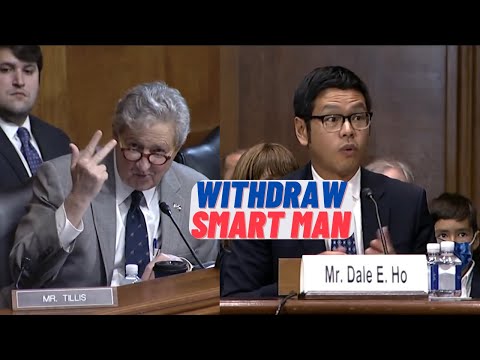
“You’re a Smart Man, But an Angry Man”: Kennedy Grills Judicial Nominee Dale Ho on “Anti-Democratic Virus” Comment and Partisan Tweets
On December 1, 2021, Senator John Kennedy (R-LA) subjected Biden judicial nominee Dale Ho to one of his signature interrogations, pressing him on whether he had called “Republicanism an anti-democratic virus,” whether he had meant the partisan tweets he sent about Republican senators, and whether he would withdraw his nomination if certain statements were confirmed. Ho, then director of the ACLU’s Voting Rights Project, found himself unable to deny, confirm, or defend his social media history, repeatedly telling Kennedy he couldn’t remember specific tweets or their context. Kennedy’s closing assessment was characteristically blunt: “Mr. Ho, you’re a smart man, I can tell. But I think you’re an angry man. We don’t need federal judges who are angry. We need federal judges who are fair and can see both points of view."
"Did You Say Republicanism Is an Anti-Democratic Virus?”
Kennedy opened with a direct question: “Did you say, quote, ‘Republicanism is an anti-democratic virus’?”
“No, Senator. I don’t believe I’ve used those words,” Ho replied.
“You’re under oath now,” Kennedy reminded him.
“Yes, Senator. I don’t believe I’ve used those words,” Ho maintained. He offered what he recalled saying: “I do remember saying last year that there was a loss of confidence in our elections that has spread kind of like a virus.”
Kennedy acknowledged the distinction — “Well, that’s a long way from calling the Republican Party an anti-democratic virus” — but pressed further: “If you did use those words, will you pull down your nomination?”
Ho’s response was evasive: “Senator, I don’t believe I’ve used those words.”
“But if you did, will you withdraw?” Kennedy pressed.
“It’s hard for me to imagine a scenario in which I would use those words,” Ho said.
Kennedy tried one more time: “I’m just saying, assume it. If you said it, will you withdraw?”
Ho offered a conditional that answered nothing: “If I were quoting someone else saying it to describe that kind of sentence, I wouldn’t be expressing my own views. But Senator, I don’t believe I’ve ever used those words.”
The exchange was notable for what Ho would not say. Kennedy was asking a simple hypothetical — if you said it, would you withdraw? — and Ho refused to give a direct answer across four attempts, suggesting either that he was unsure whether the quote existed or that he was unwilling to commit to any consequence for his own statements.
The Twitter Interrogation: “Door A, Door B”
Kennedy then turned to Ho’s social media history, specifically tweets about Republican senators Tom Cotton, Marsha Blackburn, and John Cornyn. “Did you send out those personal tweets about Senator Cotton, Senator Blackburn, and Senator Cornyn? Did you mean them at the time?”
Ho’s response set the pattern for the exchange: “Without hearing those tweets, Senator Kennedy, it’s hard for me to remember precisely what was said or what I was thinking at the time.”
He offered a general concession: “I do very much regret the tone that I’ve taken on social media from time to time. I know that I’ve crossed the line from time to time.”
Kennedy seized on the admission: “When you crossed the line, did you mean it?”
“Without knowing the specific context or the specific tweet that you’re referring to, Senator Kennedy, it’s kind of hard for me to say,” Ho responded.
Kennedy tried a different angle: “Do you generally tweet things you don’t mean?”
Ho attempted to shift to a broader critique of the platform: “Senator Kennedy, I would agree with you that Twitter has become a very coarse place.”
“I don’t want to debate Twitter,” Kennedy cut in. “Do you generally tweet things that you don’t mean?”
Ho offered: “I’ve contributed to the coarseness on Twitter sometimes by pushing the envelope to break through.”
Kennedy pressed again: “When you did it, did you mean it?”
“It’s hard for me to respond to that kind of generally—”
“You’re a smart guy. I’m sure you can,” Kennedy interrupted. “You either meant it or you didn’t. You got two choices — door A, door B.”
Ho acknowledged he had “pushed the envelope” but would not choose a door.
The Motive Question
Kennedy then delivered what was perhaps the exchange’s most incisive question. After Ho said he regretted his tweets, Kennedy asked: “Do you regret it because you didn’t mean it? Or do you regret it because it might cause you not to be confirmed?”
“Senator Kennedy, I regret it because I think it’s contributed to the coarseness of our discourse overall,” Ho answered.
Kennedy pushed further: “When did you have this epiphany that everybody has equal dignity and worth — when you were nominated?”
Ho attempted to connect the principle to his faith: “I believe you’re referring to my religious faith, Senator.”
“No, I’m not,” Kennedy replied. “I’m referring to your coarseness.”
“The equal dignity and worth is a principle of my religious faith, Senator,” Ho maintained.
“It’s also a principle of morals and good judgment,” Kennedy concluded.
”Wild-Eyed Sort of Leftist”
Kennedy also read back Ho’s own self-description. “You’ve described yourself as a, quote, ‘wild-eyed sort of leftist.’ Do I have that right?”
Ho attempted to reframe: “Senator, I think I was referring to a caricature of the way that I think other people may have described me, not how I would describe myself. And I want to assure you that I understand that the role of a judge is to set aside whatever personal views that person may have.”
“I heard your testimony,” Kennedy replied, making clear he was not persuaded.
Kennedy also asked whether Ho had called Georgia Governor Brian Kemp “a pioneer of voter suppression.” Ho said: “Senator Kennedy, I do not believe I have said that.”
“May want to check your records,” Kennedy suggested. “Yes, sir,” Ho replied.
On the question of political donations disclosure, Kennedy cited Ho’s stated support for “compelled disclosure of political donations by wealthy individuals, but not by minorities.” Ho said he didn’t recall using those words.
”An Angry Man”
Kennedy’s closing assessment combined personal observation with institutional concern: “Mr. Ho, you’re a smart man, I can tell. But I think you’re an angry man. And I really have great concerns about voting for you. We don’t need federal judges who are angry. We need federal judges who are fair and can see both points of view. And you said these things.”
The characterization — smart but angry — encapsulated Kennedy’s argument. He was not questioning Ho’s intelligence or legal credentials. He was arguing that Ho’s documented pattern of partisan statements revealed a temperament unsuited to the bench. The role of a federal judge requires hearing cases involving people of all political persuasions and rendering impartial judgments. A nominee who had publicly attacked Republican senators and described himself (even in caricature) as a “wild-eyed sort of leftist” faced a credibility gap in claiming he could set those views aside.
The Broader Pattern
Ho’s nomination was part of the Biden administration’s effort to reshape the federal judiciary, with a particular emphasis on nominees from civil rights and public interest backgrounds. Ho’s tenure at the ACLU had made him a hero to progressive advocates and a target for conservative critics.
The confirmation hearing illustrated the tension that activist-lawyers faced when nominated for the bench. The same passion and partisanship that made them effective advocates created a record that opponents could use to question their judicial temperament. Ho’s repeated inability to confirm or deny his own statements — saying he “didn’t believe” he had used certain words, couldn’t remember specific tweets, or found it “hard” to respond — left the impression of a nominee who had said things he could not defend but also could not deny.
Despite Kennedy’s opposition, Ho was confirmed to the U.S. District Court for the Southern District of New York, though the confirmation process was protracted and contentious.
Key Takeaways
- Kennedy asked Ho four times whether he would withdraw if confirmed to have called “Republicanism an anti-democratic virus” — Ho refused each time, saying only “I don’t believe I’ve used those words” while unable to categorically deny the quote or commit to consequences.
- Ho admitted he had “crossed the line” on Twitter regarding Republican senators but could not say whether he meant the tweets, prompting Kennedy’s “door A, door B” ultimatum and the question: “Do you regret it because you didn’t mean it, or do you regret it because it might cause you not to be confirmed?”
- Kennedy concluded that Ho was “a smart man, but an angry man,” saying “we don’t need federal judges who are angry” after Ho attempted to characterize his “wild-eyed sort of leftist” self-description as a caricature and cited his religious faith as the basis for believing in human dignity.