 HYGO News
 Dem: I need more migrants for redistricting, ADMITTED cheat elections; help country of Somalia
Dem: I need more migrants for redistricting, ADMITTED cheat elections; help country of Somalia
Five Democrats on tape in a single news cycle, each producing material the administration’s allies immediately weaponized. Rep. Yvette Clarke (D-NY) said plainly: “I need more people in my district, just for redistricting purposes” — the kind of admission that validates years of Republican warnings about the census, redistricting, and immigration’s interaction with congressional apportionment. Maine Rep. Deqa Dhalac referred to Somalia as “our country” and asked how the “politics in Somalia” could reflect U.S. democracy — in remarks directed at building the U.S. to “help our country, our former country, Somalia.” Sen. Alex Padilla continued his anti-ICE defense with: “70% of people, ICE arresting and booking have no criminal convictions.” Rep. Jasmine Crockett predicted “dark money going pour in on the behalf of the American people” in the midterms. And Press Secretary Karoline Leavitt shut down CNN: “The only people who are suggesting that the director of national intelligence would release evidence to try to boost her standing with the president are the people in this room … And it is not working.”
Clarke: “I Need More People in My District”
Rep. Yvette Clarke’s framing was unusually direct. “And from Brooklyn, New York, we have a diaspora that can absorb a significant number of these migrants. And when I hear colleagues talk about the doors of the end being closed, no room in the end, I’m saying, I need more people in my district, just for redistricting purposes.”
“I need more people in my district, just for redistricting purposes” is the phrase the administration’s allies seized on. It is a direct admission that immigration flows are being viewed, at least in part, through the lens of redistricting and congressional apportionment.
The underlying math is straightforward. U.S. congressional districts are apportioned based on population counts from the decennial census. The census counts all residents — citizens, legal residents, and unauthorized immigrants alike. More residents in a district or state means more congressional representation for that district or state. For districts and states that are losing native-born population, migration flows maintain the population counts that preserve representation.
The “Hijacking Democracy” Frame
The administration’s framing of Clarke’s statement: “This is how you hijack democracy. The Democrats told us that they NEVER use illegal aliens to cheat elections. THEY JUST ADMITTED IT.”
That is a specific political charge. The claim is not merely that Democrats benefit from immigration flows — every political coalition benefits from some demographic patterns. The claim is that Democrats are deliberately using immigration flows to manipulate the political map in ways that preserve their coalition’s representation.
Clarke did not endorse that full charge. She admitted to one narrow fact — that her district could use more people to remain competitive in redistricting cycles, and the migrant population she mentioned would serve that purpose. The leap from that narrow admission to “hijacking democracy” is political framing.
But the admission itself is notable. Democratic members of Congress do not typically say on camera that migration flows are useful for their redistricting math. Clarke did.
”Our Country, Our Former Country, Somalia”
Rep. Deqa Dhalac of Maine — one of the first Somali American state senators, now a Maine state representative — offered remarks that referenced Somalia in terms unusual for an American elected official. “Policies, how can the politics in Somalia can be, you know, resonate what we have here in the United States, the democracy that we have? How can you help us, you know, be a better country, build back what we used to have back in a long time ago?”
The “politics in Somalia” framing — asking how Somali politics can “resonate” with U.S. democracy — is the kind of framing that blurs the distinction between the U.S. political system and Somalia’s. American elected officials typically frame their work in terms of American constituents and American policy objectives. Dhalac’s frame positions her legislative work as partly oriented toward Somalia.
“So hopefully, we will be able to help our country, our former country, Somalia.”
“Our country, our former country, Somalia” — the slip-correction is the telling moment. “Our country” is the first instinct. “Our former country” is the correction. The original phrasing reveals the political identity Dhalac is operating from. Somalia is not just where she was born. It is, in her immediate phrasing, “our country.”
That is not a fireable offense — Americans are allowed to maintain cultural connections to their countries of origin. But for a U.S. elected official to refer to another country as “our country” in a sitting position is a data point about where the center of loyalty and attention lies for that elected official.
Padilla on ICE Statistics
Sen. Alex Padilla continued the anti-ICE framing with a specific statistical claim. “The rhetoric I keep hearing about immigrants and crime as if every single immigrant is a criminal. 70% of people, ISIS arresting and booking have no criminal convictions against this.”
“ISIS” is obviously Whisper’s garbled rendering of “ICE.” Padilla’s argument: 70% of ICE apprehensions result in individuals with no criminal convictions. Therefore, the administration’s framing of ICE operations as targeting criminals is overstated.
“This is ice statistics of the 30% of them who have some sort of conviction, a significant portion of those offenses come from traffic violations or yes, immigration offenses.”
That is the follow-on. Of the 30% with convictions, many have only traffic violations or immigration offenses. Few have serious criminal records, in Padilla’s framing.
The counter-argument — which is well documented in the administration’s data releases — is that “no criminal conviction” is not the same as “no criminal record.” Individuals with pending charges, prior deportation orders, prior arrests that did not result in conviction, gang affiliations, and other markers of criminal risk are frequently detained. Padilla’s “70% without convictions” figure does not account for those categories.
Additionally, Padilla’s framing ignores the specific predicate of the Mora Nunes case — the Border Patrol agent shot in New York — where the attacker had four NYC arrests, was charged with grand larceny, had a Massachusetts armed-robbery warrant, and faced kidnapping charges. In specific cases like Mora Nunes’s, the “70% without convictions” framing provides cover for the repeat offenders who, despite multiple arrests, had not yet been convicted.
Crockett on “Dark Money”
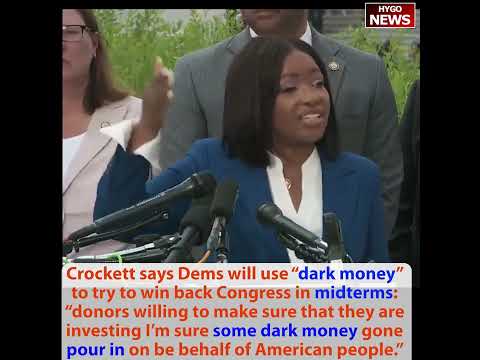
Rep. Jasmine Crockett addressed the midterm strategy. “We also know that there are donors that I’m sure are going to be willing to make sure that they are investing and making sure that they can take down some of these candidates since they don’t want to rule out dark money. We will, I’m sure, some dark money going pour in on the behalf of the American people.”
“Dark money going pour in on the behalf of the American people” is an extraordinary phrase. Democrats have spent years arguing that “dark money” — campaign donations whose ultimate sources are obscured — is a corrupting influence on American politics. Campaign finance reform has been a consistent Democratic priority.
Here, Crockett is not just conceding that Democrats will benefit from dark money in the midterms. She is welcoming it. “I’m sure some dark money going pour in on the behalf of the American people” frames the dark money as serving the public interest — not as the corrupting influence Democrats have been campaigning against for two decades.
That inconsistency — dark money is corruption when Republicans benefit from it, but service to the American people when Democrats benefit from it — will be used in political messaging throughout the midterm cycle.
Leavitt Shuts Down CNN
Press Secretary Karoline Leavitt’s exchange with a CNN reporter crystallized the media-administration friction. The CNN reporter had apparently suggested that DNI Gabbard was releasing documents to improve her standing with Trump — a theory that reduces the Russia-collusion document release to internal White House politics.
Leavitt’s pushback was direct. “And we found irrefutable evidence of Russia meddling, which the director of national intelligence just confirmed for all of you, that Russia was trying to sow distrust and chaos.”
Then Leavitt re-focused on the intelligence-community manufacture framing. “But what’s the outrage in this that Secretary Rubio did not say at the time the Democrats were saying at the time is the fact that the intelligence community was concocting this narrative that the president colluded with the Russians, that the president’s son was holding secret meetings with the Russians, all of these lies that were never true.”
“Concocting this narrative” is Leavitt’s language. Not analyzing, not assessing. Concocting.
”Deeply Troubling Actions”
Leavitt continued, invoking Secretary of State Marco Rubio. “And he also said at that time we discovered deeply troubling actions taken by the FBI under Comey, particularly their acceptance and willingness to rely on the Steele dossier without verifying its methodology or sourcing the Steele dossier that many outlets in this room ran as the gospel truth and it was cooked up and paid for by the Clinton campaign.”
“Cooked up and paid for by the Clinton campaign” is the frame. The Steele Dossier, in Leavitt’s characterization, is not an outside intelligence product. It is campaign-funded opposition research that the Clinton campaign paid for, Steele wrote, and the FBI accepted without standard tradecraft verification.
That framing, whatever one thinks of the political uses being made of it, is factually accurate. The Clinton campaign and the DNC funded Fusion GPS, which commissioned Steele. The FBI did rely on Steele’s reporting in the FISA application for Carter Page surveillance. The Inspector General report documented significant FBI misconduct in the FISA process.
”Who Was Saying That?”
“Who was saying that, that she would release this to try to boost her standing with the president? Who has said that?”
Leavitt is challenging the CNN reporter to identify sources for the theory that Gabbard’s document release is driven by White House-internal politics. The challenge is effective because the theory is, in fact, one that has been circulated by media outlets without named sources.
“Well, the president has publicly undermined her when it came to Iran. He said she was wrong. He told me that she didn’t know what she was talking about. That was on Air Force One, on camera.”
The reporter cites Trump’s Iran disagreement with Gabbard. That was a real event — Trump publicly contradicted Gabbard’s characterization of Iranian nuclear capability during the run-up to the U.S. strike. The reporter is using that prior friction as evidence that Gabbard needs to rebuild credibility with Trump.
”It Is Not Working”
“The only people who are suggesting that the director of national intelligence would release evidence to try to boost her standing with the president are the people in this room who constantly try to sow distrust and chaos amongst the president’s cabinet. And it is not working.”
“The people in this room” — the White House press corps — is Leavitt’s direct target. She is accusing reporters of running narratives designed to fracture the administration’s cabinet. “And it is not working.”
“I will just answer your question directly. I am with the president of the United States every day. He has the utmost confidence in director Gabbard. He always has. He continues to. And that is true of his entire cabinet who is all working as one team to deliver on the promises this president made.”
That is the close. Trump has confidence in Gabbard. The document release is not internal politics. The reporters’ attempts to frame it otherwise are failing.
Key Takeaways
- Rep. Yvette Clarke (D-NY): “I need more people in my district, just for redistricting purposes” — the kind of direct admission about migration and political apportionment that validates Republican warnings.
- Maine Rep. Deqa Dhalac referred to Somalia as “our country, our former country” and asked how “politics in Somalia” could “resonate” with U.S. democracy.
- Sen. Alex Padilla claimed “70% of people ICE arresting and booking have no criminal convictions” — a figure that does not account for individuals with pending charges, prior deportation orders, and other criminal-risk markers.
- Rep. Jasmine Crockett welcomed midterm “dark money” — “I’m sure some dark money going pour in on the behalf of the American people” — a reversal of longstanding Democratic campaign finance rhetoric.
- Press Secretary Leavitt shut down CNN: “The only people who are suggesting that the director of national intelligence would release evidence to try to boost her standing with the president are the people in this room who constantly try to sow distrust and chaos amongst the president’s cabinet. And it is not working.”