 HYGO News
 Dem Booker (not veteran) called Mike Waltz Army Special Forces coward; Dem Jeffries & Zohran Mamdani
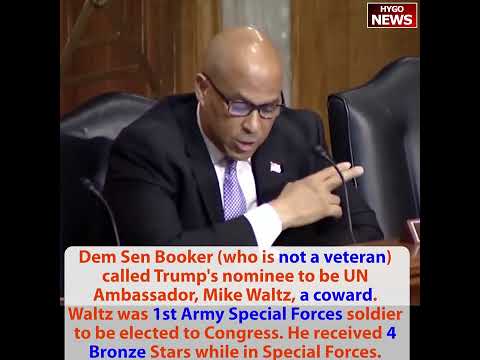
Dem Booker (not veteran) called Mike Waltz Army Special Forces coward; Dem Jeffries & Zohran Mamdani
A sharply charged cycle of Democratic positioning. Senator Cory Booker — who is not a veteran — called UN Ambassador nominee Mike Waltz, a former Army Special Forces soldier who received four Bronze Stars, “profound cowardice” during Waltz’s confirmation hearing over the Signal-chat national security matter. House Democratic Leader Hakeem Jeffries said he is “looking forward” to meeting Zohran Mamdani, the socialist winner of the NYC Democratic mayoral primary, on Friday. Democratic Rep. Maxwell Frost declared America has not had “fair elections” because of “voter suppression laws” — the kind of election-denial language that used to be strictly coded as a right-wing preoccupation. Democratic Rep. Pramila Jayapal called Mamdani “inspiring” and cited his “authenticity … smart … commitment to lifting up working people.” And Rep. Jasmine Crockett, in a stretch, defended funding Sesame Street in Iraq as a counter to foreign “propaganda about us.” Five Democrats, five fronts.
Booker’s “Cowardice” Attack on Waltz
Senator Cory Booker’s confrontation with Mike Waltz at the UN Ambassador confirmation hearing was structured around the Signal-chat controversy — the incident in which The Atlantic’s Jeffrey Goldberg was inadvertently added to a Signal group chat among senior administration officials discussing an imminent military strike. Booker’s line of attack drilled through the entire story.
“When you were involved in the sharing of sensitive information about imminent military operations. I’ve listened to you now for weeks and months. You said this journalist intentionally infiltrated that signal chain. You said that he was sucked in.”
The “sucked in” phrase is Waltz’s language from his own defense — that Goldberg was not merely accidentally added but had in some sense positioned himself to be included. Booker’s characterization: denial and deflection from the actual facts.
“You denied, deflected, and then you did something that to me really lacks integrity as you sought out to demean and degrade that very journalist and crass and frankly, cruel ways that made him a target."
"That’s Not Leadership”
Booker’s argument built to a character indictment. “That’s not leadership. When you blame people that tell the truth, that’s not leadership. When you can’t say the words, I made a mistake. I could have done better. I learned valuable lessons from this experience.”
Then the escalation. “Instead, at a moment where our national security was clearly compromised, you denied, you deflected, and then you demeaned and degraded those people who objectively told the truth and criticized your actions.”
“Smearing people, attacking folks, singling them out, just furthers, compounds what I think is disqualifying about you for this position. It also to me just shows profound cowardice.”
The “Coward” Charge: The Veteran Context
The political context of the “cowardice” line is what made it newsworthy. Mike Waltz is a retired Army National Guard colonel and one of the first Special Forces soldiers to serve in Congress. He was awarded four Bronze Stars during his military career. Whatever one thinks of his conduct in the Signal-chat matter, the word “coward” is a particularly loaded choice when directed at someone with that service record by a senator who has never served.
“You should step up right now,” Booker continued, citing colleagues’ questions. “I heard Senator Coons, I heard you being asked by Senator Cain. Again and again, to simply say, I was wrong. I made a mistake. I take responsibility for my actions.”
Waltz’s response as captured in the transcript: “Unfortunately, what you’re doing to me is perfectly in line with the way this administration as a whole has operated. I’ve never seen an administration that has made no mistakes.”
That return framing — accepting that the administration has made mistakes, then suggesting Booker’s characterization is itself the form of personal attack — is the rhetorical counter Waltz deployed. Whether it satisfied the hearing’s dynamics is a separate question from whether it satisfied the confirmation math.
Jeffries on Mamdani: “Looking Forward”
House Democratic Leader Hakeem Jeffries was asked directly about the Mamdani meeting. “Your meeting with Zora Mamdani, you have not endorsed him yet. What do you say to people who say, what gives, why are you not endorsing the guy that won the Democratic primary in a contested election in your backyard?”
Jeffries: “Well, I look forward to sitting down and talking to him. I didn’t get involved in that primary election and I don’t know him well. We had a very good conversation the day after the primary we agreed to meet. And so I’m looking forward to having that discussion on Friday.”
The non-endorsement is the message. Mamdani is the Democratic nominee for mayor of New York City — one of the most prominent Democratic jurisdictions in the country. Jeffries, as the top House Democrat, not endorsing his own party’s nominee is a signal. Not yet. Not automatically. The meeting is happening because the machinery of party coordination requires it, not because the endorsement is foreordained.
“I didn’t get involved in that primary election and I don’t know him well” is the diplomatic rendering of what is almost certainly a more substantive concern about Mamdani’s socialist, defund-the-police, anti-Israel record — positions that create real headaches for the broader Democratic coalition.
Maxwell Frost: “Fair Is an Interesting Word”
Rep. Maxwell Frost, the young progressive Florida Democrat, took a remarkable position on the legitimacy of U.S. elections. Asked whether he had faith in fair midterm elections, he began with a reassuring line: “Listen, it’s gonna be good as long as y’all show up to vote, we will have a fair election in the midterms and we don’t have to worry about Trump for a third term.”
Then the pivot. “I mean, fair is an interesting word. I mean, we could argue that our country hasn’t really had fair elections, right? Because of voter suppression laws, especially in the South, that prevent and keep young people, black people from being able to vote.”
“Fair is an interesting word” is a phrase that has been, for the past five years, the near-exclusive property of the right — specifically, of Trump and his allies regarding the 2020 election. For a Democratic member of Congress to deploy that framing in the other direction, arguing that American elections are structurally unfair due to voter ID laws and related measures, is the same kind of election-legitimacy-challenging rhetoric Democrats have spent half a decade condemning in its conservative form.
The consistency problem for the Democratic Party is acute. “The elections aren’t really fair” cannot be a position their officials hold when their party loses and object to when their opponents make analogous claims. Frost’s framing acknowledges, implicitly, that the election-legitimacy argument cuts multiple directions.
Jayapal: Mamdani “Inspiring”
Rep. Pramila Jayapal gave Mamdani the glowing treatment Jeffries declined. “I think it’s hard not to be won over because it’s the combination of his authenticity, his smart and his commitment to lifting up working people and making life better for real folks that is really inspiring.”
“Inspiring” from the chair of the Congressional Progressive Caucus, on Mamdani, is the full endorsement of the progressive wing. It is also the framing that the party’s moderate wing — represented by Spanberger’s dodge, Jeffries’s non-endorsement, and similar positioning — is trying to avoid being tethered to.
Jayapal’s three-word triad — “authenticity … smart … commitment to lifting up working people” — is the standard progressive compliment package. It maps onto Mamdani specifically the way it would map onto Bernie Sanders, AOC, or Rashida Tlaib. Authentic. Smart. Committed to workers. What it does not address is the defund-the-police record, the anti-Israel positioning, the communist-coded economics. Those are either praised, ignored, or assumed away in Jayapal’s framing.
Crockett on Sesame Street in Iraq
Rep. Jasmine Crockett’s defense of PBS and NPR funding took an unusual turn toward international broadcasting. “When you start to talk about whether or not Sesame Street or anything else that’s on NPR or PBS ends up in other places, this is so that there is not this warped thought process about the Western world or about the United States.”
“We’re talking about making sure that we don’t end up allowing people to be radicalized against us because they have a terrible vision of us because they may be in a government that actually puts out bad, terrible propaganda about us.”
The argument — that American soft-power broadcasting, including children’s programming, reaches foreign audiences and shapes their view of the United States — has some historical validity. Voice of America, Radio Free Europe, and comparable programs have served that soft-power function for decades.
But Crockett’s specific framing — defending Sesame Street funding in Iraq as a counter-propaganda tool — is a stretch that the administration’s allies quickly seized on as an out-of-touch-with-budget-priorities position. “Waste their hard-earned money on funding Sesame Street in Iraq” is how the administration’s critics paraphrased the position, and that paraphrase will travel further than Crockett’s original nuance.
Five Democrats, Five Fronts
Booker challenging Waltz’s service record by calling his conduct “cowardice.” Jeffries declining to endorse his own party’s most prominent mayoral nominee. Frost declaring American elections aren’t really “fair.” Jayapal calling Mamdani “inspiring.” Crockett defending Sesame Street in Iraq against foreign propaganda.
Each of those Democratic positions has an internal logic. Each of them also creates political exposure. The cumulative effect — the party’s top House Democrat not endorsing its flagship mayoral nominee, the party’s younger members echoing election-legitimacy framings, the party’s progressives championing socialism, the party’s centrists dodging — is a coalition under significant internal strain.
The administration’s allies are not creating this story. They are documenting it. Each clip in the package runs without a Republican politician interrupting the Democrat’s own words. The material speaks for itself, and the editorial choice is simply which Democratic statements to foreground.
Key Takeaways
- Sen. Cory Booker (not a veteran) called UN Ambassador nominee Mike Waltz (a Special Forces veteran with four Bronze Stars) guilty of “profound cowardice” in Signal-chat fallout: “You denied, you deflected, and then you demeaned and degraded those people who objectively told the truth.”
- House Democratic Leader Hakeem Jeffries is “looking forward” to meeting socialist NYC mayoral nominee Zohran Mamdani on Friday — pointedly without endorsing him: “I didn’t get involved in that primary election and I don’t know him well.”
- Rep. Maxwell Frost declared “fair is an interesting word” regarding U.S. elections: “we could argue that our country hasn’t really had fair elections … because of voter suppression laws, especially in the South” — using language previously coded as right-wing election-denial.
- Rep. Pramila Jayapal called Mamdani “inspiring,” citing “his authenticity, his smart and his commitment to lifting up working people” — the full progressive caucus embrace that Jeffries has declined.
- Rep. Jasmine Crockett defended funding Sesame Street in Iraq as a counter to foreign “propaganda about us” and to prevent “people to be radicalized against us because they have a terrible vision of us.”