 HYGO News
 Day 3 Ted Cruz questions Supreme Court nominee Amy Coney Barrett
Day 3: Ted Cruz Questions Supreme Court Nominee Amy Coney Barrett
On October 14, 2020, during Day 3 of Judge Amy Coney Barrett’s Supreme Court confirmation hearing, Senator Ted Cruz (R-TX) opened by mocking the near-empty Democratic side of the dais and spent his questioning time attacking Democratic positions on healthcare, dark money, the Federalist Society, and court packing. Cruz argued that Obamacare had been “catastrophic” for American families, that Democratic dark money networks dwarfed Republican ones, and that the distinction between filling judicial vacancies and packing the court was fundamental to judicial independence. Barrett herself answered only a handful of direct questions, most notably affirming that policy mandates are the legislature’s job, not a judge’s.
Empty Chairs and a Confident Prediction
Cruz opened by declaring the hearing effectively over in terms of substance. “Three days of hearings have revealed very good news. They have revealed the news that Judge Barrett is going to be confirmed by this committee and by the full Senate,” he said.
He drew attention to the near-empty Democratic side of the hearing room: “It is striking that as we sit here right now in this committee room, there are only two Democratic senators in the room. Chair after chair after chair is empty. The Democratic senators are no longer even attending.”
Senator Dick Durbin (D-IL) objected, citing the COVID-19 pandemic and noting that members were following from their offices. Cruz dismissed the explanation, pointing out that “all but two of the Democrats were physically here yesterday and after the questioning, made the decision not to be here.”
Obamacare as “Catastrophic Failure”
Cruz addressed the healthcare arguments that Democrats had made central to the hearing, arguing they belonged in the Health Committee rather than the Judiciary Committee. He acknowledged bipartisan agreement on protecting pre-existing conditions but turned to what he called Obamacare’s failures.
“Obamacare has doubled the profits of the big health insurance companies, doubled them. Obamacare has been great corporate welfare for giant health insurance companies,” Cruz said. He cited the Kaiser Foundation, stating that “premiums, average family’s premiums, have risen $7,967 per year on average. That is catastrophic that millions of Americans can’t afford healthcare. It is a catastrophic failure of Obamacare.”
He emphasized that healthcare policy disputes were properly legislative matters: “Judge Barrett will not be the decision maker on what the appropriate approach to healthcare is as a policy matter.”
The Fourteenth Amendment and Felon Voting
Cruz responded to Senator Durbin’s earlier exchange with Barrett about felon voting rights. He read from Section 2 of the Fourteenth Amendment, which provides that the right to vote may be denied for “participation in rebellion or other crime.”
Cruz argued that Barrett’s distinction between voting rights and Second Amendment rights for felons was a straightforward textual analysis: “Senator Durbin may not like that the Fourteenth Amendment explicitly contemplates that if you commit a crime, if you’re a felon, you may forfeit your right to vote, but that is in the text of the Constitution. And as a judge, Judge Barrett would be not doing her job were she not to look at the text of the Constitution and follow the text of the Constitution.”
Barrett confirmed that the Second Amendment contains no comparable language authorizing restrictions based on criminal conviction.
Defending the Federalist Society, Exposing Democratic Dark Money
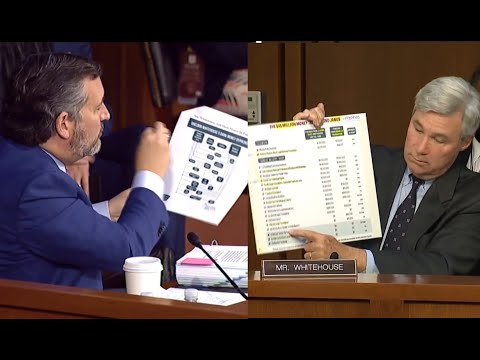
Cruz expanded on his previous day’s rebuttal of Senator Whitehouse’s dark money presentation, this time bringing his own chart. “I was feeling a little bit bad that I didn’t have a chart with sort of red fuzzy yarn connecting all the things that are the deep conspiracies going on,” he quipped.
He then detailed a specific case: Judge John J. “Jack” McConnell of Rhode Island, who had been treasurer of the Rhode Island Democratic Party and a director of the state’s Planned Parenthood branch. Cruz said McConnell had “contributed about $500,000 to Democratic political committees before becoming a judge” — more than any other judge nominated by Obama or Trump — and that McConnell’s wife had given another $250,000 to Democratic candidates and causes.
Cruz connected McConnell to an effort on the Judicial Conference’s Committee on Code of Conduct to ban judges from membership in the Federalist Society. “After Judge McConnell and the committee put out this assault on the Federalist Society to prohibit judges from being members, Senator Whitehouse and six other Democratic senators loudly cheered that effort in writing,” Cruz said.
He noted the effort was withdrawn after over 200 federal judges signed a letter opposing it, and emphasized that “the Federalist Society takes no positions. It doesn’t lobby, doesn’t file amicus briefs, doesn’t take public policy positions. Most of its events are debates where people on the left are featured prominently.”
School Choice and Judicial Restraint
Cruz used school choice to illustrate the difference between his approach to the courts and what he described as the Democratic approach. He argued that while he was “deeply passionate” about school choice and considered it “the civil rights issue of the next century,” he did not want courts to mandate it.
“Do I want to see a federal court issue an order mandating school choice across the country? It might be simpler if I could just convince five justices to order every jurisdiction in America, ‘You must have school choice,’” Cruz said. “But that would not be an appropriate judicial role.”
He cited the case of Zelman v. Simmons-Harris, where the Supreme Court upheld Ohio’s school choice program by a 5-4 vote. “Four justices were prepared to strike down that program as unconstitutional, and with it, every other school choice program in America,” Cruz warned.
Barrett affirmed the principle succinctly when asked whether it was a judge’s role to implement policy positions: “That’s your job, not a judge’s.”
Court Packing Warning
Cruz closed with an extended warning about court packing, which he defined narrowly as “expanding the number of justices to achieve a political outcome.” He accused Democrats of trying to redefine the term to include filling existing vacancies: “With all due respect, what utter nonsense.”
He quoted multiple Democrats and Justice Ginsburg against the concept. Biden in 1983 had called FDR’s court-packing plan “a boneheaded idea.” Durbin in 2018 had praised Congress for “stopping this popular president named Franklin Roosevelt from that idea.” Ginsburg in 2019 had said, “If anything would make the court look partisan, it would be that. One side saying, ‘We’re in power. We’re going to enlarge the number of justices so we would have more people who would vote the way we want to.’”
Cruz concluded: “That’s the next fight we’re facing if Democrats win the majority. I hope that we don’t see that come to pass.”
Key Takeaways
- Cruz mocked the near-empty Democratic side of the hearing room and argued that two days of questioning had failed to produce substantive criticism of Barrett’s qualifications, predicting a party-line confirmation vote.
- He challenged Democratic healthcare arguments by citing Kaiser Foundation data showing average family premiums rising $7,967 under Obamacare, and detailed a Rhode Island judge’s $500,000 in Democratic donations and subsequent role in an effort to ban judges from the Federalist Society.
- Cruz warned that court packing was the “next fight” if Democrats won the majority, quoting Biden, Durbin, and Justice Ginsburg against the concept and arguing that Barrett confirmed the core originalist principle that policy mandates belong to the legislature, not the judiciary.