 HYGO News
 Day 2 Ted Cruz questions Supreme Court nominee Amy Coney Barrett
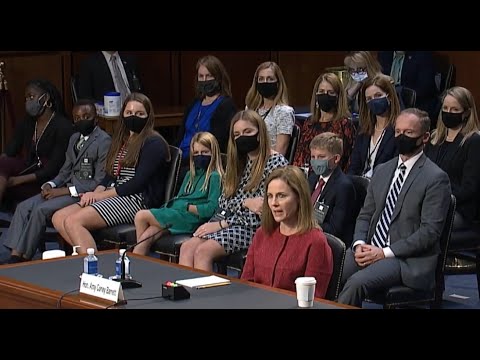
Day 2: Ted Cruz Questions Supreme Court Nominee Amy Coney Barrett
On October 13, 2020, during Day 2 of Judge Amy Coney Barrett’s Supreme Court confirmation hearing, Senator Ted Cruz (R-TX) used his questioning time primarily to respond to Democratic arguments about dark money in judicial politics and to frame the nomination as a pivotal moment for the Bill of Rights. Cruz argued that Democrats were “deeply hypocritical” on campaign finance, that the Supreme Court was one vote away from erasing fundamental rights in the First Amendment, Second Amendment, and religious liberty, and that Democrats had “abandoned democracy” by seeking to impose policy through the courts rather than through legislation. He concluded with a lighter personal exchange with Barrett about her family, her piano playing, and her decision to adopt two children from Haiti.
Flipping the Dark Money Argument
Cruz opened by praising Barrett’s credentials and noting that Democratic questioners had largely failed to challenge her qualifications. He then pivoted to directly rebut Senator Sheldon Whitehouse’s presentation on dark money in conservative judicial organizations.
Cruz challenged the premise with data: “Of the top 20 organizations spending money for political speech in the year 2016, 14 of them gave virtually all of their money to Democrats and another 3 split their money evenly. So, only 3 of the top 20 gave money to Republicans.” He cited specific numbers showing top super PAC donors contributed $422 million to Democrats versus $189 million to Republicans.
He singled out Arabella Advisors, a for-profit entity managing nonprofits including the 1630 Fund and the New Venture Fund. “In the year 2017 and 2018, those entities reported $987.5 million in revenue. That’s nearly a billion dollars,” Cruz said, contrasting it with the $250 million Whitehouse had criticized on the conservative side.
Cruz also identified Demand Justice as a project of these entities, noting it had “spent $5 million opposing Justice Brett Kavanaugh, and has just launched a seven-figure ad buy opposing your confirmation.” His conclusion: “All of the great umbrage about the corporate interests spending dark money is wildly in conflict with the actual facts that the corporate interests that are spending dark money are funding the Democrats by a factor of 3 to 1 or greater.”
Citizens United and Free Speech
Cruz provided a detailed explanation of the Citizens United case, arguing that most Americans did not understand what it actually involved. He described it as a case about “whether or not it was legal to make a movie criticizing a politician,” in which a small nonprofit made a film critical of Hillary Clinton and faced punishment from the Obama Justice Department.
He highlighted what he called a “truly chilling” moment at oral argument: “Justice Sam Alito asked the Obama Justice Department, ‘Is it your position under your theory of the case that the Federal Government can ban books?’ And the Obama Justice Department responded, ‘Yes.’”
Cruz emphasized the narrow margin: “Citizens United was decided 5 to 4. By a narrow 5-4 majority, the Supreme Court concluded the First Amendment did not allow the Federal Government to punish you for making a movie critical of a politician.” He noted that Hillary Clinton had “explicitly promised every Justice she nominated to the Court would pledge to overturn Citizens United.”
The Second Amendment at Stake
Cruz turned to the Second Amendment, framing the Heller decision as a case about whether the right to bear arms existed at all, not merely about the scope of permissible regulation. “The issue at Heller was much more fundamental. It was whether the Second Amendment protects an individual right to keep and bear arms at all. The vote in Heller was 5 to 4,” he said.
He explained that four dissenting justices took the position that the Second Amendment protected only a “collective right of the militia, which is fancy lawyer talk for a non-existent right.” If that view had prevailed, Cruz warned, the government “could ban guns entirely, could make it a criminal offense for any one of us to own a firearm, and no individual American would have any judicially cognizable right to challenge that.”
Religious Liberty Cases
Cruz devoted a significant portion of his time to religious liberty, drawing on cases he had personally litigated. He described the Ten Commandments case, Van Orden v. Perry, where a monument had stood on the Texas Capitol grounds since 1961. The case was decided 5-4, with “four justices willing to say in effect, send in the bulldozers and tear down that monument.”
He recounted the Mojave Desert Veterans Memorial case involving a lone white Latin cross erected to honor World War I veterans. “The ACLU filed a lawsuit saying you cannot gaze on the image of a cross on public land, and the ACLU won in the district court. They won in the Ninth Circuit Court of Appeals. The federal court ordered that veterans’ memorial to be covered up with a burlap sack with a chain on the bottom, and then a plywood box.”
Cruz added a historical flourish, noting that the image of the Ten Commandments appears 43 times inside the Supreme Court building itself, including on the wooden doors, bronze gates, and the carved image of Moses holding the tablets above the justices’ bench.
He also discussed the Little Sisters of the Poor and the Hobby Lobby case, arguing that the Obama administration had “litigated against nuns” to force them to pay for abortion-inducing drugs, and that Biden had pledged to resume the legal campaign against them.
A Personal Exchange
Cruz concluded with a lighter personal exchange. Barrett revealed she had played piano for 10 years growing up, now mostly playing children’s songs and supervising her kids’ practice. She shared the story of her decision to adopt two children from Haiti, explaining that she and her husband Jesse had made the decision while engaged after meeting other couples who had adopted. “I was expecting Tess when we went and got Vivian. She and Tess, I functionally call them my fraternal twins. They’re in the same grade, and it really has enriched our family immeasurably,” Barrett said.
When Cruz asked what advice she would give to little girls, Barrett recalled her father’s pre-spelling-bee encouragement — “anything boys can do, girls can do better” — then added with a laugh, gesturing to her sons behind her, “but boys are great too.”
Key Takeaways
- Cruz directly rebutted Democratic dark money criticisms by citing data showing Democratic super PACs received $422 million versus $189 million for Republicans in 2016, and highlighting Arabella Advisors’ nearly $1 billion in managed revenue versus the $250 million Whitehouse had criticized on the conservative side.
- He framed the Barrett nomination as a pivotal vote on the Bill of Rights, arguing the Supreme Court was one vote away from overturning Citizens United, eliminating the individual right to bear arms under Heller, and removing religious monuments from public land.
- Cruz shared Barrett’s personal story of adopting two children from Haiti while expecting her biological daughter Tess, and closed on a light note with Barrett’s advice to young girls that “anything boys can do, girls can do better.”