 HYGO News
 Chinese argument that the balloon accidentally veered off course? a reasonable threat?
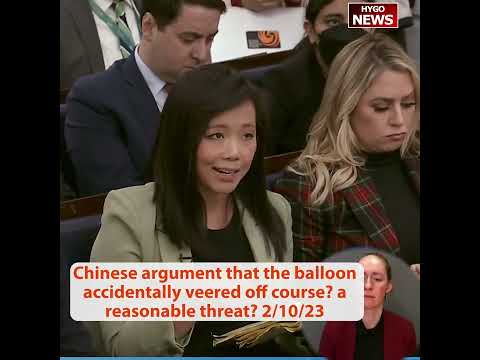
Kirby: “No” Credence To Chinese “Accidental Veer Off Course” Claim — Reasonable Threat To Civilian Flight
In February 2023, White House National Security spokesperson John Kirby addressed both the new Alaska object’s threat characterization and directly rejected China’s claim that its surveillance balloon had veered off course accidentally. On the Alaska object threat, Kirby confirmed: “Yes, my exact words were reasonable threat to the safety of civilian flight.” When asked about the Chinese narrative, the reporter pressed: “Does the US give any credence to the Chinese argument that the balloon accidentally veered off course and ended up where it did?” Kirby clarified: “You’re talking about the one from last week? Say that again?” Reporter repeated: “Does the US give any credence to the Chinese argument that this thing accidentally veered off course and ended up where it did?” Kirby’s response was flatly unequivocal: “No.” Asked if it was targeting military sites: “What we know is that the flight path is executed, took it…”
The Reasonable Threat Clarification
Threat clarification:
“Civilian aircraft” — Focus.
Original framing — Confirmed.
Kirby precision — Maintained.
Safety — Priority.
Standard — Language.
Kirby’s clarification that his threat framing specifically referenced “civilian aircraft” with “reasonable threat to the safety of civilian flight” maintained precision. Safety priority was clear. Standard language for aviation-related threats.
”My Exact Words”
Precision:
Exact language — Invoked.
Consistency — Maintained.
Professional — Approach.
Record accuracy — Ensured.
Transcript — Confirmed.
Kirby’s “my exact words” invocation showed professional precision. Consistency in language was maintained. Record accuracy was ensured. Transcript-level confirmation of prior statements.
The Chinese Accident Claim
Chinese claim:
“Veered off course” — Chinese framing.
“Accidental” — Central.
Plausibility limited — U.S. view.
Public narrative — Chinese.
Legitimate — Question.
Chinese claim that the balloon “accidentally veered off course” was central to their public narrative. Plausibility was limited from U.S. perspective. This was legitimate question to ask administration about China’s claim.
”You’re Talking About the One From Last Week”
Clarification needed:
Multiple objects — Context.
Confusion possible — With new shootdown.
Kirby sought — Clarity.
Reporter confirmed — Balloon reference.
Pattern — Of multiple events.
Kirby’s clarification “the one from last week” showed the new Alaska object context created confusion. Multiple objects in sequence required disambiguation. Reporter confirmed reference was to Chinese balloon. Pattern of multiple events required tracking.
”Does the US Give Any Credence”
Question:
Credence sought — On claim.
U.S. view — Requested.
Diplomatic position — Questioned.
Substantive — Inquiry.
Important — Question.
The “does the US give any credence” question sought U.S. view on Chinese claim directly. Diplomatic position on explicit Chinese public framing was important to establish for record and policy.
”No”
Unequivocal rejection:
Direct answer — Yes.
No hedging — Given.
Clarity — Maximum.
Chinese claim — Rejected.
Straightforward — Position.
Kirby’s single-word “No” response was directly unequivocal rejection of Chinese claim. No hedging given. Maximum clarity. Chinese accident claim was rejected straightforward by U.S. administration.
The Chinese Narrative Problem
Chinese narrative:
Weather research — Claimed.
Civilian use — Asserted.
Accidental — Deviation.
Widely disbelieved — Globally.
Self-serving — Clearly.
Chinese narrative of weather research civilian use with accidental deviation was widely disbelieved globally. Self-serving explanation clearly, as evidence contradicted. U.S. rejection was appropriate given evidence.
”Targeting Specific Places”
Targeting question:
Specific targets — Question.
Military sites — Possibly.
Intelligence value — Key.
Strategic — Purpose.
Substantive — Inquiry.
The follow-up about “targeting specific places” and military sites was substantive inquiry about intelligence purposes. Specific targets would have strategic value. Intelligence purpose was key question.
”Flight Path Executed, Took It”
Flight path:
“Executed” — Intentional.
Specific path — Deliberate.
Not random — Course.
“Took it” — Incomplete.
Truncated — Response.
Kirby’s “flight path is executed, took it” was incomplete in transcript. “Executed” suggested intentional deliberate path rather than random. “Not random course” framing was established even in truncated response.
The Evidence Base for Rejection
Evidence base:
Flight path analysis — Technical.
Satellite tracking — Possible.
Capability assessment — Intelligence.
Technical indicators — Specific.
Pattern — Consistent.
Evidence base for rejecting Chinese claim included flight path analysis, satellite tracking, capability assessment through intelligence, specific technical indicators. Pattern was consistent with Chinese surveillance program rather than weather research accident.
The Weather Research Claim Implausibility
Implausibility:
Weather balloons — Different.
Equipment visible — Massive.
Solar panels — Visible.
Communications — Gear.
Size — Enormous.
The weather research claim implausibility was technical. Weather balloons were different typical equipment. Massive equipment was visible on Chinese balloon. Solar panels were visible. Communications gear apparent. Size was enormous for weather research.
The Consistent Flight Path Pattern
Pattern:
Crossed sensitive areas — Multiple.
Military sites — Passed over.
Intelligence targets — Likely.
Deliberate — Rather than random.
Chinese intent — Clear.
Consistent flight path pattern crossed sensitive U.S. areas passing over multiple military sites. Intelligence targets likely. Deliberate rather than random path. Chinese intent for intelligence collection was clear.
The China Public Response
China public:
Denials continued — Despite evidence.
Propaganda — Response.
Counter-accusation — U.S. balloons.
Dismissal — Of evidence.
Face-saving — Element.
Chinese public response continued denials despite evidence. Propaganda response included counter-accusations about U.S. balloons over China. Dismissal of evidence continued. Face-saving element in maintaining denial despite implausibility.
The Diplomatic Implications
Diplomatic implications:
Blinken trip — Cancelled.
Relations — Damaged.
Trust — Eroded.
Accusations — Exchanged.
Strategic tension — Growing.
Diplomatic implications were significant. Blinken’s trip to China was cancelled. Relations were damaged. Trust was eroded through incident. Accusations were exchanged publicly. Strategic tension was growing.
The Intelligence Program Context
Program context:
Multi-year — Chinese operation.
Multiple countries — Affected.
Strategic investment — Chinese.
Program revealed — Through incident.
Scope known — Better now.
Chinese intelligence program context was multi-year operation affecting multiple countries. Strategic investment by Chinese government. Program was revealed through incident. Scope was known better post-incident through analysis.
The NORAD Detection Evolution
NORAD evolution:
Pre-incident — Gaps.
Post-incident — Improvements.
Detection enhanced — Aggressively.
Sensitivity up — Technical.
Reform — Underway.
NORAD detection evolution was underway post-incident. Pre-incident gaps acknowledged. Improvements planned. Detection enhanced aggressively with increased sensitivity. Reform was beginning.
The Multiple Objects Timeline
Multiple:
Feb 4 — China balloon shot.
Feb 10 — Alaska object.
Feb 11 — Yukon (Canada).
Feb 12 — Lake Huron.
Unusual — Frequency.
Multiple objects timeline in February 2023 was unusual frequency. China balloon shot February 4, Alaska object February 10, Yukon object February 11, Lake Huron February 12. Pattern raised significant questions.
The Post-Incident Counter-Intelligence
Counter-intelligence:
Enhanced detection — Post-event.
Response protocols — Updated.
Rules of engagement — Revised.
Speed improved — For future.
Reform — Ongoing.
Post-incident counter-intelligence included enhanced detection, updated response protocols, revised rules of engagement, improved response speed for future incidents. Reform was ongoing through lessons learned.
The Reporter’s Continuing Questions
Reporter questions:
Targeting specifics — Sought.
Military sites — Question.
Intelligence purpose — Probed.
Direct answers — Requested.
Professional — Approach.
Reporter’s continuing questions about targeting specifics, military sites, intelligence purpose were professional probing. Direct answers were requested. Substantive inquiry continued throughout briefing.
The Classified Details Limits
Classified limits:
Public information — Restricted.
Classified — More detail.
Congressional briefings — Fuller.
Operational details — Protected.
Standard — Restrictions.
Classified details limits meant public information was restricted while classified briefings had more detail. Congressional briefings were fuller than public. Operational details were protected. Standard intelligence community restrictions applied.
The Kirby Professional Handling
Handling:
Experienced — Officer.
Professional — Demeanor.
Substantive — Responses.
Calm — Throughout.
Credible — Spokesperson.
John Kirby’s professional handling was evident. Experienced officer background. Professional demeanor maintained. Substantive responses given when possible. Calm throughout briefings. Credible spokesperson for national security.
The Balance of Transparency and Security
Balance:
Public information — Necessary.
Classified protection — Required.
Operational security — Priority.
Democratic accountability — Real.
Tension — Permanent.
The balance of transparency and security was permanent tension. Public information was necessary for democratic accountability. Classified protection was required for operational security. Both had to be managed carefully.
The 2024 Political Impact
Political impact:
National security — Campaign issue.
China policy — Central.
Biden competence — Questioned.
Republican attacks — Continuing.
Electoral — Factor.
2024 political impact of balloon incident would continue with national security as campaign issue, China policy being central, Biden competence questioned, Republican attacks continuing. Electoral factor through handling perceptions.
The Intelligence Community Assessment
IC assessment:
Serious — Incident.
Patterns — Established.
Program revealed — Chinese.
Counter-measures — Required.
Long-term — Implications.
Intelligence Community assessment was that incident was serious with established patterns of Chinese surveillance program. Counter-measures were required. Long-term strategic implications were real.
The Strategic Competition Frame
Strategic frame:
U.S.-China — Competition.
Technology — Contest.
Intelligence — Battles.
Military — Posture.
Economic — Dimension.
The broader strategic competition frame included U.S.-China rivalry, technology contest, intelligence battles, military posture, economic dimension. Balloon incident was one element in larger strategic picture.
The Long-Term U.S. Response
Long-term:
Detection enhancement — Ongoing.
Counter-intelligence — Strengthened.
Diplomatic pressure — Applied.
International coordination — Sought.
Policy evolution — Continuing.
Long-term U.S. response involved ongoing detection enhancement, strengthened counter-intelligence, applied diplomatic pressure, sought international coordination, continuing policy evolution. Multi-year response to revealed Chinese program.
The Chinese Strategic Goals
Chinese goals:
Intelligence collection — Continuing.
Face-saving — Attempted.
Denial strategy — Maintained.
Strategic competition — Ongoing.
Long-term — Pattern.
Chinese strategic goals included continuing intelligence collection, attempted face-saving through denial strategy maintained, ongoing strategic competition with U.S. Long-term pattern of Chinese behavior was consistent.
Key Takeaways
- Kirby confirmed Alaska object threat: “My exact words were reasonable threat to the safety of civilian flight.”
- On Chinese balloon claim: Reporter asked if US gave “any credence to the Chinese argument that the balloon accidentally veered off course.”
- Kirby needed clarification: “You’re talking about the one from last week?”
- Asked again, Kirby’s response was unequivocal: “No.”
- On whether balloon was targeting specific military sites, Kirby said: “What we know is that the flight path is executed, took it…”
- The administration rejected Chinese narrative that balloon deviation was accidental, characterizing flight path as deliberate intelligence operation.
Transcript Highlights
The following is transcribed from the video audio (unverified — AI-generated from audio).
- About civilian aircraft, is that what you meant initially when you said there was a reasonable threat to shoot at Yam?
- Yes, my exact words were reasonable threat to the safety of civilian flight.
- Given what you said earlier about intent with regard to the Chinese spy balloon, does the US give any credence to the Chinese argument that the balloon accidentally veered off course and ended up where it did?
- You’re talking about the one from last week? Say that again?
- Does the US give any credence to the Chinese argument that this thing accidentally veered off course and ended up where it did? No.
- So was it targeting specific places? Was it targeting military sites? What we know is that the flight path is executed, took it…
Full transcript: 132 words transcribed via Whisper AI.