 HYGO News
 Brainard promised not dictate lending on Climate Risks, Cramer asked why Dems prefer her not Powell
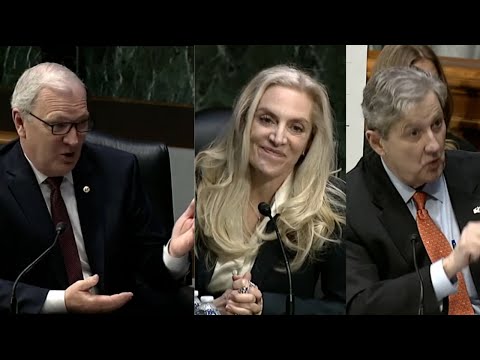
Senator Kennedy Gets Brainard to Promise Statement Against Using Fed Power to Defund Oil, Gas, and Gun Companies
On 1/13/2022, during her Senate Banking Committee confirmation hearing for Fed Vice Chair for Supervision, Lael Brainard faced pointed questioning from Senators Kennedy, Cramer, and Toomey about her views on using the Federal Reserve to steer capital away from fossil fuel companies under the guise of climate risk management. Kennedy secured a commitment from Brainard to issue a statement against using regulatory power to discourage lending to oil and gas companies, while Cramer posed a question Brainard could not answer: if her views were the same as Chairman Powell’s, why did Democrats overwhelmingly prefer her?
Kennedy: “Will You Issue a Statement?”
Senator Kennedy asked Brainard directly whether federal regulatory authorities should use their power to discourage private banks from lending to oil and gas companies. “No,” Brainard answered.
Kennedy followed up: “Do you think those federal regulatory authorities should use their power to discourage private banks from lending money to gun manufacturers and dealers?”
“It’s not our job. We don’t tell banks what sectors to lend to. We just ask them to risk-manage and we make sure they have good processes in place,” Brainard said.
Kennedy then pressed for a written commitment. “Will you issue a separate statement saying, ‘I want to make it clear for what it’s worth to all of my colleagues in government, I don’t think that you should use your power to discourage private banks from lending money to oil and gas companies and to gun manufacturers’? Will you do that?”
Brainard hedged slightly. “I won’t tell other regulators what to do, but I will be happy to talk about what we do at the Federal Reserve, what our statutory authorities require us to do,” she said.
“I take that as a yes, and I’m looking forward to that statement,” Kennedy said. “My office will work with you on that statement about oil and gas and gun manufacturers.”
Cramer: “Why Do Democrats Prefer You?”
Senator Kevin Cramer of North Dakota posed a question that cut to the heart of Republican suspicions about Brainard. He noted that Brainard had testified she was “pretty well in sync” with Chairman Powell’s assessment of climate and the Fed’s mandates.
“So how is it that you get so much more — now I’m asking you to analyze yourself or your supporters — but I’m trying to reconcile why so many of our friends on the other side of the aisle think you’re wonderful on climate, but they’re not going to support Chairman Powell for some of the same reasons,” Cramer said. “I’m just wondering, how can I reconcile that in my mind?”
Brainard offered a diplomatic non-answer: “We do operate within our statutory mandates. I do try to be aware of emerging risks generally. I thought it was important to develop research in the area of digital finance, for instance, several years ago. So I am looking out over the horizon sometimes and perhaps talk more about the research. But we’re very in sync in terms of what we actually think our responsibilities as an institution are.”
The exchange highlighted the central concern: if Brainard’s views were truly identical to Powell’s, there would be no reason for Democrats to prefer her — suggesting her actual approach to climate regulation would be more aggressive than her testimony implied.
Toomey: Climate Policy Belongs to Elected Officials
Senator Pat Toomey laid out the Republican case in his opening statement. “Governor Brainard has urged the Fed to take an activist role on global warming, which is beyond the Fed’s expertise and mission,” Toomey said, citing the New York Times.
Toomey noted a critical distinction: “We haven’t found a single bank that’s failed in the modern era due to a severe weather event.” He argued the real “transition risk” was political — “the risk that unelected bureaucrats will attempt to impair the value of energy-related assets by cutting off credit to the energy sector.”
“This isn’t about whether climate change is a significant threat to our society,” Toomey said. “It’s about the fact that climate policymaking requires trade-offs between costs and benefits. These are inherently political decisions, which is why they belong firmly in the domain of officials who are elected and directly accountable to voters.”
Cramer on Oil Production and “Climate Guilt”
Senator Cramer raised the practical impact of anti-fossil-fuel signaling on his home state of North Dakota, which was producing “about 400,000 barrels of oil less than it did before” the Biden administration. “The Bakken is cash-starved, quite honestly. And some of that is because of the signals that they’re getting from banks and that banks are getting from others that investing in oil production is persona non grata,” Cramer said.
“I worry that we want to transfer our climate guilt by suggesting that we shouldn’t produce so much in the United States while global demand goes up and our adversaries who are not nearly as environmentally friendly as we are produce,” Cramer added.
Brainard acknowledged the question was “a very big one” but said she did not study energy policy and that Fed supervisory guidance was “not specific to particular borrowers or sectors.”
Key Takeaways
- Kennedy secured Brainard’s commitment to issue a statement opposing the use of regulatory power to discourage lending to oil and gas companies and gun manufacturers.
- Brainard said she was “in sync” with Chairman Powell on climate, but Cramer asked why Democrats overwhelmingly preferred her if their views were identical.
- Toomey noted no bank had ever failed due to a severe weather event and argued climate policymaking belonged to elected officials, not “unelected bureaucrats.”
- Cramer said North Dakota’s Bakken region was “cash-starved” because banks were getting signals that oil investment was “persona non grata.”
- Brainard said the Fed should not “tell banks what sectors to lend to” but hedged when asked to make that commitment binding on other regulators.
Transcript Highlights
The following is transcribed from the video audio (unverified — AI-generated from audio).
- Do you think federal regulatory authorities should use their power to discourage private banks from lending money to oil and gas companies? No.
- It’s not our job. We don’t tell banks what sectors to lend to. We just ask them to risk-manage.
- Would you say you’re pretty well in sync with Chairman Powell’s assessment of climate? Yes, Senator. Yes, I am.
- How is it that you get so much more support from Democrats on climate but they’re not going to support Chairman Powell for the same reasons? How can I reconcile that?
- We haven’t found a single bank that’s failed in the modern era due to a severe weather event.
- The Bakken is cash-starved because of the signals they’re getting from banks that investing in oil production is persona non grata.
Full transcript: 1457 words transcribed via Whisper AI.