 HYGO News
 72 year old employees in rural stop using Sir or Ma'am because they're not inclusive
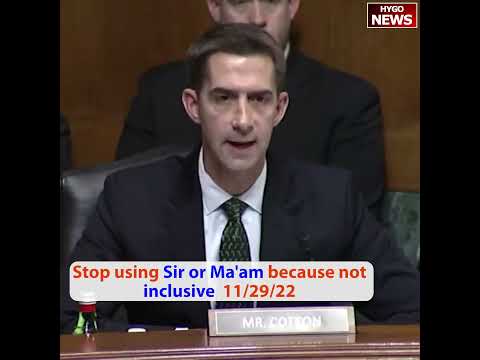
Senator Confronts Kroger CEO on “Allyship Guide” Telling Employees to Stop Using “Sir” and “Ma’am” — What About 72-Year-Old Rural Arkansas Workers?
On 12/4/2022, a senator continued questioning Kroger’s CEO during a congressional hearing by drawing attention to the company’s “Allyship Guide” — an employee training document that directed workers to stop using the words “Sir” and “Ma’am” because they were not “inclusive.” The senator raised a pointed practical question: “Do you expect 72-year-old employees in rural areas of Arkansas to really stop using words like Sir Ma’am?” The exchange captured tensions between corporate DEI initiatives and the cultural norms of older employees and customers in more traditional parts of the country. The CEO’s response — defending inclusivity while claiming not to know if employees faced disciplinary action for using the words — reflected corporate difficulty explaining practices that struck many ordinary Americans as unnecessary or intrusive.
The Allyship Guide
The senator’s question referenced a specific Kroger document. “Mr. McMullen, you’re aware that Kroger has something called an Allyship Guide for its employees?” the senator asked. (Note: the transcript calls the CEO “McMuller,” but Kroger’s CEO at the time was Rodney McMullen.)
“Yes, Senator,” the CEO confirmed.
Allyship Guides had become common corporate documents in the early 2020s, particularly at large companies with significant workforce diversity. These documents typically provided guidance on how employees could support colleagues from various backgrounds, particularly LGBT, racial minority, and other historically marginalized groups. The guidance often included specific language recommendations — preferred terminology, terms to avoid, and contexts for different word choices.
Kroger’s Allyship Guide was one instance of this broader trend. The specific content had become public through various channels — leaked documents, employee reports, and news coverage — giving critics the ability to reference specific guidance that had been distributed to employees.
”Stop Using Sir and Ma’am”
The senator cited specific guidance from the document. “In the Allyship Guide, you direct employees to stop using Sir and Ma’am because they’re not inclusive,” the senator said.
The guidance — to avoid “Sir” and “Ma’am” — was controversial because these were common terms of respect throughout much of American English. Particularly in Southern states and rural areas, using “Sir” and “Ma’am” was considered polite and respectful. Children were often taught to use these terms when addressing adults. Older Americans expected to be addressed with these terms as a sign of deference.
The rationale for discouraging “Sir” and “Ma’am” was that these terms were gendered — they assumed knowledge of the addressee’s gender identity, which could be incorrect or unwelcome for non-binary or transgender individuals. From an inclusivity perspective, gender-neutral alternatives were preferred.
But the cultural costs of this guidance were significant. Employees were being asked to abandon terms they had used all their lives. Customers in rural areas were being addressed in ways that might seem cold or overly formal to them. Regional and generational variations in language use were being flattened in favor of a single corporate standard.
”72-Year-Old Employees in Rural Areas of Arkansas”
The senator’s question was deliberately specific. “Do you expect 72-year-old employees in rural areas of Arkansas to really stop using words like Sir Ma’am?” the senator asked.
The specificity of “72-year-old employees in rural areas of Arkansas” wasn’t arbitrary. It was designed to highlight the disconnect between corporate DEI guidance and the realities of Kroger’s actual workforce. The company operated stores across the country, including in rural Arkansas (where Walmart was headquartered and where Kroger competed in various markets).
The older rural workforce was particularly likely to use “Sir” and “Ma’am” as standard courtesy terms. For a 72-year-old Arkansan, these weren’t discretionary language choices — they were deeply ingrained habits from a lifetime of cultural practice. Asking such employees to stop using these terms effectively asked them to adopt foreign speech patterns that contradicted their lifelong communication norms.
The senator was implicitly arguing that Kroger’s corporate guidance was unrealistic for its actual workforce. A corporate policy devised in executive offices might sound reasonable to metropolitan professionals but could be impossible to implement effectively in rural America where different cultural norms prevailed.
”Inclusive Welcoming Culture”
The CEO’s response stayed at the level of abstract values. “We think it’s incredibly important to be an inclusive opening culture to welcome all associates,” the CEO said.
The phrase “inclusive opening culture” was somewhat garbled — “opening” seemed out of place, and “welcoming” would have fit better. But the substance was clear: the CEO was defending the Allyship Guide on inclusivity grounds.
The response was notable for what it didn’t address. The senator had asked a specific practical question: did Kroger really expect older rural employees to change their speech patterns? The CEO responded with abstract values rather than practical guidance about whether the expectation was realistic.
This was a common pattern in corporate DEI communications. When confronted with practical objections to specific policies, executives often retreated to abstract values that no one disputed. Everyone was for “inclusivity” in the abstract. The disagreements were about what specific policies followed from inclusivity — and specifically whether those policies were worth the cultural costs they imposed on employees and customers.
”Face Disciplinary Action”
The senator pressed on the enforcement question. “If employees in your stores in rural Arkansas refer to other employees or customers as Sir Ma’am, they face disciplinary action,” the senator stated.
The phrasing — “they face disciplinary action” — was presented as an assertion rather than a question. The senator was essentially testing whether the CEO would confirm or deny that employees could be disciplined for using terms like “Sir” and “Ma’am” that the Allyship Guide had asked them to avoid.
The CEO’s response was evasive. “Not that I’m aware of, Sir. I would have to ask,” the CEO said.
“Not that I’m aware of” was a technically non-committal answer. The CEO wasn’t confirming that employees faced discipline. But he also wasn’t denying it. “I would have to ask” suggested the CEO didn’t know the specific enforcement practices — which was itself revealing about how much control the CEO had over the specific implementation of DEI policies.
The “Sir” in the CEO’s response — “Not that I’m aware of, Sir” — was itself a notable moment. The CEO was using the term “Sir” during testimony where he was defending corporate guidance against its use. The senator presumably noticed this, and viewers would have noticed it too.
The Implementation Gap
The exchange revealed a common gap between corporate DEI policy and actual enforcement. Companies often produced detailed guidance documents — Allyship Guides, inclusion training materials, language recommendations — without establishing clear enforcement mechanisms. Individual store managers might enforce the guidance strictly, loosely, or not at all, depending on their own judgment and circumstances.
This implementation gap meant that the practical impact of corporate DEI policies varied enormously across locations. A Kroger store in San Francisco might enforce the “no Sir/Ma’am” guidance strictly. A Kroger store in rural Arkansas might ignore it entirely. Both stores were following “Kroger policy” in some sense, but the employee experience was completely different.
The CEO’s “I would have to ask” answer confirmed this gap. The CEO — the top executive in the company — didn’t know the specific enforcement practices for a policy that had been distributed to employees and that was attracting congressional scrutiny. The policy existed on paper, but its actual implementation was managed at levels below the CEO’s direct attention.
The Cultural Flash Point
The “Sir/Ma’am” issue became a minor cultural flash point in 2022 because it captured broader tensions about corporate DEI practices. Critics argued that these policies:
- Imposed progressive cultural norms on employees from different backgrounds
- Created legal risks for employees who couldn’t comply with arbitrary rules
- Divided workforces between those who accepted the norms and those who didn’t
- Alienated customers who found the new communication patterns unwelcome
- Costs significant management resources to implement and enforce
- Produced minimal measurable benefits in terms of actual inclusion outcomes
Supporters argued that these policies:
- Made workplaces more welcoming for employees from all backgrounds
- Reduced microaggressions that affected employee wellbeing
- Reflected evolving social norms about respect and inclusion
- Protected the company from discrimination claims
- Aligned the company with values customers increasingly expected
The senator’s line of questioning aligned with the critics. By highlighting the 72-year-old Arkansas worker, the senator was arguing that the policies imposed costs on specific employees that weren’t justified by the benefits.
The Kroger-Albertsons Merger Context
The hearing context was Kroger’s proposed merger with Albertsons, which would create the largest grocery chain in the United States. The senator was examining the combined company’s workforce practices as part of scrutinizing whether the merger should proceed.
If the combined Kroger-Albertsons would enforce the “no Sir/Ma’am” policy across both chains, the policy would affect hundreds of thousands of additional employees in thousands of additional stores. This made the DEI policies a legitimate topic for merger scrutiny, not just corporate governance review.
Key Takeaways
- A senator confronted Kroger’s CEO about the company’s “Allyship Guide” directing employees to stop using “Sir” and “Ma’am” as not inclusive.
- The senator asked specifically about 72-year-old employees in rural Arkansas, highlighting the cultural disconnect with older workers.
- The CEO defended the policy with abstract values about “inclusive welcoming culture” without addressing the practical question.
- When asked if employees faced disciplinary action for using “Sir/Ma’am,” the CEO said “Not that I’m aware of, Sir. I would have to ask.”
- The CEO’s use of “Sir” in the very response defending guidance against the term was itself notable.
Transcript Highlights
The following is transcribed from the video audio (unverified — AI-generated from audio).
- Mr. McMullen, you’re aware that Kroger has something called an Allyship Guide for its employees?
- In the Allyship Guide, you direct employees to stop using Sir and Ma’am because they’re not inclusive.
- Do you expect 72-year-old employees in rural areas of Arkansas to really stop using words like Sir Ma’am?
- We think it’s incredibly important to be an inclusive opening culture to welcome all associates.
- If employees in your stores in rural Arkansas refer to other employees or customers as Sir Ma’am, they face disciplinary action.
- Not that I’m aware of, Sir. I would have to ask.
Full transcript: 100 words transcribed via Whisper AI.