 HYGO News
 $40B "Schumark", Failed Public Housing, Fannie Mae & Freddie Mac Investor-Property Mortgages
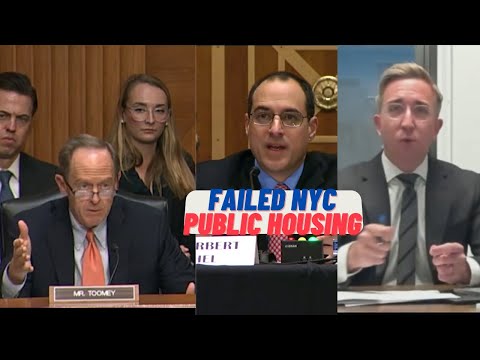
The $40 Billion “Schumark”: Toomey Exposes Failed Public Housing Model and NYCHA Bailout in Democrats’ Spending Bill
On October 21, 2021, during a U.S. Senate Banking Committee hearing, Ranking Member Pat Toomey (R-PA) delivered a detailed attack on the housing provisions in the Democrats’ spending bill. Toomey highlighted what he called a $40 billion “Schumark” — an earmark for Senate Majority Leader Chuck Schumer’s home state that would direct half of all public housing dollars to the scandal-plagued New York City Housing Authority. The hearing also featured testimony from housing policy experts who argued that public housing was a fundamentally failed model, that the lack of work requirements in the bill would destroy incentives for self-sufficiency, and that Fannie Mae and Freddie Mac’s role in subsidizing investor-property mortgages was driving up housing prices.
The “Schumark”: $40 Billion for NYCHA
Toomey coined the hearing’s most memorable term when he drew attention to the disproportionate allocation of public housing funds in the Democrats’ spending bill. He noted that despite the New York City Housing Authority managing only approximately 20 percent of the nation’s public housing stock, the bill was structured to send roughly half of all public housing dollars to NYCHA.
“Certainly looks a lot like Sen. Schumer securing a $40 billion earmark. Or should we call it the Schu-mark?” Toomey said. “So it looks like half of all the bill’s public housing dollars will go to a housing authority plagued by scandals, bribery, and chronic mismanagement.”
Toomey pointed out the contradiction in the funding structure: Senator Schumer had promised to double support for public housing, but the math revealed that the doubling was designed to benefit his home state disproportionately. NYCHA’s 20 percent share of the nation’s public housing was set to receive 50 percent of the new funding.
A hearing witness reinforced the point. When asked whether there was any justification for NYCHA receiving half of all public housing funds, the witness was blunt: “There is, in my opinion, no justification for awarding failure. NYCHA has failed as public housing and has failed to keep its residents safe.” He noted that New York’s own progressive public advocate had named NYCHA “the city’s worst landlord for three years straight.”
The witness added a pointed observation about the funding formula: “The only justification for spending $80 billion in public housing is that New York wanted $40 billion. Senator Schumer promised to double support for public housing, even though NYCHA’s share of public housing nationwide is only 20%.”
Public Housing: A “Failed Model”
Toomey placed his critique in historical context, arguing that the spending bill represented an about-face from a generation of bipartisan consensus that public housing was a fundamentally flawed approach to affordable housing.
“Public housing is a failed model of delivering assistance. Let’s face it, it’s costly. It traps families, often in multi-generational cycles of poverty,” Toomey said. He reminded his colleagues that in 1998, Congress had voted with “overwhelming bipartisan support to cap the net number of public housing units” through the Faircloth amendment.
To illustrate how broad the consensus had been, Toomey cited a remark from Senator Dick Durbin, a Democrat, who had referred to public housing developments as “vertical slums.” The fact that such language had come from a leading Democrat underscored how dramatically the party’s position had shifted in the intervening decades.
“Such is the durability of this consensus,” Toomey noted, pointing out that the Faircloth cap remained in place to that day. “But our Democratic colleagues now want to eliminate that cap.”
The Democrats’ spending bill proposed repealing the Faircloth amendment, which would remove the limit on the number of public housing units the federal government could fund. Combined with the $40 billion for NYCHA and additional billions for public housing nationwide, the bill represented the most significant expansion of government-controlled housing in decades.
The Work Incentive Problem
Toomey raised concerns about the near-total absence of work requirements in the bill’s housing provisions. He asked a witness to address how the programs would affect recipients’ incentives to become self-sufficient.
The witness’s response was forceful: “It will continue to destroy it, as that’s been going on for decades now, well over 50 years. It becomes part of an open-ended assistance system that literally destroys the incentive to become a productive member of society. It creates and perpetuates a subculture, if you will.”
Toomey pressed the point: “If you undermine and eliminate the incentive to work, you really undermine the ability to work your way into the middle class, it seems to me.”
“Yes, when I say that, that’s what I mean,” the witness confirmed. “Eliminate the incentive to build a career and build wealth.”
The exchange highlighted a philosophical divide between the two parties on housing policy. Democrats argued that the investment was necessary to address decades of underinvestment in public housing infrastructure and to provide affordable options for low-income families. Republicans countered that pouring money into a model that had already demonstrated its failure for 50 years would simply expand the dependency trap without improving outcomes.
The Real Housing Problem: Supply, Not Demand
Both witnesses at the hearing agreed on a fundamental diagnosis of the housing affordability crisis: the problem was insufficient supply, not insufficient demand. Federal policy, they argued, had been making the problem worse by making it easier to borrow money to buy homes without doing anything to increase the number of homes available.
“We have to stop increasing demand,” one witness said. “You have supply-constrained markets and housing all the time, and all federal policies geared toward doing is making it easy to get a loan and increasing demand. There’s no way that that policy ends in anything other than higher prices.”
He identified the primary mechanism: “And the way that we do that is primarily through Fannie and Freddie. So we have got to shrink their footprint. There’s no way around that.”
The second witness agreed: “We have more money chasing after an ever-vanishing supply of homes. We need to get the supply of homes increased. We need more private sector investment. Investing in public housing is not the answer. Having more government money chasing after an ever-smaller supply of homes is also not the answer.”
Toomey connected the supply-demand diagnosis to the broader economic environment. He noted that loose monetary policy had “driven up the price of virtually every asset class I can think of, from commodities to energy, equities, crypto assets, real estate,” and that housing was caught in the same inflationary dynamic affecting the rest of the economy.
Toomey’s Fannie Mae and Freddie Mac Legislation
Beyond his critique of the spending bill, Toomey announced he would be introducing separate legislation to address what he saw as another distortion in the housing market: taxpayer-subsidized loans to real estate investors through Fannie Mae and Freddie Mac.
The two government-sponsored enterprises had been acquiring single-family investor-property mortgages, effectively using their implicit government backing to subsidize loans for investors buying homes as rental properties. Toomey argued this was crowding out first-time homebuyers and contributing to the corporatization of single-family housing.
His legislation would wind down Fannie Mae and Freddie Mac’s acquisitions of these investor-property mortgages, redirecting the enterprises’ mission toward supporting owner-occupant homebuyers rather than institutional investors. The proposal reflected growing bipartisan concern about the impact of institutional investors on the housing market, though the two parties differed sharply on how to address the issue.
Key Takeaways
- Senator Toomey coined the term “Schumark” to describe a $40 billion earmark in the Democrats’ spending bill that would send half of all public housing funding to New York City’s scandal-plagued housing authority, despite NYCHA managing only 20% of the nation’s public housing and being named the city’s “worst landlord for three years straight.”
- Witnesses testified that public housing is a “failed model” that “literally destroys the incentive to become a productive member of society,” while Toomey noted that the spending bill would repeal the bipartisan 1998 Faircloth amendment that capped public housing units — a provision even Senator Durbin had supported, calling public housing “vertical slums.”
- Both witnesses argued the real housing crisis was caused by government policies that increase demand without building supply, with one calling for Fannie Mae and Freddie Mac to “shrink their footprint” and Toomey announcing legislation to stop taxpayer-subsidized loans to real estate investors.