 HYGO News
 You wrote it, did you mean Asian Americans must support discrimination against Asian Americans?
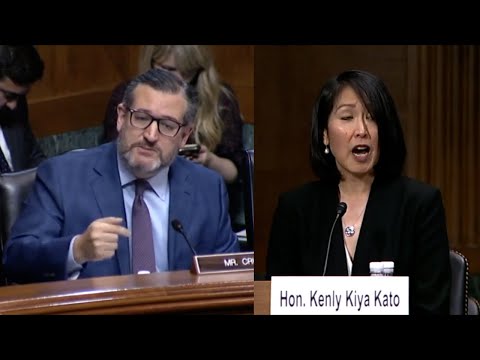
Cruz Confronts Biden Judicial Nominee Over Law Review Article Arguing Asian Americans Must Support Discrimination Against Themselves
On 2/1/2022, Senator Ted Cruz conducted a pointed cross-examination of Biden judicial nominee Judge Cotto during a Senate Judiciary Committee hearing, confronting her with a law review article she had co-written as a law student. Cruz argued the article essentially said that to be “sufficiently woke,” Asian Americans must support policies that discriminate against Asian Americans. The nominee repeatedly refused to say whether she still agreed with what she had written, citing the need for “complete context” — despite having reviewed the article before the hearing.
”Is Racial Discrimination Wrong?”
Cruz opened with a deceptively simple question. “Is racial discrimination wrong?” he asked.
“Senator, our Constitution prohibits race discrimination on the basis of race,” the nominee replied.
“Let me ask again — is racial discrimination wrong?” Cruz pressed.
“Senator, as a judge, I don’t deal with issues of morality or whether something—” the nominee began.
“You have no views on whether it’s right or wrong?” Cruz asked.
The nominee cited Canon 3 of the Code of Conduct for judges, declining to offer a personal view on the morality of racial discrimination.
The Law Review Article
Cruz then turned to a law review book review the nominee had co-written as a 23-year-old Harvard Law student. He read directly from it. The article described the Reagan presidency as “the pinnacle of the counteroffensive launched by the guardians of the status quo” and said that “in the face of institutional resistance, activist movements redirected their focus from liberation to survival.”
“Do you believe there was a threat to the survival of Asian American groups under President Reagan?” Cruz asked.
“Senator Cruz, again, that was a law review book review,” the nominee replied.
“I’m just asking if you agree with the sentiment. You wrote it,” Cruz said.
”Neoconservative” Asian Americans
Cruz then read the article’s definition of an Asian American “neoconservative” — someone with “an opposition to racism” combined with “a commitment to ending affirmative action programs.”
The article stated: “The neoconservative’s narrow vision of success currently threatens to impose divisions within the Asian American community. Emphasizing personal achievement and success as measured by the status quo, the Asian American neoconservative fails to acknowledge the shared history of oppression and then ties their individual success to the survival and liberation of all oppressed peoples.”
Cruz translated the passage. “As I read this, what you’re saying — if you will permit me to use a more common vernacular — you’re saying that to be sufficiently woke, an Asian American must support policies that discriminate against Asian Americans,” Cruz said. “I gotta tell you, that doesn’t make sense. Is my reading of what you wrote incorrect?”
Twenty-Five Years and No Answer
The nominee attempted to distance herself from the article. “Senator Cruz, we are talking about something that I wrote when I think I was a 23-year-old law student,” she said.
“I’m not asking what you thought then,” Cruz responded. “I’m saying today, as you sit here, as the Senate is considering you for a lifetime appointment as a judge, do you agree with what you wrote — that Asian Americans, to be sufficiently liberated, must support discrimination against Asian Americans?”
“Senator, without the complete context of that particular quote that you’ve excised, I cannot give you whether my opinion today — I would have to review the entirety,” the nominee said.
“But you said you did review it before this hearing, right?” Cruz asked.
“Senator, I reviewed it briefly. This was quite some time ago, over 25 years. A very short article — it’s about six pages,” the nominee said.
Harvard’s Discrimination Before the Supreme Court
Cruz connected the nominee’s writing to the active Supreme Court case challenging Harvard’s admissions practices. “As you know, our alma mater is currently before the Supreme Court for its longstanding practice of discriminating against Asian Americans,” Cruz said. “Many top universities across the country have vicious discrimination policies against Asian Americans. They are reminiscent of the quotas against Jews that we saw these same schools impose in the 1950s.”
“These schools believe that Asian Americans have been too successful academically and that if they allow students to compete based on merits, they’d have too many Asian Americans,” Cruz said.
The nominee declined to comment, citing the pending Supreme Court case.
”A Pattern of Nominating Radicals”
Cruz framed the exchange as part of a broader problem. “There is a pattern of this administration nominating political activists and radicals to the bench. And they’ve done it for a year. And it’s highly concerning,” Cruz said.
He also questioned whether the nominee had been coached not to engage. “Senator Grassley asked you about this article you wrote in law school. And your response was, ‘Well, gosh, I haven’t read that.’ Did you not reread it in preparation? Or did the Biden team tell you don’t read it, because you don’t want to answer questions about it?”
“Senator, I read it,” the nominee said.
Key Takeaways
- Cruz confronted a Biden judicial nominee with her own law review article arguing that Asian American “neoconservatives” who oppose affirmative action threaten the community by failing to support “liberation of all oppressed peoples.”
- The nominee refused to say whether racial discrimination was morally wrong, citing judicial canons about not addressing morality.
- She could not say whether she still agreed with what she had written 25 years earlier, despite reviewing the six-page article before the hearing.
- Cruz connected the writing to Harvard’s active Supreme Court case over discrimination against Asian Americans in admissions.
- Cruz accused the administration of “a pattern of nominating political activists and radicals to the bench.”
Transcript Highlights
The following is transcribed from the video audio (unverified — AI-generated from audio).
- Is racial discrimination wrong? Senator, as a judge, I don’t deal with issues of morality.
- You’re saying that to be sufficiently woke, an Asian American must support policies that discriminate against Asian Americans. That doesn’t make sense.
- I’m not asking what you thought then. Today, do you agree with what you wrote — that Asian Americans must support discrimination against Asian Americans?
- Without the complete context of that particular quote that you’ve excised, I cannot give you my opinion today.
- Did the Biden team tell you don’t read it because you don’t want to answer questions about it? Senator, I read it.
- There is a pattern of this administration nominating political activists and radicals to the bench.
Full transcript: 1426 words transcribed via Whisper AI.