 HYGO News
 Witkoff: 12 bunker buster bombs on Fordow, preposterous report; postponed briefing; Impeach Trump
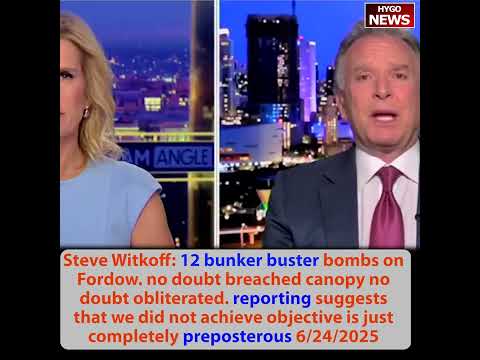
Witkoff: 12 bunker buster bombs on Fordow, preposterous report; postponed briefing; Impeach Trump
Special envoy Steve Witkoff delivered the most detailed public accounting yet of the Iran strikes in an interview that walked through each of the three targeted facilities and explained why the public reporting questioning the operation’s success is, in his words, “completely preposterous.” Witkoff described the Isfahan conversion facility destruction, the Natanz above-ground and below-ground reactor strikes, and the 12 bunker-buster bombs dropped on Fordow. The press reporting that has questioned whether the strikes achieved full destruction, he argued, is the result of leaked intelligence that itself constitutes a major security breach. Meanwhile, Senator Chuck Schumer complained that the administration postponed a classified briefing, and Representative Al Green of Texas filed articles of impeachment against Trump for launching strikes without congressional authorization.
The Leak Condemnation
Witkoff opened with his assessment of the leaks. “Leaking that type of information, whatever the information, whatever side it comes out on, is outrageous. It’s treasonous. Whoever did it, whoever’s responsible for it, should be held accountable.”
The leaks he is referencing are the preliminary Defense Intelligence Agency damage assessments that had been reported by CNN and others. Those preliminary assessments, according to the reporting, suggested that the strikes might have set Iran’s nuclear program back by months rather than the “years” the administration characterized. The assessments were classified. Their appearance in press reports means that someone with access to classified material shared it with reporters.
“Treasonous” is strong language for leak classification. Legally, leaks of classified material are typically charged under the Espionage Act rather than as treason. But Witkoff’s characterization captures the political view that leaks of operational military intelligence, in the immediate aftermath of combat operations, constitute betrayal of the country regardless of the leaker’s political motivation.
The Three Facilities
Witkoff then walked through the targeting. “There are three distinct facilities in Iran that we were concerned with. Isfahan, which is a conversion facility. You cannot weaponize unless you have a what’s called the conversion process at the beginning of enrichment, and then a conversion process to metallicize the material at the end of enrichment.”
The technical distinction is important. Enrichment is only one part of weapons production. Uranium hexafluoride gas, which is what enrichment produces, cannot be directly used in a weapon. It must be converted back to metallic uranium — a process called metallization or re-conversion. That conversion process requires specialized equipment that is distinct from the enrichment centrifuges.
Isfahan
Witkoff continued. “That conversion facility, which as far as we know is the only facility in Iran that can do this, was completely destroyed at Isfahan. It’s above ground. It was hit with a 30,000 pound bunker buster, and it could not survive that hit. So they have no conversion opportunity, and that means they cannot weaponize even if they’ve enriched to 90%.”
The significance is fundamental. Even if Iran retains enriched uranium at 90% purity, it cannot use that material in a weapon without conversion. Conversion requires the Isfahan facility. Isfahan is destroyed. Therefore, enriched uranium alone — even at weapons-grade — cannot be weaponized in the near term.
This changes the damage assessment framework. The question is not “was all enriched uranium destroyed” — the question is “can Iran weaponize what enriched uranium exists.” Witkoff’s answer: no, because conversion is gone.
Natanz
Witkoff addressed the Natanz complex. “Then there are two other nuclear reactors in Natanz, one above ground and one below ground. The below ground one, we know we eviscerated, and the above ground one, which had been hit by the Israelis and had been substantially damaged, we put another bomb on top of it just to make sure that it was eviscerated, and we know for a fact it was.”
The Natanz complex includes multiple enrichment facilities at different levels of burial. The below-ground facility is the deeper, more protected installation. The above-ground facility had already been hit by Israeli strikes before the American operation. Witkoff’s description — that American forces “put another bomb on top of it just to make sure” — reflects the belt-and-suspenders approach to high-value target destruction.
“We know for a fact it was” is Witkoff’s confidence claim. The American intelligence community has, through whatever means, confirmed destruction of both Natanz targets.
Fordow
Witkoff then addressed the most difficult target. “Fordo is the last enrichment reactor that was operating there. We put 12 bunker buster bombs on Fordo. There’s no doubt that it breached the canopy. There’s no doubt that it was well within reach of the depth that these bunker buster bombs go to, and there’s no doubt that it was obliterated.”
12 bunker-buster bombs on a single target is a massive allocation of ordnance. Each GBU-57 Massive Ordnance Penetrator weighs 30,000 pounds. 12 of them represents 360,000 pounds of explosive delivery against a single site. That level of targeting is possible only because the United States has a finite inventory of these weapons and the administration was willing to commit a substantial share to this one target.
”Breached The Canopy”
The “breached the canopy” phrase is technical. The canopy is the rock overburden that protects the underground facility. The GBU-57 is designed to penetrate rock and then detonate at depth. “Breached the canopy” means the penetrators reached through the protective rock layer and detonated within the facility’s operational depth.
”Completely Preposterous”
Witkoff’s summary dismissal of the contrary reporting was direct. “So the reporting out there that in some ways suggests that we did not achieve the objective is just completely preposterous.”
The reporting Witkoff is dismissing is not unserious journalism. It represents interpretation of preliminary Defense Intelligence Agency assessments that, on their own terms, are legitimate intelligence products. But Witkoff is arguing that the preliminary assessments are being misinterpreted or are being weighted in ways that contradict the broader operational reality.
The broader reality, in his telling, is that the conversion facility is destroyed, both Natanz reactors are destroyed, and Fordow received 12 bunker-busters with confirmed canopy breach. Given those three confirmed outcomes, suggestions that the operation failed are — in Witkoff’s word — preposterous.
Schumer’s Complaint
Senator Chuck Schumer, receiving the same reporting Witkoff was dismissing, used the reporting to attack the administration. “What is the administration so afraid of? Why won’t they engage with Congress on the critical details, the results of the recent strike, the scope and trajectory of this conflict? Such obstruction undermines the very principles of accountability and oversight that guard our democracy.”
The Schumer framing is that the administration is hiding something. If the strikes were as successful as the administration claims, why wouldn’t the administration fully engage with Congress on the details? The postponement of a scheduled classified briefing, in Schumer’s framing, suggests that what the administration does not want to share is information that would not support its public characterization.
The Postponed Briefing
Schumer pressed the point. “So Mr. President, if the press reporting about the impact of last weekend strikes in Iran is true and I cannot confirm them, then that might be the reason why the administration postponed our classified briefing today at the very last minute and deprived senators of their right to know what’s happening. So I ask again, what is the administration hiding? It’s time for answers.”
The postponement of the classified briefing has a competing explanation. Classified briefings are scheduled when briefing content is ready. If the assessment is still being refined, if new intelligence is arriving, if the briefing materials are still being finalized, postponement is a legitimate operational choice. The administration’s framing would be that the briefing was postponed because the relevant information is still being assembled, not because the information is being hidden.
Both explanations — Schumer’s and the administration’s — are consistent with the postponement. Which is accurate depends on what actually emerges when the rescheduled briefing occurs.
Al Green’s Impeachment Articles
The video closed with Representative Al Green of Texas announcing articles of impeachment. “HR 537 has been filed because I believe that the President of the United States has committed an impeachable act. So I today announce that later today I will bring these articles of impeachment to the floor and I will call for a vote.”
Al Green has been a persistent advocate for impeachment across both Trump terms. His willingness to file articles is consistent with his stated positions over years. The filing itself is procedural — articles can be filed by any member — but the vote it triggers becomes a political event.
”The Hour Of Decision”
Green’s framing elevated the significance. “I believe that the hour of decision is upon us and we all have to decide. Are we going to go down and choose the path of democracy or we allow ourselves to choose the low road of autocracy? I believe that this country has come too far to allow a single person to declare war without conferring with the Congress of the United States of America.”
The framing is the constitutional argument. The Constitution’s allocation of war-declaring authority to Congress is the foundation of Green’s impeachment case. Trump, by executing strikes without congressional authorization, has — in Green’s view — exceeded the scope of Article II authority.
The counter-argument, which the administration has repeatedly made, is that Article II authorizes limited military operations without prior congressional approval and that the Iran strikes fall within that scope. The War Powers Resolution, which attempts to constrain presidential authority, has been disputed as constitutional by presidents of both parties since it was passed in 1973.
”This Is Where I Stand”
Green closed personally. “This is where I stand. This is what I will do and I do it in the name of my country that I love dearly.”
The personal framing — where he stands, what he will do, in the name of country — is the politician’s standard close for a major announcement. Green wants the impeachment articles to be read not as partisan gamesmanship but as principled constitutional defense.
The Vote Math
Whether Green’s impeachment articles produce a vote, and whether that vote produces anything meaningful, depends on Democratic leadership’s handling. Hakeem Jeffries has generally declined to schedule impeachment votes during Republican majorities. Symbolic impeachment votes that cannot succeed procedurally generate news without producing political results.
Green’s filing is therefore the beginning of a political event. Whether it becomes a formal House vote, and whether that vote reveals the Democratic caucus’s actual appetite for impeachment, are questions that Jeffries will answer in the coming days.
The Policy Substance Versus The Political Theater
The video captures the simultaneous tracks of policy substance and political theater. Witkoff’s detailed technical accounting of the strikes is policy substance — the specific targets, the specific munitions, the specific destruction. Schumer’s complaints about postponed briefings and Green’s impeachment articles are political theater — moves designed to generate news coverage rather than to affect policy outcomes.
Voters watching both tracks form their own judgments. Voters who attend to policy substance will hear Witkoff’s detailed accounting and conclude that the strikes worked. Voters who attend to political theater will hear Schumer and Green and conclude that the administration is hiding something or acting unconstitutionally.
The administration is betting that the first group of voters is larger than the second.
Key Takeaways
- Witkoff on Isfahan: “The only facility in Iran that can do [conversion], was completely destroyed at Isfahan…they cannot weaponize even if they’ve enriched to 90%.”
- On Natanz: “The below ground one, we know we eviscerated, and the above ground one…we put another bomb on top of it just to make sure.”
- On Fordow: “We put 12 bunker buster bombs on Fordo. There’s no doubt that it breached the canopy…there’s no doubt that it was obliterated.”
- Witkoff’s verdict on contrary reporting: “The reporting out there that in some ways suggests that we did not achieve the objective is just completely preposterous.”
- Rep. Al Green: “HR 537 has been filed because I believe that the President of the United States has committed an impeachable act…I will bring these articles of impeachment to the floor.”