 HYGO News
 Wiles on Trump's cabinet: amazing group; Germany to import more US LNG; Trump: Harvard masks
Wiles on Trump’s cabinet: amazing group; Germany to import more US LNG; Trump: Harvard masks
Chief of Staff Susie Wiles offered her assessment of the Trump cabinet — “five published authors, seven billionaires, eleven lawyers, a couple of minorities, a Democrat or two” — and characterized the team as producing “not one who I would say is not a complete success.” Germany announced it would increase American LNG imports, making the United States Germany’s largest LNG supplier weeks after Trump specifically encouraged European purchases. Trump addressed a proposed Democratic bill from Senators Booker and Padilla that would require ICE and CBP officers to display legible IDs and not cover their faces — noting that protesters at Harvard and Columbia regularly wear masks without Democratic objection, but ICE officers wearing masks for safety draws specific Democratic criticism. And Democratic Rep. LaMonica McIver was arrested for assaulting an ICE agent.
Wiles’s Cabinet Assessment
Wiles opened with a specific anecdote. “I was sitting in a cabinet meeting one day and they do tend to go on a while. And so I was jotting down in my notebook how I saw the cabinet. These numbers are wrong but order of magnitude correct. Five published authors, seven billionaires, eleven lawyers, a couple of minorities, a Democrat or two.”
The Wiles inventory captures the specific character of the Trump cabinet. Published authors — cabinet officers who have written books, presumably on their specific policy areas or on their broader political philosophy. Billionaires — cabinet officers with substantial personal wealth accumulated through business activity. Lawyers — cabinet officers with legal training. Minorities — cabinet officers from non-majority ethnic backgrounds. Democrats — cabinet officers who identify or have identified with the Democratic Party.
Why The Inventory Matters
The inventory matters because it captures breadth beyond the conservative-Republican stereotype. Critics often characterize Trump’s cabinet as homogeneously Republican and ideologically uniform. Wiles’s inventory suggests a more diverse team — with specific representation from different categories.
“A Democrat or two” is particularly important. Trump has appointed specific Democrats to cabinet positions — Tulsi Gabbard as DNI (a Democrat who became independent and then aligned with Trump), RFK Jr. as HHS (a lifelong Democrat who ran for president as a Democrat before endorsing Trump), and various others. That cross-partisan appointment pattern reflects what Wiles describes.
”An Amazing Group Of People”
Wiles’s characterization. “It is an amazing group of people that he put together.”
The framing counters critical characterizations of the cabinet as weak or inexperienced. Wiles, who has worked with the cabinet daily for six months, has specific firsthand knowledge of its members’ capabilities. Her assessment is not political spin from outside — it is operational judgment from inside.
RFK Jr.
Wiles specifically highlighted Robert F. Kennedy Jr. “What Bobby Kennedy has done, the president took some criticism. Not so much for Bobby but what has he run before? And he has recruited a team that’s unparalleled.”
The framing addresses the criticism Kennedy faced at appointment. RFK Jr. had not previously run a major government agency or a large private organization. Critics questioned whether he had the management experience to lead HHS, which is one of the largest federal departments by budget.
Wiles’s observation is that Kennedy has produced specific management outcomes. He has recruited a team at HHS that, in Wiles’s characterization, is “unparalleled.” That team has been executing the administration’s health policy priorities — the food quality initiatives, the medical research reforms, the pharmaceutical pricing reforms, and others.
“He’s doing great” is the operational verdict. Whatever concerns existed at appointment, Kennedy has, in Wiles’s view, succeeded in his role.
Rollins, McMahon, Rubio
Wiles continued with specific cabinet members. “Brooke Rollins is doing great. Linda McMahon has an impossible job that she’s done with Great Grace. Marco Rubio was born for this. Just been quickly assimilated over here in his NSC position.”
Rollins — Agriculture Secretary whose work on the Big Beautiful Bill’s farm provisions and the Farm Security Action Plan has been visible. “Doing great” captures her operational success.
McMahon — Education Secretary whose mandate from Trump is to eliminate her own department by returning education authority to states. “An impossible job that she’s done with Great Grace” captures both the difficulty of the assignment and McMahon’s specific handling of it.
Rubio — Secretary of State with the additional NSC role. “Born for this” captures Rubio’s specific fit with the Secretary of State position. His Senate career, his foreign policy work, his specific regional expertise — all align with what the position requires.
”Not One Who I Would Say Is Not A Complete Success”
Wiles’s broader verdict. “It really, there’s not one I would, who I would say is not a complete success in what they’re doing in their area.”
“Not one” is a comprehensive claim. Every member of the cabinet, in Wiles’s assessment, has succeeded in their specific area. No weak links. No failures. No specific cabinet officers who have produced outcomes that have disappointed.
Whether the assessment survives scrutiny depends on the specific standards used. Different critics would apply different standards. Wiles’s standards, which reflect her specific working relationship with the cabinet, are what she reports.
The German LNG Deal
The video pivoted to energy news. “There is some non-OPEC related energy news today. Venture Global, publicly traded VG, making a deal with Germany. The U.S. would be the largest exporter of liquefied natural gas to Germany on the back of that deal.”
Venture Global LNG is one of the major American liquefied natural gas exporters. Its specific deal with Germany establishes a long-term supply relationship that makes the United States Germany’s largest LNG supplier.
The strategic significance is substantial. Germany had historically depended on Russian pipeline gas. After the 2022 Russian invasion of Ukraine, Germany had committed to reducing that dependency. The transition required alternative supplies. American LNG, transported by tanker rather than pipeline, provides the supply alternative.
Why The Germany LNG Deal Matters
The deal serves multiple strategic purposes.
American export revenue — LNG exports produce substantial trade revenue and reduce the American trade deficit with Europe.
European strategic independence — Germany is less dependent on Russian gas, reducing Russian strategic leverage over European decision-making.
Bilateral ties — The supply relationship deepens economic ties between the United States and Germany, reinforcing the broader Atlantic alliance.
Climate framework — LNG has lower carbon emissions than coal, so LNG replacement of coal-fired power generation produces specific emissions reductions despite the natural gas’s carbon content.
Each benefit flows from the specific deal. The administration’s broader energy diplomacy — which includes similar engagement with other European partners — produces cumulative outcomes that the specific Germany deal captures.
Booker And Padilla’s Bill
The video then pivoted to a legislative development. “Two Democratic senators now, Cory Booker and Alex Padilla, have a new bill out. They want to require CBP and ICE officers to have legible IDs and they don’t want CBP or ICE officers covering their faces. Would you ever sign that?”
The specific bill targets ICE and CBP operational security. The bill would require officers to display legible IDs and would prohibit them from covering their faces during operations. The premise is that masking reduces accountability.
Padilla’s inclusion in the bill is notable — he was the senator who had been physically restrained after charging Noem’s press conference. His interest in legislation constraining ICE operational security reflects the broader Democratic posture toward federal immigration enforcement.
”They Obviously Do Hate Our Country”
Trump’s response. “Be saying that if they didn’t hate our country, they obviously do. I’m surprised that they would do it.”
“They obviously hate our country” is Trump’s characterization of the motivation for the bill. The framing is harsh but captures the view that legislation constraining federal law enforcement reflects specific hostility to American institutional capacity.
“I’m surprised that they would do it” reflects Trump’s specific reaction. Even accepting the general Democratic hostility to ICE enforcement, specific legislation that would expose ICE officers to physical danger is a specific escalation that goes beyond rhetorical opposition.
”These Officers Are Doing A Tremendous Job”
Trump’s specific defense of ICE officers. “These officers are doing a tremendous job. They’re great patriots. If you expose them because of, you know, statements like have been made by Democrats and others on the left, usually mostly, I think probably exclusively, you put them in great danger, tremendous danger.”
The specific concern is operational safety. Federal enforcement officers who conduct specific operations against specific individuals face risk from those individuals’ associates, from broader political movements hostile to their work, and from individuals who may act on rhetoric characterizing ICE as enemies.
Masking reduces that risk. Officers whose faces are not visible cannot be identified by hostile actors who might target them outside their work hours. Their families — who live at specific addresses that could be targeted — are protected by the anonymity that masking provides.
The Booker-Padilla bill would remove that protection. Officers would be identifiable. Their identification would enable targeting. The physical safety of officers and their families would be reduced by the specific legislation.
The Harvard And Columbia Comparison
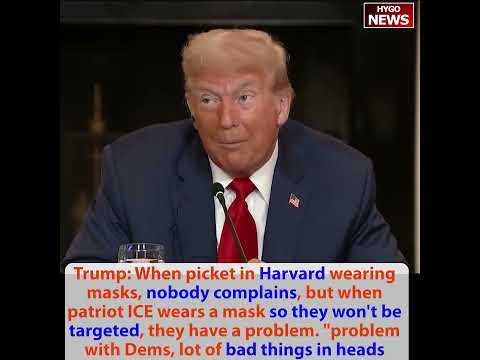
Trump offered the hypocrisy framing. “And it’s sort of funny when people pick it in front of Columbia, in front of Harvard and they have masks on, more than masks. I mean, you can’t see anything. Nobody complains about that.”
The comparison captures the specific hypocrisy. Pro-Palestinian protesters at Harvard and Columbia — and at other universities across the country — have routinely worn masks during their protests. Those masks serve specific purposes — preventing identification for employment purposes, preventing facial recognition by security systems, potentially enabling illegal activity without identification.
Democratic political commentary has not objected to the protester masking. Democratic politicians have not introduced legislation requiring protester faces to be visible. Democratic media outlets have not characterized protester masking as hypocritical.
”But When Patriots Who Work For ICE Put A Mask On”
Trump continued. “But when Patriot, who works for ICE or Border Patrol, puts a mask on so that they won’t recognize him and his family, so they can lead a little bit of a normal life after having worked so hard and so dangerously, there’s a problem with that.”
The contrast is the hypocrisy claim. Protesters wearing masks for their specific purposes is acceptable. ICE officers wearing masks for their specific purposes is not. The same action — face covering — is evaluated differently based on who is doing it.
“So they can lead a little bit of a normal life after having worked so hard and so dangerously” captures the specific stake for officers. These are federal employees who work dangerous jobs. After work, they try to live normal family lives. Masking during work enables that normal family life by preventing work identifications from following them home.
”Lost Their Confidence”
Trump’s broader political framing. “This is the problem with the Democrats. They have a lot of bad things going on in their heads. They’ve lost their confidence, number one. They’ve become somewhat deranged.”
“Lost their confidence” is a psychological diagnosis. Democrats, in Trump’s framing, are no longer politically confident in their positions. The confidence collapse produces specific behavior that does not serve their interests.
“Become somewhat deranged” is the stronger characterization. Beyond mere loss of confidence, Democrats have moved into specific irrationality. Their policy positions and political strategies no longer connect to actual voter preferences or actual institutional interests.
”Right At The Top Of The List”
Trump’s commitment. “I want to do whatever’s necessary to protect our great law enforcement people, and they are right at the top of the list.”
“Right at the top of the list” captures the specific priority. Protection of law enforcement officers is not a secondary concern for the administration. It is a primary concern that will drive specific policy decisions.
The administration’s position is that bills like the Booker-Padilla legislation, even if they pass Congress, will be vetoed. The veto threat is specific. Legislation that reduces officer safety will not receive Trump’s signature.
The McIver Arrest
The video then pivoted to the Democratic response to enforcement. “Democrat Rep. LaMonica McIver was arrested for ASSAULTING an ICE agent.”
The specific incident involved Rep. LaMonica McIver, a Democratic Congresswoman from New Jersey, being arrested for assault on an ICE officer during an enforcement operation. McIver had been at the scene of an operation in her district and had physically engaged with federal officers conducting enforcement activity.
The Democratic Framing
The Democratic response captured the specific framing. “Democratic lawmakers are standing up to bear witness and to say that this is unacceptable. And what has DHS done in response? Manhandle, assault, and arrest members of Congress, elected officials.”
The framing characterizes McIver’s physical engagement with ICE as “bearing witness” rather than as assault. The DHS response — charging McIver with assault — is characterized as “manhandling” elected officials.
The specific characterization requires treating McIver’s actions as legitimate oversight rather than as illegal obstruction. Members of Congress have specific institutional authority to observe federal operations. They do not have authority to physically interfere with those operations.
”Manhandle, Assault, And Arrest”
The specific Democratic characterization. “In New York, DHS agents arrested a member of Representative Jerry Nadler’s staff and New York City Comptroller Brad Lander in separate incidents, both of which were connected to these alarming immigration court arrests.”
The additional examples captured broader Democratic resistance. A Nadler staffer was arrested in one incident. New York City Comptroller Brad Lander was arrested in a separate incident. Both arrests involved specific interference with federal enforcement activities.
The Democratic framing places all these arrests in the same category — elected officials being wrongfully targeted by the administration. The administration’s framing places them in the category of specific individuals who obstructed specific federal operations.
”Just When You Think”
The Democratic rhetorical close. “Just when you think that this administration cannot sink any lower, they get out of shovel and keep digging.”
The framing is characteristic of Democratic political rhetoric against the administration. Each specific action is characterized as worse than the previous one. The administration, in this framing, continuously finds new depths of bad behavior.
The administration’s counter is that federal law enforcement is doing its lawful job. Obstructing that lawful job — whether by members of Congress, staff, or other officials — is what produces the specific arrests. The fault lies with those who obstruct, not with the officers who respond to obstruction.
The Broader Pattern
The Booker-Padilla bill, the McIver arrest, the Nadler staffer arrest, the Lander arrest — all fit a broader pattern. Democratic elected officials and staff are increasingly engaging in specific obstruction of federal immigration enforcement. That obstruction produces specific consequences — arrests, charges, potential prosecutions.
The pattern reflects the deeper political conflict. One side of American politics views federal immigration enforcement as legitimate law enforcement that must be supported. The other side views it as improper targeting of vulnerable populations that must be resisted. Those two views cannot be reconciled. The conflict produces specific incidents that accumulate over time.
Key Takeaways
- Wiles on the cabinet: “Five published authors, seven billionaires, eleven lawyers, a couple of minorities, a Democrat or two. It is an amazing group of people.”
- Germany LNG deal: “The U.S. would be the largest exporter of liquefied natural gas. To Germany on the back of that deal.”
- Trump on Harvard vs. ICE masks: “When people picket in front of Columbia, in front of Harvard and they have masks on…Nobody complains about that. But when Patriot, who works for ICE or Border Patrol, puts a mask on…there’s a problem with that.”
- Trump on Democrats: “They have a lot of bad things going on in their heads. They’ve lost their confidence, number one. They’ve become somewhat deranged.”
- The McIver arrest: “Democrat Rep. LaMonica McIver was arrested for ASSAULTING an ICE agent.”