 HYGO News
 'Why Do You Not Know?', How Involved Kamala, 100% Vet, Hawley Grills Mayorkas
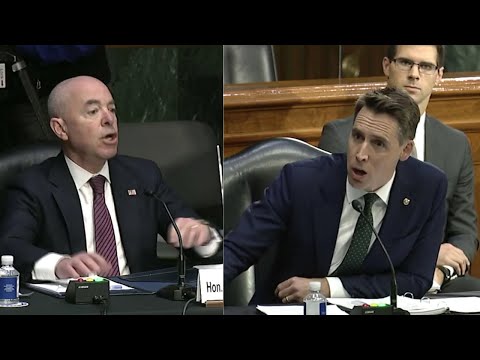
Hawley Grills Mayorkas: Harris “Not Directly” Involved in Border Policy, Afghan Vetting Falls Short of 9/11 Commission Standards
On November 16, 2021, Senator Josh Hawley (R-MO) subjected Department of Homeland Security Secretary Alejandro Mayorkas to a pointed interrogation during a Senate Judiciary Committee hearing that exposed three significant vulnerabilities in the Biden administration’s position. First, Hawley revealed that Vice President Kamala Harris had not been “directly” involved in DHS’s key policy decisions despite being designated to address the “root causes” of migration nearly eight months earlier. Second, Mayorkas admitted that the government was not conducting in-person interviews of all Afghan evacuees brought to the United States, contradicting his claim that “100 percent” had been screened and vetted. Third, Hawley pressed Mayorkas on his earlier testimony to Senator Cruz that paying illegal immigrants $450,000 would “not be a pull factor” for future illegal immigration.
Harris: “More Than a Handful” of Meetings in Eight Months
Hawley opened by reminding Mayorkas of President Biden’s March 2021 announcement designating Harris to address the border crisis. Biden had called Harris “the most qualified person” to help in “stemming the movement of so many folks, stemming the migration to our southern border.”
“Do you report to her?” Hawley asked Mayorkas directly.
Mayorkas pushed back on the framing: “Senator, I report to the vice president and the president, and your question misstates the facts. The president did not appoint the vice president to be the border czar. He asked her to lead the effort in addressing the root causes of irregular migration. Those are two very different things.”
Hawley zeroed in on the distinction Mayorkas was drawing. “So is she working closely with you on that important endeavor? How often do you meet with her?”
Mayorkas offered a vague response: “I am certainly in close touch with the vice president.”
When Hawley pressed for specifics, the answer was revealing. “I’ve met with the vice president more than a handful of times,” Mayorkas said.
“More than a handful? Well, so what’s that, six or seven times in the last year?” Hawley replied. Mayorkas corrected the timeline — he had not been in office for a full year — but could not provide a more specific number.
Hawley then asked whether Harris had been involved in any of the department’s major policy changes: ending the Remain in Mexico policy, ending the public charge rule, or changing ICE enforcement guidance. Mayorkas’s answer was direct: “I have not consulted with the vice president directly about those policies.”
The admission created a paradox that Hawley was quick to highlight: “You said she’s not the border czar. That’s not her role. We’re wrong about that. She’s not doing anything like that. She’s doing something very different, is what your testimony is, but you’re not actually consulting with her on any policy. So what is it that she’s doing, exactly?”
Mayorkas fell back on a formulation he had used throughout the hearing: “Senator, as I have repeatedly testified, she is focused on addressing the root causes of irregular migration in the context of the migration channels.”
The exchange left unresolved the question of what concrete actions Harris had taken in her border-related role and why, if she was addressing root causes, the DHS secretary responsible for border security had met with her only “more than a handful” of times in eight months.
”100 Percent Screened and Vetted” — But Not Interviewed
The most explosive portion of the exchange involved Afghan evacuees. More than 60,000 Afghans had been brought to the United States following the chaotic August 2021 withdrawal from Afghanistan. Mayorkas had testified repeatedly that the government had “rigorous screening and vetting in place” for all evacuees.
Hawley pressed on what “rigorous” actually meant. “For those who got on the C-17s and other planes, how many were vetted before they got on the plane by American officials?”
Mayorkas responded: “It is our policy to vet and screen 100 percent of them.”
Hawley pushed for facts rather than policy statements: “So 100 percent of those people that got on the plane were vetted. That’s your testimony under oath?”
“It is our policy to do so,” Mayorkas repeated.
“I don’t care what your policy is. I’m asking how many people were vetted before they got on the plane. Do you know the answer?” Hawley said.
Mayorkas conceded: “Senator, I do not know.”
Hawley then shifted to the specific screening procedures being used. He asked whether all evacuees were receiving in-person interviews, which is the standard refugee screening procedure recommended by the 9/11 Commission.
Mayorkas admitted the interviews were not universal: “You are correct that we are not conducting in-person full refugee interviews of 100 percent of the individuals.”
“What percentage are you conducting?” Hawley asked. “I don’t have that information,” Mayorkas replied.
“What number have been interviewed?” Hawley pressed. Again, Mayorkas could not provide a figure: “When you’re speaking of a full refugee-like interview, I don’t have that data.”
Hawley was incredulous: “Why don’t you have it? You run the Department of Homeland Security. Why do you not know who has been interviewed or not before they’re brought to this country?”
The 9/11 Lesson: Only One Hijacker Was Interviewed
Hawley drove his point home with a reference to the September 11 attacks that reframed the entire debate around national security rather than immigration policy.
“Do you know how many of the hijackers were given an in-depth interview?” Hawley asked Mayorkas.
“I do not,” Mayorkas answered.
“One,” Hawley said. “The answer is one. That person did not enter the country. The others were not given an interview. We know the outcome.”
Hawley continued: “For that reason, the 9/11 Commission recommended in-person interviews for all refugees and others brought to this country in these circumstances. That was 20 years ago. That’s why the standard procedure is an in-person interview for refugees or visa applicants.”
He then delivered his conclusion: “The fact that you are not conducting the most standard interviews for tens of thousands of people brought to this country is astounding to me. And it seems to me you’ve not learned the most basic lessons that we learned on 9/11 since then. And the security risk is unbelievable.”
Mayorkas attempted to defend the process by noting that biographic and biometric information was being captured, and that individuals flagged for concern were not brought to the United States. But he could not bridge the gap between his claim of “rigorous” screening and his admission that the most fundamental screening tool — an in-person interview by a trained official — was not being applied to all evacuees.
The $450,000 Pull Factor Revisited
Hawley also revisited Mayorkas’s earlier exchange with Senator Ted Cruz regarding the proposed $450,000 payments to illegal immigrants separated under the Trump administration’s zero tolerance policy. Hawley confirmed the headline testimony: “To Senator Cruz, I think you just said that your view is that paying illegal immigrants $450,000 or more — million, more per family — that that is not a pull factor.”
Mayorkas stood by his position: “The settlement payment of the federal tort claims arising from family separation affected under the prior administration’s zero tolerance policy would not be a pull factor. That is my testimony.”
Hawley highlighted the significance: “I think that’s news that you think that these payments to illegal immigrants would not be a pull factor, would not — that paying them would not encourage more illegal immigration. That’s news.”
The exchange underscored the political implications of Mayorkas’s testimony. By framing the payments as legal settlements rather than incentives, Mayorkas was attempting to separate them from the broader immigration debate. But critics argued that the distinction between a legal settlement and a reward was meaningless to prospective migrants who would see only that the United States was paying hundreds of thousands of dollars to people who had crossed the border illegally.
The Pattern of “I Don’t Know”
The hearing revealed a pattern that had characterized Mayorkas’s Senate testimony throughout 2021. On the Harris question, he could describe her role in abstract terms but could not point to specific policy involvement. On Afghan vetting, he could cite the policy of 100 percent screening but could not say how many people had actually been interviewed. On the $450,000 payments, he could offer a legal justification but could not address the practical incentive effects.
Hawley’s repeated question — “Why do you not know?” — captured the frustration that Republican senators expressed throughout the hearing: that the head of the Department of Homeland Security could not provide basic operational data about the department’s most consequential decisions.
Key Takeaways
- Mayorkas admitted he had not consulted with Vice President Harris “directly” on key DHS policy changes including ending Remain in Mexico, ending the public charge rule, and changing ICE guidance, despite Harris being designated to address migration root causes eight months earlier — and could only say he had met with her “more than a handful of times.”
- Mayorkas claimed “100 percent” of Afghan evacuees were screened and vetted but admitted the government was not conducting in-person interviews for all of them, could not provide the percentage or number who had been interviewed, and acknowledged the process “deviates” from standard refugee screening procedures recommended by the 9/11 Commission.
- Hawley noted that only one of the 9/11 hijackers received an in-depth interview — and that person did not enter the country — arguing that Mayorkas had “not learned the most basic lessons” of September 11 by failing to interview tens of thousands of Afghan evacuees before bringing them to the United States.