 HYGO News
 Wholesale prices flat, below expectations, very good news; Trump welcomes Crown Prince & PM Bahrain
Wholesale prices flat, below expectations, very good news; Trump welcomes Crown Prince & PM Bahrain
The June Producer Price Index landed flat — unchanged — against economist expectations of a 0.2% increase, and year-over-year headline PPI came in at 2.3%, two-tenths below the 2.5% consensus. Core readings were cooler still. The data directly rebuts the most common pre-tariff warning from Wall Street and academic economists: that expanded tariffs would produce a measurable wholesale-price surge. Trump welcomed the Crown Prince and Prime Minister of Bahrain to the White House for bilateral discussions. LA Mayor Karen Bass declared victory after 2,000 National Guard troops were pulled from the city — even though the troops had been deployed to restore order after riots she had failed to contain — framing the de-escalation as “we won.” And Florida Democratic State Rep. Anna Eskamani called ICE arrests of criminal illegal aliens “political theater” while asserting detainees are being denied due process and “racially motivated” profiling is driving enforcement.
The PPI Report: “Unchanged”
The monthly Producer Price Index is the cleanest wholesale-inflation signal in the U.S. data suite. It measures prices received by domestic producers before goods reach consumers. A cool PPI is a leading indicator that consumer prices will follow cool — or at least will not surge.
“For the month of June, PPI comes in unchanged,” the reporter said. “Unchanged, we’re expecting up two tenths. Unchanged would be the smallest inflationary wholesale increase in it since it was minus one tenth in March of this year.”
“Unchanged” when the market expected +0.2% is a meaningful miss — the kind of miss that moves bond yields, adjusts Fed expectations, and reframes the inflation debate for the next data cycle.
Core: “Zero”
The core reading — PPI excluding food and energy — was cooler still. “Strip out food and energy, it remains zero. Unchanged, zero. That would once again, that would come towards April when we were minus two tenths, which by the way was lowest inflation rate going all the way back to April of 2020.”
Zero core PPI is unusual. The core measure is designed to strip out the volatile components that cycle quickly — food and energy — to reveal underlying wholesale inflation. A zero reading indicates that the underlying pricing dynamic is flat, not merely that a one-off category has pulled the headline number down.
The April 2020 reference point — the last time the series hit minus two-tenths — is a specific moment. That was the depth of the COVID-era deflationary shock, when demand collapsed across sectors and producers slashed prices to clear inventory. For current PPI to print readings comparable to that moment, without a demand shock, is notable.
Super-Core: Also Unchanged
“If we strip out food, energy and trade, unchanged, unchanged, that also would come towards April of this year.”
“Super-core” PPI — excluding food, energy, and trade services — is the measure that economists follow most closely for signals about underlying services inflation. It too printed unchanged. That is three cuts of the PPI data, all showing the same signal: wholesale pricing pressure is absent.
The Year-Over-Year Picture
“Now, let’s take a bigger view, year over year. Year over year headline expected 2.5 comes in two tenths light, 2.3%. That would be the lightest in the way back machine going to September of last year.”
Annual PPI at 2.3% — two-tenths below expectations and the lightest reading in nine months — is a clear downward trend relative to the anxiety that characterized the inflation debate throughout the early part of 2025.
“If we strip out food and energy, up 2.6 a tenth light, and that is four tenths less rear view mirror, which was up 3%, that 2.6, well we have to go back to July of last year, one year, and that was 2.6, find a lower number, you’re in April of 24.”
Annual core PPI at 2.6% — a four-tenths deceleration from the prior reading. The last time core PPI printed this low was July of the prior year; to find a lower reading, one has to go back to April 2024.
”All Very Good News”
“And finally, the year over year, ex food, ex energy, ex trade, 2.5%, two tenths lighter than 2.7, 2.5, way back machine, you’re equally where we were in November of 23. To find a lower number, you’re in February of 21.”
“Now that is all very good news, these numbers are less than expectations, they’re sequentially less.”
“Sequentially less” is the economist’s compact phrasing for “each successive reading is lower than the prior one.” That is the defining pattern of the current inflation data — not just below expectations in any given month, but declining from one month to the next. Fed policy decisions key off that kind of pattern more than they key off any single reading.
The Political Framing
The administration and its allies seized on the PPI report as direct vindication of the tariff policy. The argument Treasury Secretary Scott Bessent and others have been making — that Wall Street and academic economists got the price-level prediction wrong on tariffs — is now supported by the actual data rather than by contrarian projection.
That does not resolve the academic debate permanently. Tariff pass-through can show up with lags, and some analysts argue that the full effect of the expanded tariff schedule will only be visible in the second half of 2025 as inventory layers imported at pre-tariff costs are exhausted. But for the current cycle, the data is running cooler than the consensus forecast called for, and the administration’s political argument is on solid statistical footing.
Bahrain at the White House
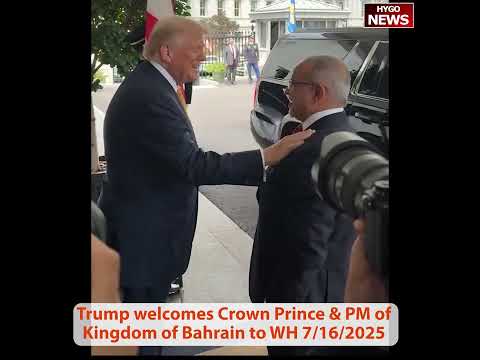
Trump welcomed the Crown Prince and Prime Minister of the Kingdom of Bahrain to the White House. Bahrain is a small but strategically important Gulf ally — home to the U.S. Fifth Fleet’s headquarters, a participant in the Abraham Accords, and a consistent American partner in Gulf security architecture.
The bilateral visit is the kind of working diplomatic engagement that does not always produce headline deliverables but that knits the relationship at the personal level between leaders who will rely on each other in regional contingencies. Trump’s second-term Middle East posture — ongoing engagement with Saudi Arabia, Israel, the UAE, Bahrain, and selective pressure on Iran — runs through exactly this kind of Crown-Prince-and-PM meeting.
Bass: “We Won”
Los Angeles Mayor Karen Bass declared victory after the federal government pulled 2,000 National Guard troops out of the city. “Hello Los Angeles, we had a major victory today. After standing strong, Angelinos were united. The peaceful protests, the just egregious situation that has been going on in the city, we’ve been notified that 2,000 troops are leaving, they are retreating. We stood strong, we peacefully protested, we demanded that the troops were not needed here and we want.”
The framing is exactly backwards on the predicate. The National Guard was deployed because Bass’s municipal authorities had lost control of the streets during anti-ICE riots. The federal troops stabilized the situation. Their withdrawal reflects that stability has been achieved, not that the protests against ICE succeeded.
“We won” is political framing for an audience that will not parse the sequence. The troops are leaving — so, in Bass’s narrative, Los Angeles won. That the winning was enabled by the arrival of federal forces in the first place is elided.
“Retreating” is the word Bass chose. Troops deployed to restore order, having restored order, do not retreat. They redeploy. The semantic choice is deliberate — “retreating” frames the outcome as a defeat for the federal posture rather than as a successful de-escalation.
Eskamani: ICE Arrests as “Political Theater”
Florida State Rep. Anna Eskamani took a different tack. “I want to just affirm this point about how the overwhelming majority of those being detained have no criminal background, because it doesn’t start at this everglades detention center, it actually starts to your point when folks get pulled over for small traffic violations, end up in a local jail under an ice hold, have no ability to seek due process.”
The “Everglades detention center” reference points to the Florida detention facility the state is standing up for ICE. Eskamani is arguing that the pipeline into that facility begins with minor traffic violations rather than criminal offenses — that individuals with no criminal history are being funneled through a system designed to process them toward removal without adequate due-process protection.
“And the reality is that a lot of these folks don’t have the money to even afford an attorney. And so you’re creating an environment that is racially motivated that is not going to keep anyone more safe because you’re pulling law enforcement away from their actual jobs of going after a violent crime. All for what? A political theater?”
The “Political Theater” Framing
Labeling ICE enforcement “political theater” is a specific rhetorical choice. It characterizes the operations as performance rather than as substantive law enforcement. The argument: the visible enforcement actions are designed to signal political posture, not to actually improve public safety.
That framing depends on the claim that detainees have “no criminal background.” The administration’s position is that criminal aliens — individuals with prior deportation orders, prior convictions, or outstanding warrants — constitute a substantial share of the detention population, and that the rest have immigration violations that are themselves the predicate for their removal.
Both framings have a factual basis. The detention population is genuinely mixed. Different jurisdictions and different operational phases produce different ratios of criminal to non-criminal detainees. Eskamani’s framing emphasizes the non-criminal portion. The administration’s framing emphasizes the criminal portion. The full data reveals both.
”Pulling Law Enforcement Away”
Eskamani’s final argument is the resource-allocation claim. Devoting law enforcement capacity to civil immigration enforcement, in her framing, draws those resources away from “going after a violent crime.” That is the same argument Virginia gubernatorial candidate Abigail Spanberger has been making.
The counter-argument is that violent crime by criminal aliens is itself one of the categories ICE enforcement is addressing. The two are not parallel — they overlap. Removing criminal aliens is, in the administration’s framing, violent-crime enforcement via a different institutional lane.
A Day of Data
The day’s spine is the PPI data. Wholesale prices flat when economists predicted an increase, with core readings even cooler, and the trend sequentially declining. That is the kind of data point around which a policy argument gets made durable. The administration’s tariff policy — frequently predicted to drive inflation — continues, month after month, to not drive it in the aggregate indices.
Bahrain diplomacy, Bass’s framing of the National Guard withdrawal, Eskamani’s “political theater” charge — each runs in its own lane. The PPI is the one that will echo in bond markets, Fed futures, and monetary policy conversations for the rest of the month.
Key Takeaways
- June PPI came in flat (unchanged) against consensus expectations of +0.2%, with core (ex food/energy) at zero and year-over-year headline at 2.3% — two-tenths below the 2.5% expected and the lightest reading since September.
- Core year-over-year PPI at 2.6% was four-tenths below the prior 3.0% reading — “to find a lower number, you’re in April of 24.”
- The data undermines the pre-tariff prediction that expanded duties would produce a substantial wholesale-price surge: “these numbers are less than expectations, they’re sequentially less.”
- Mayor Karen Bass declared “we won” after 2,000 National Guard troops were pulled from LA — framing their withdrawal as “retreating” despite the troops having been deployed to stabilize the city she failed to control.
- Florida State Rep. Anna Eskamani called ICE arrests of illegal immigrants “political theater,” arguing the detention pipeline starts with traffic stops and produces “an environment that is racially motivated.”