 HYGO News
 White House sharply worded on Oversight Committee assignments, Marjorie Greene, Gosar, Boebert
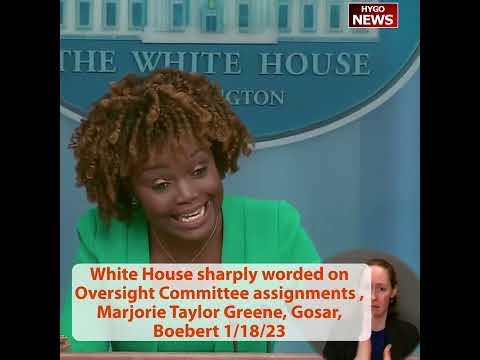
White House Blasts GOP Oversight Committee Picks: “Keys to the Most Extreme MAGA Members” — Greene, Gosar, Boebert
In January 2023, the White House issued an unusually sharp statement about House Republican committee assignments, particularly the placement of Representatives Marjorie Taylor Greene, Paul Gosar, and Lauren Boebert on the House Oversight Committee. “On some of these key committees, it appears that House Republicans have handed over the keys to the most extreme MAGA members of the Republican caucus,” the White House spokesperson said. The statement specifically called on Republican leaders to “come clean with the American people about the secret agreements, the secret deals that were made with these extreme MAGA extremists that are currently in the House.” The aggressive rhetoric marked a departure from usual administration restraint about Congressional matters and signaled an intensifying White House strategy of confrontation with the House GOP as oversight battles loomed.
The Committee Assignments Context
The committee assignments came at the start of the new Congress:
Republican-controlled House — Beginning January 3, 2023.
Speaker McCarthy — Newly elected.
Committee assignments — Reflecting deals.
Oversight Committee — Key investigative body.
Extremist placement — Raising concerns.
The House Oversight Committee had broad investigative authority over the executive branch. Its membership determined who would question administration officials, subpoena records, and lead investigations of the Biden White House. Committee assignments therefore had significant political implications.
The Specific Members
Three members drew particular attention:
Marjorie Taylor Greene (R-GA) — Previously stripped of committees.
Paul Gosar (R-AZ) — Censured for violent imagery post.
Lauren Boebert (R-CO) — Various controversial statements.
Each member had been controversial in the prior Congress:
Greene — Had been stripped of committee assignments in 2021 after social media history surfaced.
Gosar — Had been censured in 2021 after posting violent anime imagery targeting AOC.
Boebert — Had various confrontational moments and controversial statements.
Their placement on the powerful Oversight Committee signaled Republican embrace of members who had been marginalized in the prior Congress.
The Speaker Deal Context
McCarthy’s path to the Speakership had required deals:
15 ballots — Extended voting.
Freedom Caucus demands — Concession-heavy.
Committee assignments — Part of deals.
Rules changes — Weakening Speaker.
Investigative priorities — Agreed upon.
To win the Speakership, McCarthy had made significant concessions to the far-right House Freedom Caucus. These concessions included committee assignments for members like Greene, Gosar, and Boebert. The deals were public in broad strokes but specifics remained unclear.
”Handing the Keys of Oversight”
The White House statement used pointed imagery. “Handing the keys of oversight to the most extreme MAGA members in the Republican caucus,” the statement read.
The “keys of oversight” metaphor:
Control implication — Power transfer.
Extremist framing — Of those receiving.
Republican responsibility — For the handoff.
Institutional concern — For Committee function.
Political framing — Not substantive.
The language was calibrated for maximum political effect. By framing Republicans as handing over “keys” to “extremists,” the White House was delegitimizing the Committee’s upcoming work in advance.
”The Most Extreme MAGA Members”
The “most extreme MAGA” characterization was pointed:
MAGA identification — Trump-era identifier.
Extreme modifier — Distinguishing from other Republicans.
Label adoption — Using Trump movement’s term.
Delegitimization — Of specific members.
Internal GOP division — Implied between MAGA and non-MAGA.
The “MAGA extremist” framing was becoming standard Biden administration vocabulary. It distinguished between regular Republicans (who might be reasonable) and “MAGA extremists” (who were beyond pale). This division was politically useful for framing GOP actions as driven by extreme elements.
”Come Clean With the American People”
The statement demanded transparency about McCarthy’s deals. “They should have to explain, not us, they should have to explain why allowing these individuals to serve on these committees and come clean with the American people about the secret agreements, the secret deals that were made,” the statement said.
The demand framing:
Transparency demand — From Republicans.
Secret deals — Emphasizing concealment.
Public accountability — Owed.
Not White House burden — Explicitly.
Responsibility placement — On GOP.
The “secret deals” framing was effective rhetoric. It took public knowledge that deals had been made (which was openly reported) and characterized them as shadowy. This generated public interest in specifics while framing Republicans as hiding something.
The McCarthy Deal Transparency Issue
There was legitimate substance to the transparency concern:
Deals were made — Publicly acknowledged.
Specifics not released — By GOP leadership.
Reporting speculation — About terms.
Freedom Caucus statements — Occasionally revealing.
Full picture obscured — Intentionally.
McCarthy’s Speaker deal had multiple components, some formally documented and some verbally agreed. The complete list of concessions wasn’t fully public. White House pressure for complete transparency was part of broader effort to keep the deal-making process visible as political liability.
”This Is What We’re Seeing From the Other Side of Pennsylvania Avenue”
The reference to Pennsylvania Avenue positioned the White House against Congress. “This is what we’re seeing from the other side of Pennsylvania Avenue,” the spokesperson said.
The framing:
Geographic metaphor — White House vs. Capitol.
Institutional distance — Not partisan.
Observer posture — Watching and reacting.
Accountability frame — Looking at them.
Separation — From the problematic activity.
Using “other side of Pennsylvania Avenue” rather than “Republicans” gave institutional framing to partisan criticism. It positioned the administration as observing Congressional dysfunction rather than engaging in partisan fight.
The Departure From Restraint
This statement represented departure from usual administration restraint:
Prior pattern — Careful about Congressional matters.
Institutional respect — For Congress’s internal processes.
Branch separation — Maintained.
Personal attacks — Usually avoided.
Measured responses — To GOP actions.
This statement was notably more aggressive. Calling members “extremists” and demanding Republicans “come clean” about “secret deals” was rhetorical escalation. The White House was shifting to more combative posture.
The Political Strategy
The aggressive statement fit broader administration strategy:
Preemptive framing — Before investigations begin.
Democratic base mobilization — Against GOP.
Media narrative shaping — About coming oversight.
Moderate Republican discomfort — Creating internal GOP pressure.
Political positioning — For 2024.
By framing oversight upfront as extremist-led, the administration was trying to delegitimize coming investigations before they happened. If investigators were characterized as “extremists,” their findings could be dismissed as partisan. The preemptive characterization was strategic.
The Reporter Follow-Up
The reporter pushed back on implications. “Sounds like you don’t view the committee as very…” the reporter began, before being cut off.
The attempt:
Question pattern — Following the attack.
Implication exploration — Of stated position.
Legitimate inquiry — About administration view.
Push-back — On characterization.
Professional engagement — With position.
The reporter seemed to be testing whether KJP would go further in attacking the committee itself — perhaps suggesting the White House would refuse to cooperate with its investigations. This would have been a significant statement.
”I Did Not Say That”
KJP interrupted. “I did not say that. I laid out…” KJP began.
The immediate correction:
Explicit disavowal — Of reporter’s framing.
Characterization pushback — Against extension.
Position limits — Clarifying scope.
Strategic distinction — Between members and committee.
Administrative caution — Despite aggressive statement.
Even while attacking committee members, the administration wasn’t ready to attack the committee itself or commit to non-cooperation. The distinction was legally and politically important. Committee legitimacy was constitutionally anchored; member characterization was political commentary.
The Oversight Battles Ahead
This exchange was at the beginning of oversight battles:
Investigations coming — On multiple fronts.
Subpoenas planned — For various matters.
Hunter Biden focus — Significant GOP interest.
Biden family issues — Under scrutiny.
Administration policies — Various topics.
The aggressive preemptive framing was setting up for coming confrontations. By characterizing the committee leadership as extreme upfront, the administration was establishing grounds for future criticism of its work.
The Hunter Biden Investigation
A particular focus of GOP oversight:
Business dealings — Under examination.
Foreign connections — Questions about.
Laptop evidence — Being analyzed.
Tax matters — Under DOJ investigation.
Political implications — For Biden presidency.
The Hunter Biden investigation was a major GOP priority. Committee membership determined who would conduct this work. Extremist framing of the committee was partly about preparing to dismiss Hunter Biden findings as politically motivated.
The Committee Tradition
The House Oversight Committee had a significant institutional tradition:
Bipartisan origins — For investigating executive branch.
Cross-party history — Of investigations.
Abuse potential — In various eras.
Institutional authority — Constitutional basis.
Political weapon potential — Historically realized.
The committee’s political use varied with which party controlled the White House. Democrats had used Oversight against Trump; Republicans were about to use it against Biden. The pattern wasn’t new, but current GOP committee assignments raised questions about conduct.
The Rhetoric Escalation Pattern
The White House rhetoric escalation paralleled broader political escalation:
Biden “semi-fascism” — Earlier characterization.
“MAGA extremism” — Continuing theme.
“Ultra-MAGA” — At times.
“Extremist” — Common descriptor.
Polarization language — Standard.
The statement fit administration’s increasing willingness to use strong language about political opponents. This was tactical choice — aggressive rhetoric could motivate base and frame opposition as illegitimate.
The Normative Concerns
The escalation raised normative concerns:
Institutional comity — Weakening.
Opposition legitimacy — Questioned.
Political norms — Evolving.
Democratic debate — Narrowing.
Polarization intensifying — Across institutions.
Whether the political benefits of aggressive rhetoric outweighed the institutional costs was debatable. The White House was choosing partisan effectiveness over institutional restraint.
The GOP Response Context
Republicans had their own framing:
Legitimate oversight — Constitutional duty.
Executive branch accountability — Essential function.
Administration shortcomings — To investigate.
Hunter Biden concerns — Legitimate.
Border crisis — Requiring investigation.
Republicans viewed the coming oversight as legitimate function they had won the power to conduct. White House preemptive characterization as extremist-led was itself partisan framing they disputed.
The Media Coverage Impact
The aggressive statement generated coverage:
Headlines about conflict — White House vs. House.
Extreme MAGA framing — Amplified.
McCarthy deal focus — Heightened.
Committee assignment scrutiny — Intensified.
Political conflict narrative — Strengthened.
Media coverage of the statement was extensive. The “keys to extremists” framing was quoted widely. The White House was successful in getting its preferred characterization into the news cycle, even if Republicans disputed it.
Key Takeaways
- The White House issued an unusually sharp statement about House GOP committee assignments placing Greene, Gosar, and Boebert on Oversight.
- “It appears that House Republicans have handed over the keys to the most extreme MAGA members of the Republican caucus,” the statement said.
- The statement demanded Republicans “come clean with the American people about the secret agreements, the secret deals” made during the Speaker vote.
- The aggressive “MAGA extremists” rhetoric marked escalation from usual administration restraint about Congressional matters.
- When a reporter tried to extend the characterization to dismissing the committee itself, KJP pushed back: “I did not say that.”
- The preemptive framing was strategic — trying to delegitimize coming oversight investigations before they began.
Transcript Highlights
The following is transcribed from the video audio (unverified — AI-generated from audio).
- The White House State put out this really sharply worded statement about the committee assignments, the oversight committee assignments, Marge Taylor Green, Representative Gosar, Representative Boebert.
- On some of these key committees, it appears that House Republicans have handed over the keys to the most extreme MAGA members of the Republican caucus.
- This is what we’re seeing from the other side of Pennsylvania Avenue.
- Republican leaders should explain, they should have to explain, not us, they should have to explain why allowing these individuals to serve on these committees.
- Come clean with the American people about the secret agreements, the secret deals that were made with these extreme MAGA extremists.
- Sounds like you don’t view the committee as very… I did not say that. I laid out…
Full transcript: 177 words transcribed via Whisper AI.