 HYGO News
 White House no update on baby formula crisis, which began more than 8 months ago
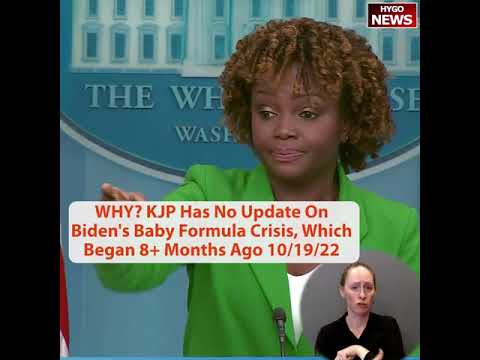
One-Third of Families Still Can’t Find Baby Formula 8 Months Into Crisis — KJP Has No Update: “We’re Going to Continue to Work on That”
On 10/19/2022, a reporter cited U.S. Census Bureau data showing that one-third of households with infants still had trouble finding baby formula — more than eight months after the shortage began. The reporter asked why the crisis was “still ongoing after so much time” despite the administration’s efforts. KJP had no new information, no update, and no specific plan, offering only that the administration “has taken actions” and “we’re going to continue to work on that as well.” The non-answer, delivered eight months into a crisis affecting the nation’s most vulnerable population, epitomized the administration’s pattern of acknowledging problems without resolving them.
”One-Third of Households”
The reporter presented Census Bureau data that quantified the ongoing suffering. “The U.S. Census Bureau said recently that adults in roughly one-third of households with infants and children that use formula had trouble finding it,” the reporter said. “Obviously, the administration has taken a number of steps over the last several months to try to address the shortage. Why is the shortage still ongoing after so much time, and what more can be done?”
One-third was a staggering number. It meant approximately 33% of American families with formula-dependent babies were still struggling to find a basic nutritional necessity for their infants in October 2022 — in the wealthiest country in the world, eight months after the shortage became a national crisis.
The reporter’s question acknowledged the administration’s efforts (“the administration has taken a number of steps”) while asking the essential follow-up: if those steps were working, why were millions of families still unable to feed their babies? It was the accountability question that KJP could neither answer nor avoid.
”We Have Progress to Address This Issue”
KJP’s response was a study in saying nothing substantive. “So, look, the President and his administration has taken actions, as you know, through the last several months to make sure that we have progress to address this issue that is currently happening right now,” KJP said.
The sentence was grammatically tortured and substantively empty. “Progress to address this issue that is currently happening right now” managed to simultaneously claim progress and acknowledge the problem was ongoing — a contradiction that left the listener with no useful information about what was actually being done.
“We have seen some improvement,” KJP added. “We understand that there’s more work to be done. And so we’re going to continue to work on that as well.”
“Some improvement” when one-third of families still couldn’t find formula was a remarkably low bar for success. And “continue to work on that” was the most generic possible commitment — no specifics, no timeline, no measurable goals. After eight months, the administration’s answer to suffering parents was: we acknowledge the problem exists, and we will keep doing things.
The Origin of the Crisis
The baby formula shortage began in February 2022 when Abbott Nutrition voluntarily recalled several products and shut down its Sturgis, Michigan manufacturing plant following reports of bacterial contamination. The Sturgis facility was one of the largest formula production plants in the country, responsible for a significant share of the nation’s supply.
The FDA had received a whistleblower complaint about conditions at the Sturgis plant in September 2021 — five months before the shutdown. The agency did not inspect the plant until January 2022 and did not act on its findings until February. The delay between the whistleblower report and the FDA’s response became one of the most criticized aspects of the federal government’s handling of the crisis.
The White House later acknowledged it was slow to recognize the severity of the shortage. Biden administration officials conceded they did not fully understand the concentration of the baby formula market — where a handful of companies dominated production — until the crisis was already severe. The fact that a single plant closure could create a nationwide shortage revealed the fragility of a supply chain the government had failed to monitor.
”Operation Fly Formula”
The administration’s most visible response was “Operation Fly Formula,” launched in May 2022, which used military aircraft to transport formula from overseas manufacturers to the United States. The initiative generated dramatic images of pallets of formula being unloaded from cargo planes — visual evidence of presidential action.
But the program’s actual impact was limited. The quantities imported through military flights represented a tiny fraction of national demand. The shortage was fundamentally a domestic production problem that could not be solved by importing relatively small quantities from European manufacturers who were themselves operating at capacity.
The administration also invoked the Defense Production Act for formula production, relaxed import restrictions to allow foreign brands into the U.S. market, and pressured the FDA to expedite its inspection of the Abbott facility. The Sturgis plant partially reopened in June 2022 but shut down again briefly after severe storms flooded the facility — further delaying the recovery.
Eight Months and Counting
By October 2022, the formula shortage had persisted for eight months — far longer than the administration’s initial projections. Several factors contributed to the extended crisis:
The Abbott plant’s restart was slower than expected, with full production not resuming until late summer 2022. Even at full capacity, the supply chain needed time to rebuild inventory levels that had been depleted during months of shortage.
The concentrated market structure that made the crisis possible in the first place had not been reformed. The same handful of companies still dominated production, meaning the supply chain remained vulnerable to future disruptions.
Foreign formula that had been imported through emergency measures was available in limited quantities and was unfamiliar to American parents, many of whom struggled to find the specific brands and formulations their pediatricians recommended and their infants tolerated.
WIC program restrictions — which limited which brands and sizes government-assisted families could purchase — further constrained options for lower-income families, who were disproportionately affected by the shortage.
The Political Context
The formula shortage had been a potent political issue in the spring and summer of 2022, generating emotional Congressional hearings and intense media coverage. By October, the issue had faded from front-page news — replaced by inflation, midterm elections, and other crises — but the underlying problem persisted for the families living it daily.
The reporter’s question was a reminder that crises don’t end when media coverage moves on. One-third of families with infants were still affected. Parents were still driving to multiple stores, checking online retailers, and asking friends and family in other states to ship formula. The crisis had simply become normalized — an ongoing hardship that no longer generated the urgency it warranted.
KJP’s inability to provide any update — no new initiatives, no projected timeline for resolution, no specific data on supply recovery — suggested the administration had moved on as well. The formula shortage had been absorbed into the background noise of governance, with no one at the White House actively managing it to resolution.
The Broader Pattern
The formula shortage exemplified a pattern that repeated across multiple Biden-era crises: a slow initial response, a burst of visible action when media pressure peaked, and then a gradual fading of attention while the underlying problem persisted. The administration treated crises as communications challenges to be managed rather than operational problems to be solved.
The formula response followed the same trajectory as the supply chain crisis, the border surge, and the inflation fight: acknowledge the problem, announce actions, claim progress, and eventually stop talking about it — regardless of whether the problem was actually resolved.
Key Takeaways
- Census Bureau data showed one-third of families with infants still had trouble finding formula eight months into the crisis.
- KJP had no update, no new initiatives, and no timeline — only “we’re going to continue to work on that.”
- The crisis began when Abbott shut down its Sturgis plant in February 2022 after the FDA delayed acting on a September 2021 whistleblower complaint.
- “Operation Fly Formula” imported small quantities via military aircraft but addressed only a fraction of demand.
- The concentrated formula market that made the crisis possible had not been reformed, leaving supply chains vulnerable to future disruptions.
Transcript Highlights
The following is transcribed from the video audio (unverified — AI-generated from audio).
- The Census Bureau said roughly one-third of households with infants that use formula had trouble finding it.
- The administration has taken a number of steps to address the shortage. Why is it still ongoing after so much time?
- The President and his administration has taken actions to make sure that we have progress to address this issue.
- We have seen some improvement.
- We understand that there’s more work to be done.
- We’re going to continue to work on that as well.
Full transcript: 122 words transcribed via Whisper AI.