 HYGO News
 White House no answer Biden only responsible for gas down but not gas up?
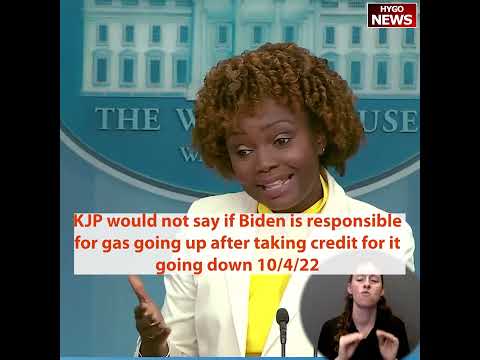
Doocy Catches KJP: If Biden Is Responsible for Gas Prices Coming Down, Is He Responsible for Them Going Up?
On 10/4/2022, Fox News reporter Peter Doocy confronted White House Press Secretary Karine Jean-Pierre with a simple logical question the administration had never been able to answer: “You’ve said the president was responsible for gas prices coming down. Is the president responsible for gas prices going up?” KJP said it was “a lot more nuanced than that,” blamed “global challenges” and other countries, then pivoted to the Inflation Reduction Act — never actually answering whether Biden bore any responsibility for the price increases that preceded the decline he was taking credit for.
”Is the President Responsible for Gas Prices Going Up?”
Doocy’s question was designed to expose the administration’s selective credit-taking. For months, Biden had personally taken credit for falling gas prices — tweeting about declining prices, pointing to pump stickers his supporters printed, and having KJP repeatedly cite gas price declines as proof of presidential leadership.
“You’ve said the president was responsible for gas prices coming down,” Doocy began. “Is the president responsible for gas prices going up?”
The question was binary. If Biden deserved credit when prices fell, logic demanded he accept responsibility when they rose. The administration had never reconciled this contradiction — claiming credit for every penny of decline while attributing every penny of increase to Vladimir Putin, OPEC+, oil companies, or the pandemic.
KJP: “A Lot More Nuanced Than That”
KJP’s response avoided the direct question entirely. “So it’s a lot more nuanced than that, right? Peter, you know this,” KJP said. “There have been global challenges that we have all dealt with — when I say all, meaning other countries.”
The appeal to “nuance” was itself revealing. When gas prices fell, the White House messaging was anything but nuanced — it was direct, unambiguous credit-taking. Biden pointed at himself. KJP cited “historic steps.” The president’s Twitter account posted charts showing price declines. But when asked about price increases, suddenly the situation required careful, complex analysis of global factors beyond any one president’s control.
The inconsistency had become one of the most frequently noted contradictions of the Biden communications strategy. Gas prices going down: “The president did that.” Gas prices going up: “It’s complicated."
"Saving American Families Over a Dollar Per Gallon”
KJP then shifted to the administration’s preferred metric — measuring progress from the peak rather than the baseline. “We saw that every day this summer over saving American families over a dollar per gallon,” KJP said.
The framing measured the decline from the June 2022 peak of roughly $5 per gallon to the October level of approximately $3.80. But it ignored that gas was roughly $2.39 when Biden took office — meaning families were still paying about $1.40 more per gallon than on Inauguration Day. The administration was effectively taking credit for partially cleaning up a mess that critics argued its own policies had helped create.
The “dollar per gallon savings” talking point also obscured the mechanism. The primary tool Biden used to bring down prices was releasing oil from the Strategic Petroleum Reserve at unprecedented rates — a temporary measure that depleted America’s emergency stockpile without addressing underlying supply constraints. It was the equivalent of raiding a savings account to pay monthly bills, then claiming financial success because spending hadn’t stopped.
The Inflation Reduction Act Pivot
When the gas price logic became uncomfortable, KJP pivoted to broader legislation. “That is what the president is going to continue to stay focused on, American consumers. How do we continue to keep prices down? That’s why we did the Inflation Reduction Act,” KJP said.
The pivot was notable because the Inflation Reduction Act — despite its name — was primarily a climate and healthcare spending bill. Multiple independent analyses, including from the Congressional Budget Office and the Penn Wharton Budget Model, found the legislation would have negligible impact on inflation in the near term. Some economists argued the additional spending could actually increase inflationary pressure.
Invoking the IRA in response to a question about gas prices was a non-sequitur designed to redirect the conversation from a question KJP could not answer to legislation the administration wanted to promote.
The Broader Pattern
The exchange captured a pattern that defined the Biden White House’s economic messaging throughout 2022. The administration operated under a consistent framework: positive economic indicators were the direct result of presidential action, while negative indicators were caused by external forces — Putin, OPEC+, supply chains, the pandemic, or the previous administration.
This selective attribution extended beyond gas prices. When job numbers were strong, Biden took direct credit. When inflation surged, it was “transitory” or caused by supply chains. When GDP contracted, it didn’t mean recession. When the stock market fell, it was global factors. The framework ensured the president was always positioned favorably regardless of actual conditions — but it required ignoring the logical inconsistencies that reporters like Doocy continued to surface.
The Numbers in Context
By October 2022, the gas price picture told a story the administration preferred to tell only partially. The national average had fallen from its June peak of $5.01 to roughly $3.80 — a decline the White House highlighted constantly. But the fuller timeline showed gas at $2.39 on January 20, 2021, meaning prices had risen approximately 59% under Biden even after the summer decline. Diesel, which powered the trucks that moved consumer goods, was even higher relative to its pre-Biden baseline, contributing to elevated prices across the economy.
The question Doocy asked — and KJP declined to answer — remained the central unresolved tension of the administration’s energy messaging for the remainder of Biden’s term.
Key Takeaways
- Doocy asked the logical follow-up the White House had avoided: if Biden is responsible for gas prices coming down, is he responsible for them going up?
- KJP said it was “a lot more nuanced than that” and blamed global challenges — the same factors the White House ignored when taking credit for price declines.
- She claimed families saved “over a dollar per gallon” by measuring from the June peak, while gas remained roughly 59% higher than on Inauguration Day.
- KJP pivoted to the Inflation Reduction Act, which independent analyses said would have negligible near-term impact on inflation.
- The exchange captured the administration’s pattern of claiming credit for positive indicators while attributing negative ones to external forces.
Transcript Highlights
The following is transcribed from the video audio (unverified — AI-generated from audio).
- You’ve said the president was responsible for gas prices coming down. Is the president responsible for gas prices going up?
- So it’s a lot more nuanced than that, right? Peter, you know this.
- There have been global challenges that we have all dealt with, meaning other countries.
- We saw that every day this summer over saving American families over a dollar per gallon.
- That is what the president is going to continue to stay focused on, American consumers.
- That’s why we did the Inflation Reduction Act.
Full transcript: 105 words transcribed via Whisper AI.