 HYGO News
 Whether to Call You Professor or Comrade, Kennedy To OCC Nominee During Confirmation
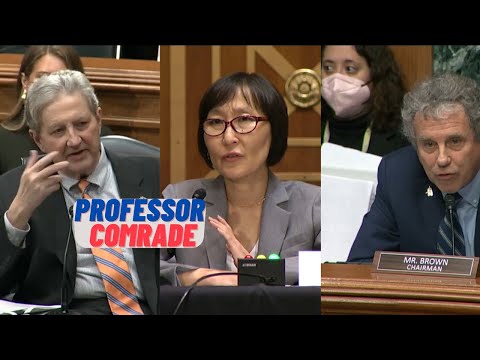
“I Don’t Know Whether to Call You Professor or Comrade”: Kennedy Confronts Biden’s OCC Nominee on Marxist Writings
On November 18, 2021, Senator John Kennedy (R-LA) delivered one of the most memorable confrontations of the Biden-era confirmation hearings when he systematically cataloged the writings and affiliations of Saule Omarova, President Biden’s nominee to lead the Office of the Comptroller of the Currency. Kennedy cited her Moscow State University thesis on Karl Marx, her membership in the Young Communists organization, her academic papers calling for the federal government to set wages and prices, her proposal to abolish bank accounts in favor of Federal Reserve accounts, and her description of the financial services industry as “a quintessential asshole industry.” He concluded: “You have the right to believe every one of these things. You do. This is America. But I don’t mean any disrespect. I don’t know whether to call you professor or comrade.” The exchange drew an audible gasp from the hearing room and triggered a heated clash between Kennedy and Committee Chairman Sherrod Brown (D-OH) over “senatorial courtesy” and “character assassination.”
The Record Kennedy Assembled
Kennedy’s questioning was methodical. Rather than making broad accusations, he walked through specific items from Omarova’s academic and public record, building a cumulative case before delivering his conclusion.
He began with her education: Omarova had written her thesis at Moscow State University on “Karl Marx’s Economic Analysis and the Theory of Revolution in the Capital.” She had also studied “scientific communism” at the university, which Kennedy described as “the science regarding the working class struggle and the socialist agenda.” Kennedy noted that Omarova had declined to send a copy of her thesis to Senator Patrick Toomey, the ranking Republican on the Banking Committee, despite multiple requests.
Kennedy then moved to her more recent writings and statements. In 2019, he noted, Omarova had called the financial services industry “a quintessential asshole industry” in a Canadian documentary — “not 30 years ago,” Kennedy emphasized, but two years before her nomination.
He cited a paper titled “Systemically Significant Prices” in which Omarova called for the federal government to set wages, food prices, and gas prices. He referenced her 2020 paper “The People’s Ledger,” which proposed abolishing traditional bank accounts and requiring Americans to set up accounts directly with the Federal Reserve. Kennedy characterized this as giving “the federal government access to your data.”
He cited another 2020 paper, “The Climate Case for a National Investment Authority,” in which Omarova argued that the federal government should effectively bankrupt the oil and gas industry to address climate change. Kennedy paraphrased: “What we need to do to the oil and gas industry is have the federal government bankrupt them so we can tackle climate change.”
Finally, Kennedy noted that in 2019, Omarova had joined a Facebook group he described as “a Marxist Facebook group to discuss socialist and anti-capitalist views."
"Professor or Comrade”
Having laid out the record, Kennedy delivered the line that would dominate coverage of the hearing.
“Now that’s what I see from your record, and you have the right to believe every one of these things. You do. This is America,” Kennedy said, his tone measured. “But I don’t mean any disrespect. I don’t know whether to call you professor or comrade.”
The hearing room reacted audibly. Someone could be heard saying “Oh my goodness.”
Omarova responded firmly: “Senator, I’m not a communist. I do not subscribe to that ideology. I could not choose where I was born.” She addressed the Facebook group allegation directly: “I do not remember joining any Facebook group that subscribes to that ideology. I would never knowingly join any such group. There is no record of me ever actually participating in any Marxist or communist discussions of any kind.”
The Young Communists Question
A significant portion of the exchange focused on Omarova’s membership in the Komsomol, the Young Communist League of the Soviet Union. Kennedy asked directly: “You used to be a member of a group called the Young Communists. Didn’t you?”
Omarova attempted to provide context: “Senator, are you referring to my membership in the youth communist organization while I was growing up in the Soviet Union?”
“I don’t know. I wanted to ask you that question,” Kennedy replied.
After some back and forth over the organization’s formal name — the Leninist Communist Young Union of the Russian Federation — Omarova acknowledged her membership but explained it was universal: “Everybody in that country was a member of the Komsomol, which was the communist youth organization. That was a part of normal progress in school.”
Kennedy pressed on whether she had formally resigned. “Did you send them a letter though, resigning?”
Omarova explained that membership ended automatically with age: “As far as I remember how the Soviet Union worked, at certain age, you automatically stopped being a member of that organization.”
Kennedy was not satisfied: “Could you look at your records and see if you can find a letter of resignation for me?”
Brown vs. Kennedy: “Character Assassination” vs. “Senatorial Courtesy”
Chairman Sherrod Brown intervened during the exchange, triggering a heated clash between the two senators that overshadowed the substance of the questioning.
Brown interjected to note that Omarova had renounced her Soviet citizenship. “I understand that, but you’re not the witness. She is,” Kennedy responded.
After Kennedy delivered his “professor or comrade” line, Brown pushed back more forcefully, accusing Kennedy of conducting a “character assassination.”
“Well, that’s your opinion,” Kennedy shot back.
The exchange escalated as Kennedy accused Brown of violating “senatorial courtesy” by interrupting his questioning time. “I didn’t interrupt you when you gave your introduction. And I don’t like being interrupted when I’m asking my question,” Kennedy said.
Brown countered: “Senator Kennedy, senatorial courtesy is also not doing character assassination.”
Kennedy insisted on his procedural rights: “I’m entitled to ask my questions. You and I don’t agree. I still like you. We’re friends. You have the right to your opinion, but I’ve got the right to mine. And you can’t just interrupt me when I’m asking my question.”
The confrontation between the chairman and the senator reflected the broader tension surrounding Omarova’s nomination. Democrats viewed Republican questioning as xenophobic attacks on a woman who had immigrated from the Soviet Union and built a distinguished academic career in the United States. Republicans argued they were performing their constitutional duty to evaluate whether a nominee’s publicly stated views were compatible with overseeing the nation’s banking system.
The Broader Nomination Battle
The Kennedy exchange was the most viral moment of Omarova’s confirmation process, but it was part of a broader Republican campaign against her nomination. Senator Tim Scott had argued earlier in the same hearing that no one on his side had engaged in “communist insinuation of her character” — a claim Kennedy’s remarks would immediately complicate.
Senator Marco Rubio had separately called Omarova “a communist” in public statements, and the White House had pushed back through Press Secretary Jen Psaki, who said she “enjoyed” Senator Elizabeth Warren’s defense of Omarova and called the nominee “eminently qualified.”
Omarova’s academic writings — particularly her proposals for government-set prices, the abolition of private bank accounts, and the deliberate bankrupting of the oil and gas industry — provided substantive grounds for opposition beyond her Soviet background. Critics argued these were not positions of an academic simply exploring ideas but a policy blueprint for fundamentally restructuring the American financial system.
The nomination was already effectively dead by the time of the Kennedy exchange. Several moderate Democrats, including Senator Jon Tester of Montana, had expressed reservations. Omarova would formally withdraw her nomination on December 7, 2021, three weeks after this hearing, citing “unacceptable” personal attacks but acknowledging she lacked the votes for confirmation.
Key Takeaways
- Kennedy cataloged Omarova’s Moscow State University thesis on Karl Marx, her papers calling for government-set wages and prices, her proposal to abolish bank accounts in favor of Fed accounts, her call to bankrupt the oil and gas industry, and her description of Wall Street as “a quintessential asshole industry” — then told her “I don’t know whether to call you professor or comrade.”
- Omarova responded “I’m not a communist” and explained her Komsomol membership was universal in the Soviet Union, while Kennedy pressed her to produce a letter of resignation from the Young Communists and to provide her Marx thesis to the committee — which she had declined to do.
- Chairman Brown intervened to accuse Kennedy of “character assassination,” sparking a heated exchange about “senatorial courtesy” that exposed the partisan divide over whether scrutinizing Omarova’s writings was legitimate oversight or xenophobic attack — the nomination was withdrawn three weeks later without the votes for confirmation.