 HYGO News
 when Americans feel inflation relief? WH: not going to get into when!
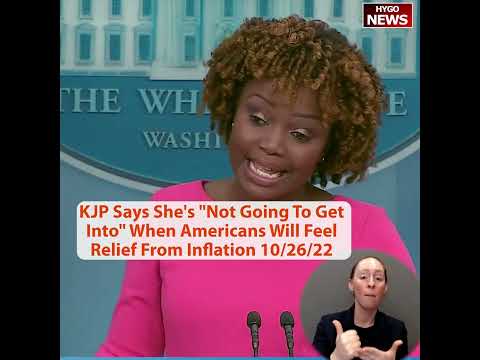
Reporter Asks When Americans Will Feel Inflation Relief — KJP: “I’m Not Going to Get Into When That’s Going to Occur”
On 10/26/2022, a reporter asked White House Press Secretary Karine Jean-Pierre the question every American family wanted answered: “Can the administration say when Americans can expect to feel relief from inflation? Is there a date they can look to?” KJP’s response was blunt: “I’m not going to get into when that’s going to occur.” She then listed familiar talking points — the president was “laser-focused,” families were being “squeezed,” and “we understand there’s more work to be done” — without providing any timeline, any benchmark, or any measurable commitment for when the inflation crisis would end.
”Is There a Date?”
The reporter’s question was among the most basic any administration could face. “You had just said that there are no plans to adjust the economic team after the midterms,” the reporter said, establishing that the same people would be managing the economy. “So I just want to ask: can the administration then say when Americans can expect to feel relief from inflation? Is there a date they can look to?”
The question was not asking for an exact date — it was asking for a general timeline, a projection, a sense of direction. Will it be six months? A year? Two years? Families making budgeting decisions, businesses planning investments, and workers negotiating salaries all needed some indication of when the price pressure would ease.
Every prior administration facing an economic challenge had offered at least general guidance about expected improvement. The Obama administration provided quarterly economic projections during the 2008-2009 financial crisis. The Trump administration offered pandemic recovery timelines. The absence of any timeline from the Biden White House was not prudent caution — it was an admission that the administration either didn’t know when relief was coming or knew the answer would be politically damaging.
”I’m Not Going to Get Into When”
KJP’s refusal was explicit. “I will let the experts speak to that. I’m not going to get into when that’s going to occur,” KJP said.
The deferral to “experts” was a dodge. The Biden administration employed dozens of economists — at the Treasury Department, the Council of Economic Advisers, the Office of Management and Budget, and the National Economic Council. These experts regularly produced economic forecasts and projections. If the administration’s own economists had a timeline for inflation relief, KJP could have shared it. If they didn’t, that itself was newsworthy.
The refusal also contradicted the administration’s frequent claims that its policies were working. If Biden’s “laser-focused” economic agenda was producing results, those results should have a projected timeline. Businesses forecast revenue. Governments forecast budgets. Doctors forecast recovery. But on the issue the American people cared about most, the White House offered: “I’m not going to get into when."
"We Have Seen Some Relief”
KJP attempted to demonstrate progress. “But we have seen some relief over the past several months. We understand there’s more work to be done,” KJP said.
The “some relief” she referenced was the decline in gas prices from their June 2022 peak — achieved primarily through draining the Strategic Petroleum Reserve — and a slight moderation in month-over-month CPI increases. But year-over-year inflation remained at 8.2%, food prices were up 11.2%, shelter costs were rising at the fastest pace in decades, and cumulative price increases since Biden took office stood at approximately 13%.
Telling families paying 13% more for everything that there had been “some relief” was tone-deaf in the same way that telling a patient with a 103-degree fever that it used to be 104 was technically accurate but fundamentally unhelpful. The question was when the fever would break, and KJP couldn’t answer.
”Laser-Focused”
KJP deployed the “laser-focused” descriptor — another addition to the rotation of intensity modifiers the White House used to convey seriousness without substance. Biden had been described at various points as “laser-focused,” “working every day,” making inflation his “top domestic priority,” and “doing the work.” Each phrase conveyed effort and attention without committing to outcomes.
“Look, the President has been laser-focused on doing the work every day,” KJP said. “What the President did last week is going to help, pardon me, tens of millions of Americans. And that matters.”
The “pardon me” interjection was notable — KJP caught herself saying something appeared to start as “hurt” before correcting to “help.” The near-slip was harmless but illustrated the precariousness of maintaining optimistic messaging while discussing economic conditions that were objectively hurting the people the White House claimed to be helping.
”Don’t Want to Get Into the Economists’ World”
KJP then distanced herself from the analytical framework that could have answered the reporter’s question. “We don’t want to get too much into the economists’ world,” KJP said.
The phrase was remarkable coming from the spokesperson for a president who described himself as having “more substantive experience on domestic policy than any president ever.” The administration routinely cited economic data — jobs numbers, deficit figures, gas price declines — when the numbers were favorable. But when asked the most fundamental economic question — when will things get better? — KJP didn’t want to enter “the economists’ world.”
The selective use of economics — citing favorable data while avoiding unfavorable projections — was a pattern throughout the Biden White House’s inflation communications. Economic data was useful when it supported the narrative and “the economists’ world” when it didn’t.
”Don’t Leave Anybody Behind”
KJP closed with a Biden catchphrase. “Because of the President’s economic policies, we have made sure — the President has made sure — that we don’t leave anybody behind,” KJP said.
The “leave nobody behind” promise sounded noble but was disconnected from the economic reality of October 2022. Inflation was a regressive tax that hit lower-income families hardest — those who spent the largest share of their income on food, energy, and housing saw the greatest erosion of purchasing power. The families Biden pledged not to leave behind were the families most left behind by the inflation his policies helped create.
Real wages had declined for 18 consecutive months. The cost of basic necessities had risen faster than the overall CPI. Low-income families — who received the least benefit from stock market gains, home equity appreciation, and nominal wage increases — were effectively poorer than they had been when Biden took office.
The No-Timeline Pattern
The refusal to provide a timeline for inflation relief was part of a broader White House pattern of offering empathy and effort without commitments or accountability. The formula was consistent across dozens of briefings:
- Acknowledge the problem (“we understand families are being squeezed”)
- Claim effort (“the president is laser-focused”)
- Cite past action (“what the president did last week”)
- Promise future action (“more work to be done”)
- Refuse to project outcomes (“not going to get into when”)
The structure ensured the White House always appeared responsive without ever being measurable. Without a timeline, there was no accountability. Without benchmarks, there was no way to evaluate whether the “laser focus” was producing results. The administration maintained permanent effort without permanent responsibility.
Key Takeaways
- A reporter asked when Americans could expect to feel inflation relief; KJP said flatly “I’m not going to get into when that’s going to occur.”
- She deferred to “experts” while the administration’s own economists regularly produced forecasts it chose not to share publicly.
- KJP claimed “some relief” while cumulative prices remained 13% above when Biden took office and food was up 11.2%.
- She said “we don’t want to get into the economists’ world” — after the White House routinely cited economic data when favorable.
- The refusal to offer any timeline ensured no accountability for when the “laser-focused” effort would produce measurable results.
Transcript Highlights
The following is transcribed from the video audio (unverified — AI-generated from audio).
- Can the administration say when Americans can expect to feel relief from inflation? Is there a date they can look to?
- I’m not going to get into when that’s going to occur. But we have seen some relief over the past several months.
- The President has been laser-focused on doing the work every day.
- What the President did last week is going to help, pardon me, tens of millions of Americans.
- We understand that families are being squeezed by what’s happening currently with inflation.
- We don’t want to get too much into the economists’ world.
Full transcript: 182 words transcribed via Whisper AI.