 HYGO News
 What is the President's greatest fear about TikTok?
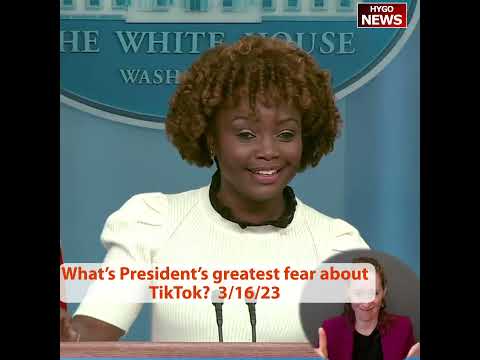
What Is The President’s Greatest Fear About TikTok?
A reporter asked White House Press Secretary Karine Jean-Pierre to articulate the administration’s message to over 100 million American TikTok users and explain President Biden’s “greatest fear” about the Chinese-owned platform during a March 2023 briefing. Jean-Pierre offered a general concern about China’s “potential use of software platforms that could endanger or threaten America’s safety and their national security” — a phrasing that sidestepped specifics about data harvesting, algorithmic manipulation, or propaganda distribution.
The 100 Million User Question
- User scale: The reporter’s 100 million figure reflected TikTok’s own reported U.S. monthly user count at the time.
- Actual reach: By some industry estimates, U.S. TikTok usage had climbed closer to 150 million monthly active users.
- Demographic skew: TikTok dominated among users under 30, with penetration rates exceeding 60% in some age brackets.
- Economic stake: TikTok supported a significant creator economy with small businesses, influencers, and content producers relying on the platform.
- Policy tension: Any restriction would directly affect more Americans than nearly any other national security action in recent memory.
KJP’s “Greatest Fear” Answer
- Opening deflection: Jean-Pierre’s initial response — “we’ve talked about this many times from here before” — deferred substance to prior briefings.
- Software concern frame: She landed on “China’s potential use of software platforms that could endanger or threaten America’s safety.”
- Congressional pivot: The press secretary quickly redirected attention to congressional action, seeking to place the onus beyond the White House.
- Non-specific threats: No mention of specific mechanisms like data transfer, algorithmic manipulation, or propaganda distribution.
- Trailing off: The transcript captured an incomplete answer with “We…” suggesting the press secretary pivoted to other topics.
The Software Platform Framing
- Generic threat: The “potential use of software platforms” phrasing avoided naming TikTok’s specific ByteDance ownership structure.
- Indirect risk: By framing the concern as potential rather than actual, the White House preserved negotiating space.
- Category concern: The language opened the door to broader tech policy beyond just TikTok.
- Safety vs. security: Jean-Pierre paired “safety” and “national security” as dual concerns without distinguishing between them.
- Cover for negotiation: General language allowed the administration to avoid foreclosing specific outcomes of the CFIUS review.
The Congressional Action Pivot
- DATA Act: The RESTRICT Act in the Senate and DATA Act in the House had been introduced to authorize broader executive action on foreign-owned apps.
- Bipartisan sponsors: Sens. Mark Warner and John Thune led the Senate effort with significant cross-aisle support.
- Administration backing: The White House endorsed the RESTRICT Act, giving congressional sponsors political cover.
- Legislative path: Both chambers needed to pass authorizing legislation before any administration ban could withstand legal challenge.
- Urgency framing: KJP’s call for Congress to “take action” reflected administration concern about legal exposure.
Three Threat Categories
- Data security: Chinese law requires companies to cooperate with state intelligence work, creating theoretical forced data access risk.
- Algorithmic manipulation: Recommendation algorithms could theoretically be tuned to amplify content beneficial to Chinese interests.
- Surveillance: Device permissions granted to the app could theoretically enable location tracking or other surveillance.
- Content suppression: Allegations have emerged of TikTok de-prioritizing content critical of the Chinese government.
- Accessing minors: Privacy advocates have raised separate concerns about TikTok’s handling of data from underage users.
The Public Messaging Challenge
- Ambiguous ask: Telling 150 million users their app was dangerous without telling them to stop using it created a messaging vacuum.
- Creator economy: The White House had not directly addressed economic impact on creators from any potential ban.
- Youth voter risk: Democrats faced political exposure with young voters if a ban proceeded during an election cycle.
- Alternative platforms: Meta, Google, and Snap stood to benefit from any TikTok restriction, raising competitive fairness questions.
- First Amendment concerns: Free-speech advocates warned that banning a platform based on foreign ownership raised constitutional questions.
TikTok’s Defensive Posture
- CEO preparation: Shou Zi Chew was preparing for congressional testimony that would follow the briefing.
- Project Texas: TikTok’s proposal to house U.S. data with Oracle remained on the table as an alternative to divestiture.
- Independence claims: The company consistently argued ByteDance-owned TikTok operated independently of Beijing.
- Algorithmic disclosure: TikTok had offered unprecedented algorithmic transparency as a concession.
- Legal arsenal: First Amendment lawyers had been retained in anticipation of litigation over any restriction.
The Broader China Policy Context
- Semiconductor controls: October 2022 chip export restrictions represented the most aggressive U.S. tech decoupling effort from China.
- Balloon incident: February 2023 Chinese surveillance balloon had intensified public concern about Chinese intelligence gathering.
- Taiwan tensions: Anticipated Speaker McCarthy meeting with Taiwan’s president added diplomatic friction.
- Economic statecraft: TikTok fit into a pattern of economic tools being deployed for national security aims.
- Allied coordination: The U.S. was coordinating with UK, Canadian, and EU partners on TikTok policy approaches.
Key Takeaways
- Jean-Pierre articulated Biden’s TikTok concern as “China’s potential use of software platforms” — a generic framing rather than specific threat mechanics.
- The press secretary offered no direct message to the 150 million American users as the reporter requested.
- KJP pivoted quickly to the need for congressional action, placing responsibility for decisive steps on Capitol Hill.
- The White House avoided naming specific threats like data harvesting or algorithmic manipulation, preserving negotiation space.
- The briefing came as the RESTRICT Act and DATA Act sought to authorize broader executive power over foreign-owned apps.
- Administration messaging carefully balanced national security concerns against the political risk of alienating young voters.
Transcript Highlights
The following quotations are drawn from an AI-generated Whisper transcript of the briefing and should be considered unverified pending official transcript release.
- “We’ve expressed concerns over China’s potential use of software platforms that could endanger or threaten America’s safety and their national security.” — Karine Jean-Pierre
- “That is why we have called on Congress to take action.” — Karine Jean-Pierre
- “Over 100 million people now use this app. What is your message to them about why you’re so concerned about this platform?” — Reporter question
- “What is the President’s greatest fear about TikTok?” — Reporter follow-up
- “We’ve talked about this many times from here before. The President has spoken about this.” — Karine Jean-Pierre
- “We want to make sure that our administration…” — Karine Jean-Pierre (incomplete sentence)
Full transcript: 121 words transcribed via Whisper AI.