 HYGO News
 WH: why having Marines behind Biden, speech "vote, vote, vote" is not political, dismisses criticism
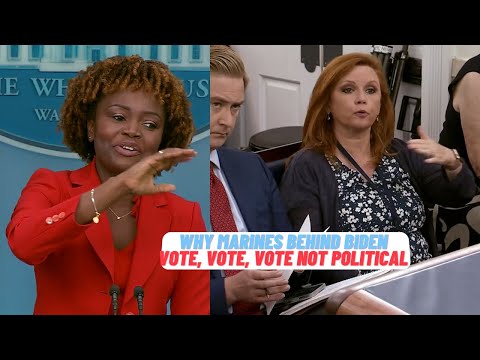
KJP Insists Biden’s “Vote, Vote, Vote” Speech With Marines as Backdrop Was “Not Political”; Reporters Press: “What’s the Action?”
On 9/2/2022, KJP faced sustained pushback from the press corps over Biden’s primetime speech at Independence Hall where he stood flanked by two uniformed Marines under blood-red lighting and concluded by urging Americans to “vote, vote, vote.” Multiple reporters asked how a speech telling Americans to vote to “reject MAGA forces” was not political. KJP insisted “standing up for democracy is not political” and said the Marines were there to demonstrate Biden’s “deep and abiding respect” for the military. When pressed repeatedly on what concrete action Biden would take beyond speeches, KJP could only say “making your voices heard is a powerful tool."
"Vote, Vote, Vote” — Not Political?
A reporter posed the core question. “Is a speech in which the President concludes by saying ‘vote, vote, vote’ inherently political?”
“He wasn’t referring to voting for any candidates,” KJP said. “He wasn’t saying vote for Dr. Oz.”
“He was saying vote to reject the MAGA forces. Isn’t that a political speech?” the reporter pressed.
“We don’t think it’s a political speech,” KJP said. “Voter participation and getting folks out there to make your voices heard — it is the most powerful action that an American can take.”
Another reporter was more direct. “Can you address the criticisms about why the President delivered what sounded very much like a politically charged speech as an official White House event, taxpayer-funded, with two Marines in uniform flanking him and visible on camera throughout?”
“Standing up for democracy is not political,” KJP said.
Marines as Backdrop
Multiple reporters pressed on the use of uniformed Marines as a visual backdrop for what critics saw as a partisan speech. “Where does the President think the line should be drawn for having members of the military who could be perceived as being part of stagecraft?” a reporter asked.
“The presence of the Marines at the speech was intended to demonstrate the deep and abiding respect the President has for these service members, for these ideals, and the unique role our independent military plays in defending our democracy,” KJP said. “It is not an unusual site or an unusual event.”
A reporter noted the distinction. “The former President was criticized for using military in many different settings. But to be at a location in Pennsylvania where the Marines are not normally stationed — where does the President see the line?”
KJP did not draw one.
”What’s the Action?”
The most persistent line of questioning was about substance. Multiple reporters asked what Biden would actually do beyond giving speeches about threats to democracy.
“What kind of concrete actions does he actually plan to take, given that he described this essentially as a fairly existential threat?” a reporter asked.
“One way we can do that is by making our voices heard,” KJP said.
“Other than urging Americans to vote, the President has no plan to confront this threat?” the reporter pressed.
“Making your voices heard is a powerful action,” KJP repeated.
Another reporter tried. “Can the American people expect any sort of policy rollout underlying the speech to actually address the threat?”
“The President was trying to give Americans a choice. How do we move forward in this inflection point?” KJP said.
“What’s the administration’s action besides telling people to go vote?” the reporter asked one final time.
“We should not underestimate what that can do — the power of the bully pulpit, the power of the President. We believe it resonated,” KJP said.
The exchange revealed that the “threat to democracy” speech had no policy component whatsoever — it was entirely about mobilizing voters for the midterms while being labeled “not political.”
The Circular Defense
KJP’s defense followed a consistent loop: the speech wasn’t political because defending democracy isn’t political; telling people to vote isn’t partisan because voting isn’t partisan; and the Marines were there to honor ideals, not to serve as partisan props. Each answer assumed the conclusion rather than addressing the criticism.
The red lighting, the military backdrop, the “MAGA forces” language, and the “vote, vote, vote” conclusion all pointed in one direction — but the White House insisted the direction was civic, not partisan.
Key Takeaways
- KJP insisted Biden’s primetime speech concluding with “vote, vote, vote” to “reject MAGA forces” was “not political” — “standing up for democracy is not political.”
- She said Marines flanking Biden were there to demonstrate “deep and abiding respect” for the military, not as stagecraft.
- Multiple reporters asked what concrete action Biden would take beyond speeches; KJP’s only answer was “making your voices heard is a powerful tool.”
- The speech had no policy component — no legislation, no executive action, no regulatory initiative — only a call to vote.
- A reporter noted the speech was “taxpayer-funded” as an “official White House event” while sounding “very much like a politically charged speech.”
Transcript Highlights
The following is transcribed from the video audio (unverified — AI-generated from audio).
- Is a speech that concludes with “vote, vote, vote” inherently political? We don’t think it’s a political speech.
- He was saying vote to reject the MAGA forces. Standing up for democracy is not political.
- What concrete actions does he plan to take? Making your voices heard is a powerful action.
- Why Marines flanking him at a location where they’re not normally stationed? The presence was intended to demonstrate deep and abiding respect.
- Can the American people expect any policy rollout? The President was giving Americans a choice at this inflection point.
- What’s the action besides telling people to vote? We should not underestimate the power of the bully pulpit.
Full transcript: 1107 words transcribed via Whisper AI.