 HYGO News
 WH: no difference between Gov shut down business PPP loan & students willfully took out loan, fair
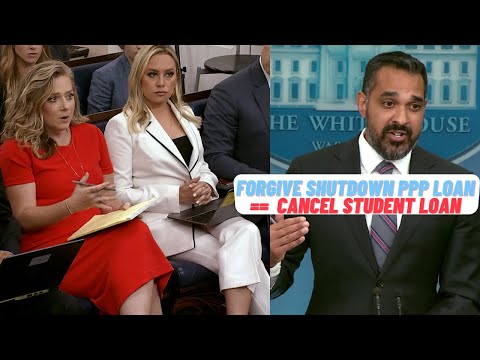
White House Says “No Difference” Between PPP Loans for Businesses Government Shut Down and Students Who Willfully Borrowed — Calls Comparison “Fair”
On 8/26/2022, a White House economic advisor called the comparison between PPP loan forgiveness and student loan forgiveness “absolutely fair” — despite a reporter laying out the clear distinction that PPP loans were designed to be forgivable for businesses the government forcibly shut down, while student loans were willfully taken out with an expectation of repayment. The advisor claimed the program was “fully paid for” by deficit reduction already on track, conceded that the $1.7 trillion in deficit reduction would become a “lower figure” after the forgiveness, and said families making $250,000 were “absolutely” middle class.
”Is There a Difference?” — “No”
A reporter methodically laid out the distinction. “Republicans and critics are saying there’s a difference between PPP loans — voted on by Congress, for businesses that were shut down by the government involuntarily because of a natural disaster — versus students who willfully took out their loans and are now unable for whatever reason to repay them. There is a difference there,” the reporter said.
“Both actions are based on laws that Congress passed. We are implementing a law that Congress passed — actually a Republican Congress and Republican President in 2003, the Heroes Act,” the advisor said.
Another reporter pressed harder. “There is a difference between a loan program that was conceived to be forgivable — the PPP was designed so that if you spent 80% on payroll, it would be forgiven — as opposed to student loans, which individuals took with the expectation they’d be paying them back.”
“We absolutely think it’s a fair comparison,” the advisor said. He then pivoted to attack Republican hypocrisy: “Has any Republican in the last year stood up and said, ‘Inflation is really high, you guys should stop providing PPP loan forgiveness’?”
$250,000 Is “Absolutely” Middle Class
A reporter questioned the income thresholds. “The median household income is roughly $67,000. This goes to individuals making up to $125,000 — almost twice the median. A significant percentage of Americans would view that as making a lot of money.”
“Nearly 90% of the benefits go to people making under $75,000,” the advisor said. “Folks under $125,000 are middle class. They would widely be considered as such.”
“Against $125,000 or $250,000 — would you view a family making under $250,000 as middle class?” the reporter pressed.
“Absolutely,” the advisor said. “Nobody in the top 5% benefits."
"Fully Paid For” — Deficit Gets Smaller
A reporter caught the accounting trick. “Are you still considering this self-paid for? Because there aren’t internal pay-fors for this bill.”
“Yes, this is paid for. It is paid for, and far more, by the amount of deficit reduction that we’re already on track for this year — $1.7 trillion,” the advisor said.
“So is it fair to say that $1.7 trillion becomes a lower figure given that it’s not paid for internally?” the reporter asked.
“That’s a fair way of thinking about it,” the advisor conceded. “Another way of thinking about it is that we go from the single largest deficit reduction in history to the single largest deficit reduction in history” — acknowledging the number gets smaller while keeping the superlative.
Fed Chair: “Pain” Ahead
Fed Chair Powell had spoken the same day about likely continued rate hikes that “could result in pain — both a slower economy and job losses.” A reporter asked whether Biden’s endorsement of Fed independence extended to endorsing outcomes that hurt workers.
“I’m not going to answer that hypothetical. We have great respect for the independence of the Federal Reserve,” the advisor said.
Payments and Forgiveness “Offset Each Other”
The advisor argued the program was effectively neutral on inflation. “We view that the impact of restarting payments and providing relief are largely going to offset each other,” he said — meaning the inflationary effect of forgiveness was cancelled out by the deflationary effect of resuming payments.
Key Takeaways
- The White House called the PPP-to-student-loan comparison “absolutely fair” despite PPP being designed as forgivable for businesses government forced to close, while student loans were voluntarily taken.
- A family making $250,000 was called “absolutely” middle class; the median household income was $67,000.
- The advisor conceded the $1.7 trillion deficit reduction would become “a lower figure” after loan forgiveness — the program had no internal pay-fors.
- Fed Chair Powell warned of “pain” from continued rate hikes; the White House would not say whether Biden endorsed that outcome.
- The White House argued restarting payments and providing forgiveness would “largely offset each other” on inflation.
Transcript Highlights
The following is transcribed from the video audio (unverified — AI-generated from audio).
- PPP was for businesses government shut down involuntarily. Students willfully took out loans. There is a difference. We absolutely think it’s a fair comparison.
- A family making under $250,000 — is that middle class? Absolutely. Nobody in the top 5% benefits.
- Is this paid for? Yes, by the $1.7 trillion in deficit reduction we’re on track for. Does that number become lower? That’s a fair way of thinking about it.
- Has any Republican stood up and said stop providing PPP loan forgiveness because of inflation?
- The impact of restarting payments and providing relief are largely going to offset each other.
- Fed Chair Powell said rate hikes could result in pain — a slower economy and job losses.
Full transcript: 998 words transcribed via Whisper AI.