 HYGO News
 WH great pride on identity: color, gender, women but without mentioning Sarah Huckabee Sanders
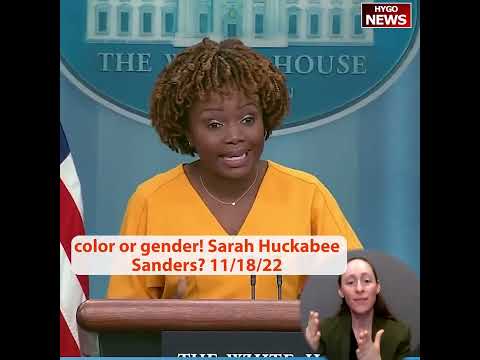
White House Celebrates “Firsts” From 2022 Midterms — Lists Women, Black, Lesbian, Latino, Gen Z, Trans Winners But Omits Sarah Huckabee Sanders, First Female Arkansas Governor
On 11/20/2022, the White House celebrated a series of “firsts” from the 2022 midterm elections, listing what they described as historic breakthroughs in identity representation. The list included: “a record number of female governors,” the first openly lesbian governors (Maura Healey of Massachusetts and Tina Kotek of Oregon), the first Black governor of Maryland (Wes Moore), the first Gen Z member of Congress (Maxwell Frost of Florida, “who is also Afro-Cuban”), the first trans man elected to a state legislature (James Roesener of New Hampshire), the first Latina to represent the Midwest (Delia Ramirez), the first Latino U.S. Senator from California (Alex Padilla), and African-American mayors in the four largest cities. Conspicuously absent from the list: Sarah Huckabee Sanders, who had just been elected as Arkansas’s first-ever female governor.
The White House List
The speaker presented the list with evident enthusiasm. “First, a record number of female governors were elected in this year’s midterms,” the speaker began.
“Maura Healey from Massachusetts and Tina Kotek of Oregon were elected the nation’s first openly lesbian governors. Wes Moore will be the first Black governor of Maryland. We have the first Gen Z member of Congress, Maxwell Frost of Florida, who is also Afro-Cuban. And in New Hampshire, James Roesener is the first trans man elected to a state legislature.”
“Delia Ramirez will become the first Latina to represent the Midwest, and Alex Padilla is the first Latino to be elected as a U.S. Senator from California. And lastly, the four largest cities in America — New York City, Los Angeles, Chicago, and Houston — are each going to be led by an African-American mayor.”
“There’s more progress to be made,” the speaker concluded.
The list was comprehensive in one sense and selectively curated in another. Each named individual represented a genuine identity-based milestone worth acknowledging. But the omissions were notable — particularly the absence of any Republican woman from a celebration of “firsts” in the 2022 elections.
The Sarah Huckabee Sanders Omission
The most glaring omission was Sarah Huckabee Sanders. On November 8, 2022, Sanders had been elected Governor of Arkansas — becoming the first woman ever elected governor of Arkansas in the state’s history. This was an unambiguous “first” by any standard: no woman had ever held the position of Arkansas governor before.
Sanders’s background made the omission even more striking. She had served as White House Press Secretary under Donald Trump, becoming only the third woman to hold that position. Her father, Mike Huckabee, had previously been Arkansas governor, giving her the additional distinction of being the first daughter to succeed a father as governor of the same state. Her election was therefore a “first” in at least two meaningful ways.
Yet Sanders didn’t appear in the White House celebration list. The omission was not coincidental — Sanders was a Republican, a Trump administration veteran, and a political opponent of the Biden White House. Her “first” was politically inconvenient to acknowledge.
The selective celebration of identity firsts based on party affiliation revealed what the White House’s celebration actually valued. It wasn’t “women in politics” in the abstract — it was “Democratic women in politics.” The frame of “firsts” was being used to highlight Democratic victories while excluding Republican ones, even when the Republican victories represented more significant historical milestones.
The Selective Identity Framework
The pattern extended beyond Sanders. The White House list included Democrats exclusively:
- Maura Healey (D-MA) and Tina Kotek (D-OR): Democratic governors
- Wes Moore (D-MD): Democratic governor
- Maxwell Frost (D-FL): Democratic House member
- James Roesener (D-NH): Democratic state legislator
- Delia Ramirez (D-IL): Democratic House member
- Alex Padilla (D-CA): Democratic senator
The four major city mayors mentioned were all Democrats, which was unsurprising given that all four cities were Democratic-dominated.
Every “first” celebrated by the White House was a Democratic victory. Not a single Republican “first” appeared on the list — even though Republican victories had also produced identity milestones. Sanders in Arkansas was the most prominent, but not the only one.
The Double Standard Problem
The selective celebration created a double standard that critics across the political spectrum noted. The rules appeared to be:
- Democratic firsts are celebrated and amplified by the White House, media, and Democratic allies.
- Republican firsts are ignored or minimized — treated as if they didn’t count or weren’t really “historic.”
- The framework of “representation matters” applies only to Democratic representation — when Republicans achieve representation milestones, the importance of representation is suddenly questioned.
This double standard undermined the broader “representation matters” argument. If representation was inherently valuable — if it was important for young girls to see women in power, for young Black boys to see Black men in leadership, for LGBTQ youth to see openly gay officials — then Sarah Huckabee Sanders’s election should have been celebrated just as much as Maura Healey’s. Both represented women achieving positions previously reserved for men.
But the White House didn’t treat them equally. Sanders’s “first” went unmentioned. Healey’s was celebrated. The difference wasn’t gender, achievement, or historical significance — it was party affiliation.
The Broader Pattern
The selective celebration of identity milestones was part of a broader pattern in Democratic political messaging. Representation was treated as politically valuable when achieved by Democrats but politically awkward when achieved by Republicans. Trailblazing was celebrated when the trailblazer held the right views and minimized when the trailblazer held the wrong ones.
This pattern extended to how major news outlets covered the 2022 elections. Sanders’s election received significantly less coverage than her “first woman governor of Arkansas” status might have warranted under a consistent standard. Meanwhile, other identity firsts received extensive celebratory coverage.
The inconsistency reflected what critics called “intersectionality with an asterisk” — a framework that valued certain identity categories (gender, race, sexual orientation) but only when combined with the correct political views. Republican women, Republican Black politicians, and Republican LGBTQ figures didn’t fit the framework because their politics disqualified them from being counted as progress.
Key Takeaways
- The White House celebrated a list of 2022 election “firsts” including women, Black, lesbian, Latino, Gen Z, and trans candidates.
- Every celebrated “first” was a Democratic victory; no Republican “firsts” appeared on the list.
- The most glaring omission was Sarah Huckabee Sanders, elected as the first woman ever to serve as Arkansas governor.
- The selective celebration revealed the White House’s framework: identity firsts mattered only when achieved by Democrats.
- The double standard undermined the broader “representation matters” argument by making it conditional on political alignment.
Transcript Highlights
The following is transcribed from the video audio (unverified — AI-generated from audio).
- A record number of female governors were elected in this year’s midterms.
- Maura Healey and Tina Kotek were elected the nation’s first openly lesbian governors.
- Wes Moore will be the first Black governor of Maryland.
- The first Gen Z member of Congress, Maxwell Frost of Florida, who is also Afro-Cuban.
- James Roesener is the first trans man elected to a state legislature.
- The four largest cities in America — New York City, Los Angeles, Chicago, and Houston — are each going to be led by an African-American mayor.
Full transcript: 137 words transcribed via Whisper AI.