 HYGO News
 WH doesn't 'have anything' on skyrocketing rent prices.
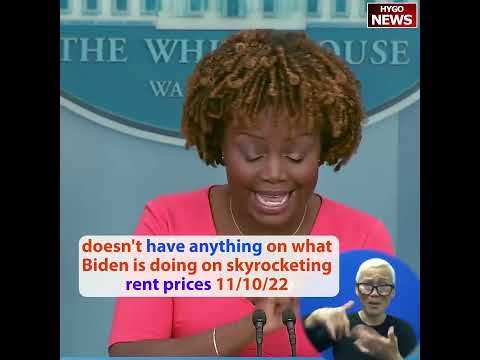
Reporter: Most Inflation Last Month Was Shelter Costs — What Is the White House Doing About Skyrocketing Rents? KJP: “I Don’t Have Anything Right Now to Share”
On 11/11/2022, a reporter pointed out that “most of the increase that we saw in inflation last month was due to rising costs for shelter” — housing and rent — but that President Biden’s statement on the CPI report didn’t mention this dominant inflation driver. The reporter asked: “What is the administration doing to contain the rapid run-up in rents right now?” White House Press Secretary Karine Jean-Pierre’s answer was remarkable for its emptiness: “I don’t have anything right now to share with you on that specific piece of the data.” On the issue driving the biggest share of inflation, affecting nearly every American household, the White House had nothing to say.
”Most of the Increase Was Shelter”
The reporter’s framing was based directly on the October 2022 Consumer Price Index report. “The CPI statement this morning from the President — most of the increase that we saw in inflation last month was due to rising costs for shelter,” the reporter said. “President Biden’s statement didn’t mention that.”
The data was unambiguous. The October CPI report showed shelter costs — which included rent, homeowners’ equivalent rent, and lodging — accounted for a substantial majority of the month’s inflation increase. Rent of primary residence was rising at its fastest pace in decades. Owners’ equivalent rent was similarly surging. Housing costs were the single largest component of the inflation Americans were experiencing.
Biden’s CPI statement had focused on declining gas prices, the Inflation Reduction Act, and the administration’s general economic progress. It had omitted the shelter cost story almost entirely — a striking omission for a statement about inflation. Shelter was the dominant inflation driver, yet it didn’t appear in Biden’s analysis.
”I Don’t Have Anything Right Now”
KJP’s response was one of her most revealing non-answers. “So I don’t have anything right now to share with you on that specific piece of the data,” KJP said.
“I don’t have anything” was a remarkable admission about the administration’s priorities. Shelter costs were the largest component of inflation — the thing that most directly affected household budgets, the metric that mattered most to voters experiencing the cost-of-living crisis. And the White House press secretary had nothing to say about it.
The response wasn’t a substantive defense of administration policy on housing. It wasn’t an explanation of why Biden’s statement omitted the shelter story. It wasn’t a promise to get back to the reporter with information. It was simply an acknowledgment that the White House wasn’t prepared to discuss the largest contributor to the inflation crisis.
The Housing Crisis KJP Couldn’t Address
The shelter inflation story was one of the most painful components of Americans’ economic experience. Rents had surged 30-40% in many major metropolitan areas over the previous two years. Homeowners faced rising mortgage payments as interest rates climbed above 7%. First-time buyers were being priced out of the market entirely. Landlords were passing their increased costs — from insurance, maintenance, and their own debt service — through to tenants.
The White House had few tools to address the crisis directly. Housing is primarily a state and local policy matter, and the federal government’s levers — housing vouchers, low-income housing tax credits, and various HUD programs — were blunt instruments that couldn’t quickly affect rental prices. The Federal Reserve’s interest rate increases, designed to fight inflation, were actually making the housing situation worse by driving up mortgage costs.
But the administration’s limited tools didn’t excuse the absence of any message. KJP could have articulated a theory of what the administration was doing, even if the tools were limited. She could have pointed to increased housing voucher funding, HUD initiatives, or coordination with state and local governments. She could have acknowledged the crisis and expressed concern for affected families.
Instead, she said “I don’t have anything” — suggesting the White House didn’t have a housing inflation strategy to articulate.
”Making Progress”
KJP tried to pivot to the administration’s general inflation messaging. “As you know, the report — the way that we saw it, and as the president says — it shows that we are making progress, which is important as we talk about CPI, on bringing inflation down,” KJP said.
The “making progress” framing was technically defensible. The headline inflation rate had declined slightly from September. But “making progress” required selectively focusing on the narrower decline rather than the broader picture: shelter costs were still rising aggressively, and the overall inflation rate remained at 40-year highs.
“The president clearly is going to continue to do the work to bring down costs for the American people,” KJP added. “We talked about the gas prices and also the Inflation Reduction Act, so that will continue to be. But that particular piece of the data, I don’t have anything to share with you.”
The contrast was stark. On gas prices, KJP had talking points. On the IRA, she had talking points. On shelter costs — the largest component of inflation — she had nothing. The asymmetry revealed the administration’s communication priorities: focus on what you can claim credit for, avoid discussing what you can’t.
The Shelter Inflation Numbers
The October 2022 CPI report, which the reporter referenced, showed shelter costs rising at some of the fastest rates in decades. Rent of primary residence was up approximately 7.5% year-over-year — the highest rate since the early 1980s. Owners’ equivalent rent was up similarly. These numbers translated to brutal real-world experiences for American families:
- A family paying $2,000 per month in rent was paying $150 more than a year earlier
- First-time homebuyers faced mortgage payments roughly 60% higher than they would have been two years earlier at the same home price
- Landlords dealing with rising costs, taxes, and insurance were pushing increases through to tenants
- Housing supply remained constrained by zoning restrictions, construction costs, and labor shortages
The shelter crisis affected roughly every American household — renter or owner. It was arguably the single most important economic issue facing families in November 2022. And the White House press secretary had nothing to say about it.
Key Takeaways
- A reporter pointed out that most of October’s inflation was shelter costs, and Biden’s statement didn’t mention it; KJP responded “I don’t have anything right now to share.”
- Shelter cost inflation — rent and owners’ equivalent rent — was rising at its fastest pace since the early 1980s.
- KJP had detailed talking points for gas prices and the IRA but nothing for the largest component of inflation affecting American households.
- The asymmetry revealed the administration’s communication priority: discuss what you can claim credit for, avoid what you can’t.
- The Federal Reserve’s rate hikes, designed to fight inflation, were actually making housing affordability worse by driving mortgage rates above 7%.
Transcript Highlights
The following is transcribed from the video audio (unverified — AI-generated from audio).
- Most of the increase that we saw in inflation last month was due to rising costs for shelter.
- President Biden’s statement didn’t mention that.
- What is the administration doing to contain the rapid run-up in rents right now?
- I don’t have anything right now to share with you on that specific piece of the data.
- The report shows that we are making progress, which is important as we talk about CPI.
- That particular piece of the data, I don’t have anything to share with you.
Full transcript: 152 words transcribed via Whisper AI.