 HYGO News
 WH confirms Biden opposes repealing covid vaccine mandate for U.S. military members
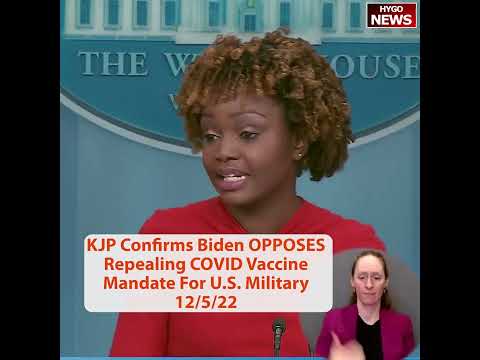
KJP Confirms Biden Opposes Repealing Military COVID Vaccine Mandate in NDAA — “Secretary of Defense Has Recommended Retaining the Mandate”
On 12/7/2022, the White House confirmed that President Biden opposed Congressional efforts to repeal the COVID-19 vaccine mandate for U.S. military service members through the National Defense Authorization Act (NDAA). A reporter asked Press Secretary Karine Jean-Pierre about the administration’s position: “What about with Congress considering repealing the COVID vaccine mandate for service members in the NDAA? John Kirby spoke earlier about the president’s position, Secretary Austin’s position of wanting, obviously, to keep it. So what is the White House prepared to do for that aspect of it? And is the president personally engaging with lawmakers on this?” KJP confirmed that incoming House Speaker Kevin McCarthy had raised the issue with Biden in their recent meeting, that Biden “told him that he would consider it,” but ultimately deferred to Defense Secretary Austin, who “has recommended retaining the mandate.” The exchange confirmed that despite Congressional pressure to repeal what critics saw as an outdated requirement, the Biden administration was committed to keeping the vaccine mandate in place.
The Congressional Push to Repeal
The reporter’s question referenced an active legislative debate. “What about with Congress considering repealing the COVID vaccine mandate for service members in the NDAA?” the reporter asked.
The NDAA — the National Defense Authorization Act — is annual legislation that sets Pentagon policy and authorizes defense spending. By December 2022, the bill had become the vehicle for a Republican-led effort to repeal the military’s COVID-19 vaccination requirement. The requirement, imposed in August 2021, had resulted in thousands of service members being discharged for refusing vaccination — losses that critics argued were unnecessary and damaging to military readiness.
The political dynamics had shifted in favor of repeal. Republicans had won control of the House in the November 2022 midterm elections. Incoming Speaker Kevin McCarthy had made repealing the military vaccine mandate a priority. The combination of Republican House control plus existing Senate moderates willing to support repeal created a legislative pathway that hadn’t existed earlier in the year.
The President’s Meeting with the “Big Four”
KJP confirmed that the issue had come up in a recent White House meeting. “When the president met with the big four just last week, as you all know, as you know, leader McCarthy raised eliminating the requirement that service members be vaccinated against COVID-19. So clearly they had a conversation,” KJP said.
The “big four” referred to the congressional leadership — the House Speaker, House Minority Leader, Senate Majority Leader, and Senate Minority Leader (or their incoming counterparts in the transition period after the midterm elections). McCarthy, as incoming Speaker-designate, was participating in these meetings to coordinate on legislation that would pass before the new Congress took office in January.
McCarthy raising the vaccine mandate issue directly with Biden was politically significant. It established that:
The issue had reached the highest level — McCarthy wasn’t leaving this to subordinates; he raised it directly with the President.
Republicans were making it a priority — Among the many issues McCarthy could have raised, the vaccine mandate was one he chose to bring up.
Biden had been directly informed of Republican positions — He couldn’t claim to be unaware of the repeal effort.
A specific negotiation had occurred — The leaders had discussed the mandate, creating a basis for expected follow-through.
”He Would Consider It”
KJP characterized Biden’s response to McCarthy. “The president told him that he would consider it, but also made clear that he wanted to consult with the Pentagon,” KJP said.
The “would consider it” phrasing was diplomatic. Biden hadn’t committed to supporting repeal, but he hadn’t ruled it out either. The commitment was to consider — a minimal but non-dismissive response that kept negotiations open.
The Pentagon consultation caveat was important. Biden was essentially saying that his decision would depend on what his military leadership recommended. This framing allowed Biden to:
Avoid direct political responsibility — If the mandate was kept, Biden could say he was following military advice.
Defer to specialized expertise — Military health policy was a Pentagon matter, making deference reasonable.
Maintain flexibility — The consultation language didn’t bind Biden to any specific outcome.
Set up an expected outcome — Observers could predict that the Pentagon would recommend keeping the mandate, given Secretary Austin’s known position.
Secretary Austin’s Position
KJP confirmed the Pentagon’s recommendation. “Since then, as we’ve all heard, the Secretary of Defense has recommended retaining the mandate,” KJP said.
Secretary Austin’s position was well-established before the NDAA debate reached its final stages. Austin had publicly stated his view that the vaccine mandate should remain in place. His rationale, which KJP alluded to but didn’t detail, was that the mandate was a readiness issue — ensuring service members were healthy and deployable in all environments.
The sequence KJP described — Biden saying he would consider it, then consulting the Pentagon, then the Pentagon recommending retention — was a path that led predictably to mandate retention. Biden had known Austin’s position before the McCarthy conversation. The “consultation” wasn’t likely to produce a reversal of Austin’s publicly-stated view.
This made the “will consider it” response functionally equivalent to saying no. The administration was rejecting the repeal, but doing so through a process that allowed it to claim it had genuinely considered the matter rather than dismissing it out of hand.
”Nothing New. History Here. Precedent.”
KJP’s explanation extended to the broader context. “This is nothing new. Again, there’s history here. There’s precedent,” KJP said.
The “nothing new” framing was a standard KJP technique for normalizing administration positions by portraying them as continuous with historical practice. The military had required various vaccinations throughout its history — smallpox, anthrax, yellow fever, and many others. Adding COVID-19 to the list of required vaccinations fit the broader pattern.
The “precedent” argument had some legitimacy. Military members have historically been required to accept many medical interventions that civilians could refuse. The reasoning was that service members were subject to different health-protection requirements because of their deployment environments, operational needs, and the government’s obligation to maintain a ready force.
But critics argued that COVID-19 was different. Unlike traditional military vaccinations:
The mRNA technology was new — Without the decades of use history of other military vaccines.
Natural immunity was widespread — Many service members had already been infected.
The vaccine didn’t prevent transmission — Making the “readiness” argument weaker than for truly disease-preventing vaccines.
The consequences were severe — Discharge rather than temporary restrictions.
The “precedent” argument, in critics’ view, papered over these differences.
The Readiness Debate
The underlying policy debate centered on military readiness. The administration argued that the vaccine mandate enhanced readiness by ensuring healthy service members. Repeal advocates argued that the mandate hurt readiness by forcing out thousands of trained personnel.
The data was genuinely disputed. By late 2022, the military had discharged approximately 8,000 service members for refusing vaccination. These were generally experienced personnel — basic training had been completed, and initial deployments had been served. Their replacements would require years of training to reach equivalent capability.
On the other hand, the administration argued that unvaccinated service members posed operational risks. A COVID outbreak on a ship, in a forward-deployed unit, or in a sensitive position could disable an entire operation. The mandate, in this view, preserved operational capability even if it came at the cost of some individual personnel losses.
Both arguments had merit. The political question was which set of costs mattered more — and that question had predictably partisan answers.
The NDAA’s Ultimate Path
The exchange previewed what would actually happen with the NDAA. The final 2023 NDAA, passed shortly after this exchange, did include a repeal of the military COVID-19 vaccine mandate. The Republican-led House and a sufficient number of Senate Democrats (along with Republicans) had combined to end the requirement.
Biden had signed the bill despite the mandate repeal provision. The “will consider it” position had been tested by legislative reality. When Congress included the repeal in must-pass defense legislation, Biden faced a choice between signing the bill with the repeal or vetoing it entirely. He chose to sign.
The practical result was that KJP’s December 7 statement — describing the administration’s opposition to repeal — reflected the administration’s preferred policy but not the policy that would actually be in effect within weeks. Congress’s action overrode the administration’s position.
Personal Engagement with Lawmakers
The reporter had asked a specific question: “Is the president personally engaging with lawmakers on this?”
KJP’s response confirmed that some engagement had occurred — Biden had spoken with McCarthy during the big four meeting. But KJP didn’t describe any active Biden lobbying beyond that single conversation. The president hadn’t apparently called individual senators, made public statements opposing the repeal, or used the bully pulpit to oppose the congressional effort.
This relatively passive engagement was notable. If the administration truly opposed the repeal, one might have expected more aggressive presidential lobbying. The actual engagement pattern suggested that the administration was prepared to accept the repeal even as it stated opposition — not fighting hard enough to derail it.
The political calculation was probably that aggressive opposition would cost more politically than accepting the repeal. By late 2022, COVID-19 policies had become deeply unpopular. Fighting Congress to preserve a vaccine mandate would have reinforced an unwelcome narrative about the administration being wedded to pandemic-era restrictions that voters wanted to end.
Key Takeaways
- A reporter asked KJP about Congressional efforts to repeal the military COVID-19 vaccine mandate through the NDAA.
- KJP confirmed that incoming Speaker Kevin McCarthy had raised the issue directly with Biden during a recent “big four” leadership meeting.
- Biden told McCarthy he “would consider it” but wanted to consult the Pentagon first.
- Defense Secretary Lloyd Austin had subsequently recommended retaining the mandate, effectively resolving the consideration in favor of keeping it.
- Despite the administration’s stated opposition, Congress ultimately included the mandate repeal in the final NDAA, which Biden signed.
Transcript Highlights
The following is transcribed from the video audio (unverified — AI-generated from audio).
- What about with Congress considering repealing the COVID vaccine mandate for service members in the NDAA?
- John Kirby spoke earlier about the president’s position, Secretary Austin’s position of wanting, obviously, to keep it.
- When the president met with the big four just last week, leader McCarthy raised eliminating the requirement that service members be vaccinated against COVID-19.
- The president told him that he would consider it, but also made clear that he wanted to consult with the Pentagon.
- The Secretary of Defense has recommended retaining the mandate.
- This is nothing new. Again, there’s history here. There’s precedent.
Full transcript: 151 words transcribed via Whisper AI.