 HYGO News
 WH Can't Say If Biden Has Even Been Briefed On National Essential Medicine Shortage
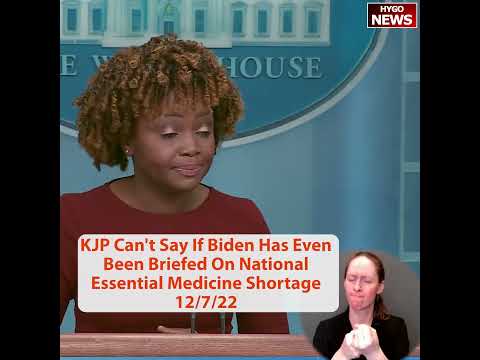
KJP Can’t Say If Biden Has Been Briefed on Children’s Medicine Shortages — “FDA and HHS Don’t Have Much Visibility in Supply Chain Issues”
On 12/7/2022, a reporter followed up with White House Press Secretary Karine Jean-Pierre on the issue of nationwide children’s medicine shortages — asking specifically whether President Biden had been personally engaged with the crisis or briefed on it. “My colleague had asked you on Monday about the drug shortages question and just wanted to follow up on that. Is this something that the President has been engaged in? Has he been briefed on medicine shortages?” the reporter asked. KJP couldn’t confirm Biden’s engagement, instead reciting generic administration monitoring language and repeating her prior line that “medicine shortages are not uncommon.” When a reporter noted the FDA’s admitted lack of visibility into pharmaceutical supply chains — companies had to voluntarily report shortages — and asked if the White House thought the FDA should get more authority, KJP offered another non-answer, saying “FDA and HHS are not going to be able to do that.”
The Follow-Up Question
The reporter referenced the prior exchange. “My colleague had asked you on Monday about the drug shortages question and just wanted to follow up on that,” the reporter said.
The Monday exchange had been an earlier question from a different reporter asking about the same children’s medicine shortage crisis — Tylenol, ibuprofen, and amoxicillin shortages during the “tripledemic” respiratory illness season. KJP had responded with her “drug shortages are not uncommon” framing that had been criticized as dismissive of parents’ concerns.
The follow-up question narrowed the inquiry to the President specifically. “Is this something that the President has been engaged in? Has he been briefed on medicine shortages?” the reporter asked.
The narrowing was deliberate. The earlier question had been about the administration’s response generally. This follow-up was about Biden personally. Was the President aware of the shortages? Had he been briefed by staff? Was he directing response efforts? These were questions about presidential engagement, not just administration posture.
The Presidential Engagement Question
The focus on Biden personally had several purposes:
Testing presidential awareness — Did Biden even know about the shortages?
Assessing policy priority — If Biden was personally engaged, the issue was a priority; if not, it wasn’t.
Evaluating executive direction — Administration responses typically reflect presidential priorities.
Creating accountability — A “yes he’s been briefed” answer created expectations of action.
The question was also testing whether KJP knew. Press secretaries should know whether their principal had been briefed on major public concerns. If KJP couldn’t answer the question, that was itself telling — either about her access to the President or about whether briefings had occurred.
The Non-Answer
KJP’s response didn’t address the presidential engagement question. “So let me just say this and share where we are. So as I’ve said, as you mentioned, on Monday I was asked by your colleague, I believe Ben. The administration is closely monitoring for the possibility of any national shortages. Medicine shortages are not uncommon. This is something that FDA and HHS is managing,” KJP said.
The response was notable for what it didn’t include. KJP didn’t say:
- Yes, the President has been briefed
- No, the President hasn’t been briefed
- The President has directed specific action
- The President is personally engaged in the response
- Anything that directly answered the question about presidential engagement
Instead, KJP recited general administration talking points. The administration was “closely monitoring.” The shortages were “not uncommon.” The agencies were “managing” the situation. These were impersonal, institutional statements that didn’t put Biden specifically in the response chain.
The conspicuous omission of any Biden-specific engagement was itself informative. If Biden had been briefed, KJP could have said so. The inability to confirm briefing suggested that either:
- Biden hadn’t been briefed
- KJP didn’t know whether Biden had been briefed
- Biden had been briefed but the administration didn’t want to attach him personally to the issue
”Medicine Shortages Are Not Uncommon”
KJP repeated her Monday framing. “Medicine shortages are not uncommon,” she said again.
The repetition confirmed that this was the administration’s settled framing for the shortage crisis. By characterizing the situation as typical rather than unusual, the administration was:
Minimizing the urgency — Shortages as routine didn’t warrant extraordinary response.
Deflecting accountability — If shortages were common, they weren’t this administration’s specific responsibility.
Avoiding comparisons — The baby formula shortage had drawn extraordinary intervention; “not uncommon” shortages didn’t.
Managing expectations — Don’t expect dramatic action for a typical situation.
But the framing remained contested. Many parents, pharmacists, and pediatricians were characterizing the children’s medicine shortages as genuinely unusual. The combination of nationwide scope, basic medication types, affected population (sick children), and duration made the situation stand out. The administration’s insistence on typicality was a political positioning rather than a description all observers would accept.
”Ready to Help When Needed”
KJP’s statement continued with conditional language. “But as I just stated, we are ready to help when needed when those requests come in,” KJP said.
The “when needed” and “when requests come in” framing was passive. The administration wasn’t initiating action — it was awaiting requests. This approach made sense for genuinely minor issues where state and local response was adequate. But for a nationwide shortage affecting millions of families, the administration’s passivity was notable.
The comparison to the baby formula shortage was again instructive. In that case, the administration had initiated action — invoking the Defense Production Act, coordinating international shipments, providing federal direction. For the medicine shortages, the administration was waiting to be asked for help.
The Supply Chain Visibility Problem
A reporter followed with a substantive policy question. “The FDA and agencies don’t have much visibility in supply chain issues. They’ve said that they’re really dependent on the industry to give them information on any issues and whether there are shortages. Does the White House think it’s time for the FDA to get more involved so that they can get better information from companies?” the reporter asked.
This question raised a real regulatory issue. The FDA’s shortage monitoring depended on voluntary industry reporting:
- Pharmaceutical companies self-reported production problems
- The FDA had limited authority to demand production data
- Supply chain disruptions often became apparent only after shortages emerged
- The FDA was typically reactive rather than proactive
Critics had long argued that this framework was inadequate. The COVID pandemic had exposed supply chain vulnerabilities. The current children’s medicine shortages confirmed that the voluntary reporting system was failing to provide early warning of critical shortages.
The reporter was asking whether the administration thought this situation should change. Did the White House support giving the FDA more authority to:
- Require detailed supply chain reporting
- Demand production data from manufacturers
- Pre-position emergency supplies
- Coordinate production expansion
- Impose mandates during shortage emergencies
These were significant policy questions with real implications for the pharmaceutical industry and public health.
The Evasive Answer
KJP’s answer didn’t engage with the policy question. “Well I just stated in my layout here that FDA and HHS are not going to be able to do that,” KJP said.
The response was confusing. The reporter had asked whether the White House thought FDA and HHS should get more authority. KJP’s answer — that they weren’t going to be able to do that — was either:
A factual claim that additional authority was impossible — Which wasn’t true; Congress could grant authority.
A description of current limitations — Which was true but didn’t address whether changes should be made.
A declaration that the administration wouldn’t seek changes — Which was implicit but not stated directly.
A verbal stumble — KJP may have intended something different.
Whatever the intended meaning, the answer didn’t address the substantive policy question. The administration’s position on whether the FDA should have more authority to prevent future shortages remained unclear.
The Pattern of Disengagement
The exchange confirmed a pattern in how the administration was handling the children’s medicine shortage:
Dismiss urgency — “Not uncommon” Deflect to agencies — FDA and HHS “managing” Avoid presidential ownership — Can’t confirm Biden has been briefed Wait for requests — “Ready to help when needed” Avoid policy commitments — Vague answers on regulatory authority
This pattern meant that the administration’s response to the shortage crisis was essentially to not have a response. The framing was that the shortage didn’t require response; the deflection ensured that any response would be bureaucratic rather than presidential; the waiting posture meant no proactive action; and the policy evasion meant no systemic improvements would be pursued.
For families dealing with sick children and unavailable medications, this pattern was frustrating. Real problems were being treated as abstractions. Parents couldn’t find Tylenol for their fevered children while the White House maintained that medicine shortages were “not uncommon” — offering no personal presidential engagement and no proactive policy response.
The Political Context
The administration’s approach reflected political calculations about which problems deserved presidential attention:
Baby formula shortage (earlier 2022) — Received presidential-level response with emergency interventions.
Children’s medicine shortage (late 2022) — Received agency-level response with dismissive framing.
The difference wasn’t the nature of the problem — both involved basic goods for children. The difference was probably political:
- Baby formula had been a peak crisis when Republicans had been attacking the administration
- Children’s medicine had emerged as Republicans were taking House control
- Baby formula had concentrated on specific brands and plants
- Children’s medicine was more diffuse and harder to address with dramatic action
- Baby formula had produced opportunities for visible success
- Children’s medicine response had fewer clear win scenarios
The administration’s triage of which crises warranted executive attention prioritized politically advantageous responses over consistent crisis engagement.
Key Takeaways
- A reporter followed up on children’s medicine shortage questions, asking whether Biden personally had been engaged or briefed.
- KJP couldn’t confirm Biden’s engagement, deflecting to general administration monitoring language.
- She repeated her “medicine shortages are not uncommon” framing from two days earlier.
- A reporter raised the FDA’s admitted lack of visibility into pharmaceutical supply chains due to dependence on voluntary industry reporting.
- KJP gave a confusing response (“FDA and HHS are not going to be able to do that”) that didn’t address whether the White House supported expanded FDA authority.
Transcript Highlights
The following is transcribed from the video audio (unverified — AI-generated from audio).
- My colleague had asked you on Monday about the drug shortages question and just wanted to follow up on that.
- Is this something that the President has been engaged in? Has he been briefed on medicine shortages?
- The administration is closely monitoring for the possibility of any national shortages.
- Medicine shortages are not uncommon. This is something that FDA and HHS is managing.
- The FDA and agencies don’t have much visibility in supply chain issues. They’ve said that they’re really dependent on the industry to give them information.
- Does the White House think it’s time for the FDA to get more involved? — I just stated in my layout here that FDA and HHS are not going to be able to do that.
Full transcript: 186 words transcribed via Whisper AI.