 HYGO News
 WH can't name a single swing-state Democrat who has asked Biden to come campaign with them
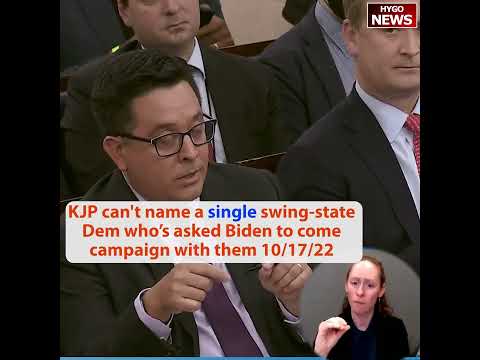
KJP Can’t Name a Single Swing-State Democrat Who Asked Biden to Campaign With Them — “I Don’t Have Any Calls to Read Out”
On 10/17/2022, a reporter laid out a devastating geography lesson for White House Press Secretary Karine Jean-Pierre: Biden was campaigning in D.C., New Jersey, New York, Massachusetts, Maryland, California, Oregon, and Colorado — all safely blue states — while his only planned visits to competitive states were “behind closed doors” private events. The reporter asked whether the White House Office of Political Affairs had received calls from Democrats in Arizona, Nevada, Georgia, Wisconsin, or Michigan asking Biden to campaign with them. KJP’s answer was a painful admission: “I don’t have any calls to read out. We don’t have any calls or personal conversations to read out.”
The Geography of Avoidance
The reporter’s question methodically exposed the pattern. “He’s giving a speech tomorrow in D.C. He’s given fundraisers in New Jersey and New York. He campaigned with Democratic governor candidates in Massachusetts and Maryland,” the reporter said. “And then he was in California, Oregon, and Colorado next week.”
Every location on that list was a safely Democratic state where Biden’s presence could only help — or at minimum, couldn’t hurt. Massachusetts, Maryland, California, Oregon, Colorado, New York, New Jersey, and D.C. were all states Biden won by double digits in 2020. Campaigning in these locations was the political equivalent of preaching to the choir — it generated friendly crowds and favorable local coverage without risking the kind of association that could cost a vulnerable candidate in a competitive race.
“Yes, he has plans to be in Pennsylvania and Florida,” the reporter continued, “but behind closed doors, with two of the Democratic candidates.”
The “behind closed doors” detail was critical. Even in the two competitive states Biden planned to visit, his appearances were private — no cameras, no public rallies, no images of local candidates standing alongside the president. The visits were designed to be invisible to voters, generating fundraising dollars without generating the optics that Republicans could weaponize.
”Arizona, Nevada, Georgia, Wisconsin, Michigan”
The reporter then named the five states that would determine control of the Senate — every one a genuine swing state with a critical race. “There’s a White House Office of Political Affairs. Have they been getting phone calls from candidates in some of those other states — Arizona, Nevada, Georgia, Wisconsin, Michigan — to say, ‘We’d love to have the President come’?” the reporter asked.
The question was precision journalism. By naming the specific states where Senate control would be decided, the reporter made it impossible for KJP to deflect with generalities about Biden’s “visibility” or “travel schedule.” Either Democrats in those states had requested Biden’s presence, or they hadn’t. The answer would reveal whether the president’s own party viewed him as an asset or a liability in the races that mattered most.
”I Don’t Have Any Calls to Read Out”
KJP’s answer confirmed what everyone suspected. “Look, I don’t have any calls to read out,” KJP said. “We don’t have any calls or personal conversations to read out.”
The double negative construction — “we don’t have any calls” — was the clearest possible admission that no swing-state Democrat had asked Biden to campaign with them. If even one candidate in Arizona, Nevada, Georgia, Wisconsin, or Michigan had extended an invitation, KJP would have named them. The silence was the answer.
“Look, the way we see it — he’s going to go where he is needed the most,” KJP continued. “And at this time, we don’t have any additional — we just don’t have any additional travel to lay out for you.”
The phrase “where he is needed the most” was doing heavy rhetorical lifting. If Biden was going “where he is needed the most,” and he was going to Massachusetts, Maryland, and California, the implication was that safely blue states needed him more than the swing states that would determine his party’s Senate majority. The logical alternative — that swing-state candidates didn’t want him — was the conclusion KJP was desperately trying to avoid stating explicitly.
The Contrast With Obama and Trump
The dynamic was historically unusual. Sitting presidents typically campaign aggressively for their party’s candidates in midterm elections, particularly in competitive races. Barack Obama held large public rallies across swing states in 2010 and 2014. Donald Trump barnstormed swing states in 2018 and continued holding massive rallies for Republican candidates throughout 2022.
Biden’s absence from swing-state campaign stages was particularly notable because his party was fighting to retain razor-thin Senate and House majorities. The Senate was 50-50. The House margin was single digits. Every competitive race mattered. Yet the president could not find a single swing-state candidate willing to share a public stage with him.
The contrast with Obama was especially stark. Obama’s 2022 midterm campaign schedule included public rallies in Georgia, Nevada, Arizona, Michigan, Wisconsin, and Pennsylvania — precisely the states where Biden was absent. Obama went where Biden could not, serving as the Democratic Party’s public campaigner-in-chief because the actual president was too unpopular to fill the role.
The Office of Political Affairs
The reporter’s mention of the White House Office of Political Affairs was pointed. The office exists specifically to coordinate the president’s political activities, including campaign appearances with party candidates. Its phone should have been ringing off the hook three weeks before a midterm election in which control of Congress was at stake.
The fact that KJP could not name a single incoming request from a swing-state candidate suggested one of two things: either the office had received requests and KJP was instructed not to acknowledge them (unlikely, since confirming requests would have helped the narrative), or no competitive-state Democrats had asked — because they had calculated, correctly, that Biden’s presence would hurt more than help.
Private Fundraisers: The Shadow Campaign
Biden’s midterm contribution was not zero — it was hidden. Through private fundraisers in New York, New Jersey, and other donor-rich areas, Biden was raising millions for Democratic candidates and party committees. These events were closed to press, produced no public images of Biden alongside candidates, and generated no footage that could appear in Republican attack ads.
The strategy was financially valuable but politically revealing. It acknowledged that Biden’s most useful contribution to the Democratic midterm effort was money, not presence. The president of the United States had become a behind-the-scenes ATM for his own party — welcome in donor living rooms but unwelcome on public stages.
The Midterm Results
When the votes were counted in November 2022, Democrats performed better than expected — holding the Senate with a net gain of one seat and losing the House by a narrower margin than historical patterns predicted. The strong performance was attributed to backlash against the Dobbs abortion decision, rejection of Trump-endorsed candidates, and effective Democratic messaging on democracy.
But notably, Democratic success came in races where Biden was absent from the campaign trail. The candidates who won in swing states — Warnock in Georgia, Kelly in Arizona, Fetterman in Pennsylvania — did so without Biden at their side. The midterm result was a vindication of the party’s strategy to keep Biden in the background — and an implicit confirmation that KJP’s “bizarre question” dismissal was itself the bizarre position.
Key Takeaways
- A reporter listed Biden’s campaign schedule — all safely blue states — and asked if any swing-state Democrats had invited him to campaign with them.
- KJP admitted “I don’t have any calls to read out” — confirming no Democrats in Arizona, Nevada, Georgia, Wisconsin, or Michigan had requested Biden’s presence.
- Biden’s only planned visits to competitive states were “behind closed doors” private events with no public campaign appearances.
- Obama filled the swing-state campaign role that Biden could not, holding public rallies in Georgia, Nevada, Arizona, Michigan, Wisconsin, and Pennsylvania.
- Biden’s primary midterm contribution was private fundraising — financially valuable but politically revealing about his standing with his own party.
Transcript Highlights
The following is transcribed from the video audio (unverified — AI-generated from audio).
- He’s giving a speech tomorrow in D.C. He’s given fundraisers in New Jersey, New York. He campaigned with Democrats in Massachusetts and Maryland.
- He has plans to be in Pennsylvania and Florida but behind closed doors with two of the Democratic candidates.
- Have they been getting phone calls from candidates in Arizona, Nevada, Georgia, Wisconsin, Michigan to say we’d love to have the President come?
- I don’t have any calls to read out. We don’t have any calls or personal conversations to read out.
- He’s going to go where he is needed the most.
- We just don’t have any additional travel to lay out for you.
Full transcript: 155 words transcribed via Whisper AI.