 HYGO News
 WH can't 'get into deep specifics' about China's 'misconception' about US
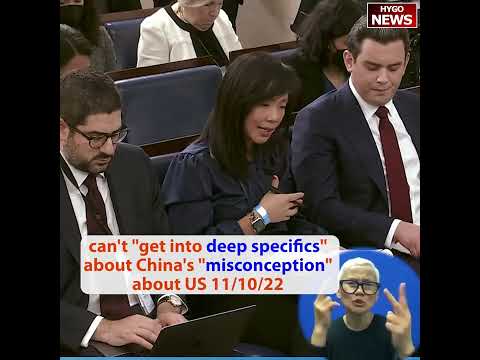
Reporter Asks What Misconceptions China Has About the US Ahead of Biden-Xi Meeting — KJP: “I Don’t Want to Get Into Deep Specifics”
On 11/11/2022, ahead of President Biden’s planned in-person meeting with Chinese President Xi Jinping at the G20 summit in Bali, a reporter asked White House Press Secretary Karine Jean-Pierre what misconceptions the administration believed China had about the United States. An administration official had said the meeting’s objective was to “deepen understanding of each other’s priorities” and reduce “misunderstanding and misperceptions” — a framing that implied China was operating on mistaken assumptions the U.S. wanted to correct. KJP’s response was evasive: “I don’t want to get into deep specifics.” On one of the most consequential foreign policy relationships in the world, the White House couldn’t articulate what it believed Beijing misunderstood about Washington.
The Framing: Reducing “Misunderstanding”
The reporter was building on language from a prior White House readout. “An administration official said that one of the main objectives is to deepen their understanding of each other’s priorities, with a goal of reducing misunderstanding and misperceptions,” the reporter noted. “What do you think are some misconceptions, misperceptions, misunderstandings that China has about the US?”
The question was pointed. If the administration believed China had misconceptions about the United States — and was framing the Biden-Xi meeting as an opportunity to correct them — the White House should have been prepared to identify those misconceptions. You can’t correct a misunderstanding if you can’t articulate what it is.
The “misconception” framing itself was diplomatically significant. It implied that the U.S.-China relationship tensions were partly a matter of communication rather than substantive disagreement. This framing was more flattering to both sides than the alternative interpretation — that the two countries had genuine conflicts of interest on Taiwan, trade, technology, human rights, and regional security.
”I Don’t Want to Get Into Deep Specifics”
KJP’s response was characteristic evasion. “So look, you know, I don’t — don’t want to get into deep specifics,” KJP said. “You know, I think you guys have followed the relationship between the two leaders over the last 20-plus months.”
The deferral to past reporting was a form of “you already know this” dismissal. But the reporter was specifically asking KJP to articulate current administration thinking ahead of a major diplomatic meeting. Past reporting didn’t answer the specific question about what misconceptions the White House believed Beijing held.
The “deep specifics” qualifier was interesting. KJP was suggesting that identifying Chinese misconceptions would require detailed analysis she couldn’t share publicly. But the question didn’t require classified intelligence or sensitive diplomatic details — it required articulating the administration’s general analysis of where Chinese understanding of U.S. positions was incorrect.
A prepared press secretary could have offered general answers: China might misunderstand American commitment to Taiwan’s defense, American willingness to confront economic coercion, American unity with allies on technology restrictions, or American determination to enforce human rights concerns. Any of these would have been substantive without being classified.
KJP had none of these. Her evasion suggested either that the administration didn’t have a clear analysis of Chinese misperceptions or that she wasn’t briefed on the talking points.
”The Face-to-Face Leader-to-Leader Conversation”
KJP pivoted to the general importance of direct dialogue. “What’s important to note is that the president really thinks it’s important to have that face-to-face, leader-to-leader conversation,” KJP said. “The president and Xi have spoken — I think about five times, which we’ve all read out to you — when they have spoken, and this will be the first time they’ll be in person.”
The shift to process — the importance of face-to-face meetings — was a diplomatic cliché that avoided the substantive question. Everyone agreed that leader-to-leader conversations were valuable. The question wasn’t whether the meeting was worthwhile but what the White House thought China misunderstood about the United States.
The clarification that Biden and Xi had spoken approximately five times was technically accurate but underscored the limited nature of the relationship. Xi had been extraordinarily selective about foreign travel since the COVID-19 pandemic, rarely meeting with foreign leaders in person. The Bali G20 was one of his first major international trips. Biden, meanwhile, had traveled extensively but had not previously met Xi face-to-face as president.
The Strategic Context
The Biden-Xi meeting took place against a backdrop of increasing U.S.-China tensions. The previous year had seen:
- Taiwan: Chinese military exercises around Taiwan following Speaker Pelosi’s August 2022 visit; accelerating Chinese preparations for potential military action against the island.
- Trade and Technology: The Biden administration’s October 2022 export controls on advanced semiconductor technology to China, described by analysts as the most aggressive trade restrictions since the Cold War.
- Military Posture: Chinese military harassment of U.S. aircraft and ships in the South China Sea; expanding Chinese naval capabilities.
- Domestic Chinese Politics: Xi’s consolidation of power at the 20th Party Congress in October 2022, with a leadership team of loyalists committed to his agenda.
- Economic Coercion: Chinese economic pressure on allies and partners, including Australia, Lithuania, and South Korea.
In this environment, identifying Chinese “misconceptions” about the U.S. should have been central to American diplomatic preparation. What did Beijing need to understand differently about American commitment to Taiwan? American technology export enforcement? American willingness to impose costs for coercion against allies?
KJP’s inability to articulate any of this suggested either that the administration hadn’t developed clear answers or that it preferred not to state them publicly before the meeting.
The Xi Preparation Gap
The contrast between American and Chinese preparation for the meeting was notable. Xi had spent weeks consolidating his domestic political position at the Party Congress. He had prepared specific demands and objectives. Chinese officials had been clear about what they wanted from the meeting — stabilization of the relationship, reduction of U.S. pressure on Taiwan, relaxation of technology restrictions.
The Biden team’s preparation seemed less focused. KJP couldn’t articulate specific misconceptions to correct. The readouts of prior Biden-Xi calls had been general. The administration’s stated goals — “deepen understanding” and “establish a floor” — were vague enough to be meaningless as actionable objectives.
The preparation gap mattered because high-stakes diplomatic meetings typically favor the side with clearer objectives. When one leader knows exactly what he wants and the other speaks in generalities about “understanding,” the clearer side usually gets more of what it wants. Xi came to Bali with specific demands; Biden came with general aspirations.
Key Takeaways
- A reporter asked what misconceptions China had about the US ahead of Biden’s planned G20 meeting with Xi Jinping; KJP couldn’t articulate any.
- KJP said “I don’t want to get into deep specifics” — despite the question not requiring classified information, just general administration analysis.
- She pivoted to the importance of “face-to-face, leader-to-leader conversation” — a process answer to a substantive question.
- The meeting came amid serious U.S.-China tensions over Taiwan, semiconductor export controls, military confrontations, and Xi’s consolidation of power.
- The contrast between American and Chinese preparation was notable — Xi came to Bali with specific demands while Biden’s team offered vague aspirations about “understanding.”
Transcript Highlights
The following is transcribed from the video audio (unverified — AI-generated from audio).
- An administration official said that one of the main objectives is to deepen their understanding of each other’s priorities.
- With a goal of reducing misunderstanding and misperceptions.
- What do you think are some misconceptions, misperceptions, misunderstandings that China has about the US?
- I don’t — don’t want to get into deep specifics.
- The president really thinks it’s important to have that face-to-face, leader-to-leader conversation.
- The president and Xi have spoken — I think about five times — and this will be the first time they’ll be in person.
Full transcript: 152 words transcribed via Whisper AI.