 HYGO News
 WH brushes off question on common medicine shortages facing Americans
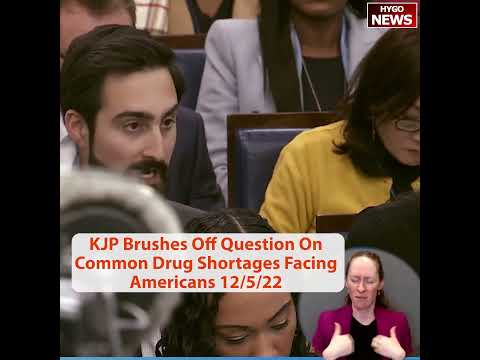
KJP: “Drug Shortages Are Not Uncommon” — White House Brushes Off Children’s Tylenol, Ibuprofen, and Amoxicillin Shortages as Respiratory Illness Season Peaks
On 12/7/2022, a reporter asked the White House Press Secretary about widespread shortages of common children’s medications — children’s Tylenol, ibuprofen, and amoxicillin — during a particularly harsh respiratory illness season. The reporter framed the problem: “The supply chain is clearly under duress and some Americans are struggling to find the drugs they need. What’s the administration doing about it and how big of an issue do you believe it is?” KJP’s response minimized the situation: “First I would refer you to the FDA who was keeping a close eye on this. But what I’ll say more broadly on this is for context is that drug shortages are not uncommon.” Asked if the administration would intervene the way it had with the baby formula shortage, KJP said: “I don’t have anything more to share.”
The Medicine Shortages
The reporter set the context clearly. “Of course, it’s been a harsh season for respiratory illnesses in children and there continue to be anecdotal reports that some drugs are in short supply in certain places like children’s Tylenol, ibuprofen, amoxicillin. The supply chain is clearly under duress and some Americans are struggling to find the drugs they need,” the reporter said.
The shortages were real. By December 2022, parents across the country were struggling to find basic children’s medications. The “tripledemic” — a simultaneous surge of COVID-19, RSV, and flu — had driven unprecedented demand for pediatric antibiotics, fever reducers, and respiratory medications. Pharmacies in many areas had depleted stocks. Parents with sick children were driving from store to store trying to find medications that would have been standard shelf items in normal times.
The specific medications the reporter named were important:
Children’s Tylenol and ibuprofen — Basic fever reducers used for virtually any childhood illness. These were the first-line treatments parents used for fevers.
Amoxicillin — The most commonly prescribed pediatric antibiotic, used for ear infections, strep throat, and various bacterial infections. A shortage of amoxicillin meant children who needed antibiotics might go without or receive less effective alternatives.
These were not exotic or specialty drugs. They were the basic pharmaceutical staples that every family with children needed access to.
”What’s the Administration Doing?”
The reporter asked two specific questions. “What’s the administration doing about it and how big of an issue do you believe it is?” the reporter asked.
The questions were substantive. They asked about both actions and assessments. If the administration was doing something, the reporter wanted to know what. If the administration thought the issue was significant, the reporter wanted to know why (and what that significance implied for action).
The questions paralleled earlier reporter questions about the baby formula shortage, COVID-19 responses, and other public health issues. Reporters regularly asked what the administration was doing about specific public concerns. The White House typically responded with lists of specific actions, coordination efforts, or regulatory steps.
”Refer You to the FDA”
KJP’s first response was a deferral. “So first I would refer you to the FDA who was keeping a close eye on this and they will share more on any details about supplies as it relates to concerns on drugs which are laying out to me, Ben,” KJP said.
The FDA deferral was a standard KJP technique. When asked about public health issues, she regularly deferred to the FDA rather than providing substantive answers from the White House. This allowed her to avoid detailed engagement while giving the impression that appropriate agencies were handling the issue.
The garbled end of the sentence — “drugs which are laying out to me, Ben” — was characteristic of KJP’s late-2022 speech patterns. The phrase was grammatically broken (was “laying out” meant to be “laying out for me”? “pointed out to me”? “bringing to my attention”?). The near-miss phrase collapsed into incoherence.
”Drug Shortages Are Not Uncommon”
KJP’s substantive framing was dismissive. “But what I’ll say more broadly on this is for context is that drug shortages are not uncommon,” KJP said.
The “drug shortages are not uncommon” framing was technically true but substantively misleading. Yes, drug shortages do occur regularly in the U.S. pharmaceutical system. The FDA maintains a shortage list that typically has hundreds of drugs on it at any given time. Individual drugs can be in shortage for various reasons — manufacturing problems, raw material issues, demand spikes, quality control concerns.
But characterizing the current situation as “not uncommon” obscured several important distinctions:
The current shortages involved basic, widely-used medications — not specialty or niche drugs that typically appear on shortage lists.
The shortages were affecting pediatric care specifically — with children unable to get fever reducers or antibiotics during an active illness season.
The shortages were nationwide — not localized to specific regions.
The shortages were affecting parents’ ability to care for sick children — a concrete humanitarian concern beyond the abstract statistics.
By framing the situation as just another instance of an ongoing pharmaceutical industry problem, KJP was minimizing the specific severity of what parents were experiencing.
”Considering Stepping In?”
The reporter asked about a specific policy response. “Considering stepping in and working with companies in any way similar to how you all did with the baby formula shortage?” the reporter asked.
The baby formula comparison was apt. Earlier in 2022, the administration had faced a baby formula shortage crisis that had drawn significant public attention. The administration had eventually responded with “Operation Fly Formula” and other interventions — shipping formula from abroad, invoking the Defense Production Act, and other emergency measures.
The reporter was asking whether the administration would take similar action for the children’s medication shortage. If the baby formula situation had warranted emergency federal intervention, why wouldn’t the current medication shortage warrant similar intervention?
”I Don’t Have Anything More to Share”
KJP’s response was a classic non-answer. “I don’t have anything more to share,” KJP said.
This was the brush-off the story’s title captured. The reporter had asked substantive questions about:
- What the administration was doing
- How big the administration thought the issue was
- Whether intervention similar to baby formula was being considered
KJP’s response had:
- Deferred to the FDA (not addressing what the White House specifically was doing)
- Dismissed the severity (“not uncommon”)
- Declined to commit to specific intervention (“I don’t have anything more to share”)
Taken together, the response conveyed a clear message: the White House didn’t consider the medication shortage a priority warranting administration-level action. The issue could be handled through normal FDA processes rather than requiring executive intervention.
The Political Calculation
The administration’s decision not to prioritize the medication shortage was likely political as well as substantive. Intervening would have required:
Acknowledging a problem — Federal action would signal that the situation was serious, contradicting the “not uncommon” framing.
Committing resources — Executive intervention requires staff attention, budget, and political capital.
Creating accountability — If the administration intervened and the shortages continued, it would own the ongoing problem.
Drawing attention to the cause — Investigating why shortages occurred might reveal policy, regulatory, or supply chain issues the administration preferred not to examine.
By deferring to normal FDA processes and framing the shortage as typical, the administration avoided these political costs. The trade-off was that parents of sick children were left to navigate the shortages without active federal support.
The Baby Formula Precedent
The baby formula comparison was particularly pointed because it demonstrated that the administration could intervene when it chose to. Baby formula had eventually produced:
- Defense Production Act invocation
- Emergency international shipments
- Regulatory flexibility to allow foreign formula imports
- Senior administration attention
The medication shortage was getting none of this. The contrast suggested that the administration had made a specific political calculation about which supply issues warranted aggressive intervention and which did not.
The Tripledemic Context
The medication shortages came during a genuinely difficult public health period. The “tripledemic” combined:
COVID-19 — Still active and causing hospitalizations RSV (Respiratory Syncytial Virus) — Unusually severe season affecting many children Influenza — Early and severe season compared to typical winters
All three conditions could cause fevers requiring Tylenol or ibuprofen. RSV and flu could lead to bacterial complications requiring amoxicillin. Children’s hospitals were reporting unprecedented admissions rates. Parents were dealing with sicker children than usual while also having fewer medications available.
In this environment, the “drug shortages are not uncommon” framing was particularly tone-deaf. Parents dealing with genuinely unusual circumstances were being told that their situation was actually normal.
Key Takeaways
- A reporter asked KJP about widespread shortages of children’s Tylenol, ibuprofen, and amoxicillin during a severe respiratory illness season.
- KJP’s response deferred to the FDA and framed the situation as typical: “drug shortages are not uncommon.”
- Asked if the administration would intervene like it had with the baby formula shortage, KJP said “I don’t have anything more to share.”
- The medication shortages were occurring during the “tripledemic” of COVID-19, RSV, and flu — creating particularly severe conditions for sick children.
- The White House’s dismissive response contrasted with the emergency intervention deployed for the earlier baby formula shortage.
Transcript Highlights
The following is transcribed from the video audio (unverified — AI-generated from audio).
- Anecdotal reports that some drugs are in short supply in certain places like children’s Tylenol, ibuprofen, amoxicillin.
- The supply chain is clearly under duress and some Americans are struggling to find the drugs they need.
- I would refer you to the FDA who was keeping a close eye on this.
- For context is that drug shortages are not uncommon.
- Considering stepping in and working with companies in any way similar to how you all did with the baby formula shortage?
- I don’t have anything more to share.
Full transcript: 155 words transcribed via Whisper AI.