 HYGO News
 WarLOAD, KJP Struggles With Pronouncing Yet Another Word: 'Russian WarLoad'
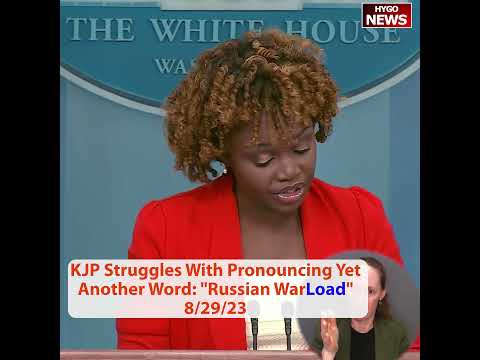
KJP Struggles With Pronouncing Yet Another Word: Says “Russian WarLoad” Instead of Warlord
On August 29, 2023, White House Press Secretary Karine Jean-Pierre was asked about the Kremlin’s announcement that Vladimir Putin would not attend the funeral of Yevgeny Prigozhin, the Wagner Group mercenary leader who had died in a suspicious plane crash just days earlier. In her response, Jean-Pierre mispronounced the word “warlord” as “warload,” adding to a growing list of verbal stumbles that had become a recurring feature of her press briefings.
While the mispronunciation itself was a minor moment, it was the latest in a pattern that had drawn attention to Jean-Pierre’s difficulties with prepared and extemporaneous remarks alike. The clip circulated widely on social media, where critics noted that the White House press secretary’s job fundamentally revolves around clear, precise communication, a standard Jean-Pierre struggled to meet consistently.
The Press Briefing Exchange
A reporter raised the topic of Prigozhin’s death and Putin’s conspicuous absence from any public mourning: “The Kremlin, as you’re aware, earlier today said Putin will not attend Prigozhin’s funeral. And we’re just wondering if there is an update on whether the U.S. thinks Putin is behind the Prigozhin plane crash.”
Jean-Pierre’s response addressed the broader context of the Wagner Group mutiny and Prigozhin’s subsequent death, but it was her pronunciation that captured attention.
“If we take a step back, if you look back for a second, all of this happened because of dysfunction inside Russia,” Jean-Pierre began. “A Russian warload himself, a cold-blooded killer, a cold-blooded murderer, became so frustrated by the way that the Russian government was waging its unprovoked war against Ukraine that he criticized Russia’s failing policies. You heard that directly from him.”
She continued: “And so, he called out the war’s needlessness and marched on Moscow before reaching a deal with Mr. Putin. He made that — we saw that. You all covered it for multiple hours. And so, now, two months later, after he struck that deal, he’s been killed.”
Jean-Pierre concluded with a thinly veiled implication about Putin’s involvement: “So, you know, it’s very clear. It’s pretty evident what happened here. I don’t have anything else to say.”
The substantive content of her answer was unremarkable, essentially restating the widely held assumption that Putin had Prigozhin killed in retaliation for the Wagner Group’s brief mutiny in June 2023. But the “warload” mispronunciation overshadowed the message.
A Pattern of Verbal Stumbles
Jean-Pierre’s “warload” moment was far from an isolated incident. Throughout her tenure as White House Press Secretary, she accumulated a notable record of mispronunciations, malapropisms, and reading errors that drew persistent criticism.
Among the more memorable instances, Jean-Pierre had previously stumbled over the word “hypotheticals,” pronouncing it as “hypo-theoreticals” on at least one occasion. She had also mispronounced the names of world leaders, stumbled over policy terminology, and at times appeared to lose her place in her briefing materials, leading to awkward pauses and restarts at the podium.
Critics argued that these verbal difficulties were not merely innocent slips of the tongue but reflected a broader lack of preparation and command of the material that the role demanded. Previous White House press secretaries had been expected to have an encyclopedic knowledge of policy positions and the verbal dexterity to communicate them under pressure. Jean-Pierre’s frequent stumbles suggested she was often reading prepared answers without fully internalizing the content.
Supporters of Jean-Pierre pushed back, noting that anyone speaking publicly every day would occasionally misspeak and that focusing on pronunciation errors was a distraction from the substance of the administration’s positions. However, the frequency and nature of the errors made them difficult to dismiss entirely, particularly when they occurred in the context of serious foreign policy discussions.
The Prigozhin Situation
The substance underlying Jean-Pierre’s remarks involved one of the most dramatic events in Russian politics in decades. Yevgeny Prigozhin, the founder and leader of the Wagner Group, a private military company that had played a significant role in Russia’s war in Ukraine, had launched a brief armed mutiny against the Russian military establishment on June 23-24, 2023.
Prigozhin’s forces had seized the Russian military headquarters in Rostov-on-Don and marched toward Moscow before abruptly halting and reaching a deal brokered by Belarusian President Alexander Lukashenko. The terms of the deal reportedly included Prigozhin relocating to Belarus and charges against him being dropped.
Exactly two months later, on August 23, 2023, Prigozhin was killed when his private jet crashed northwest of Moscow. All ten people on board died. While Russia initially claimed the crash was under investigation, the circumstances left little doubt in the minds of Western intelligence agencies and international observers that Putin had ordered the elimination of the man who had publicly challenged his authority.
Jean-Pierre’s statement that “it’s very clear, it’s pretty evident what happened here” stopped short of directly accusing Putin of ordering the assassination but left the implication unmistakable. This was consistent with the administration’s approach of publicly suggesting Russian state involvement without making a formal accusation that could have diplomatic consequences.
The Role of the White House Press Secretary
The “warload” incident renewed broader questions about Jean-Pierre’s effectiveness in the role of White House Press Secretary. The position has historically been one of the most visible and demanding in the executive branch, requiring the occupant to serve as the primary public voice of the president and the administration.
Previous press secretaries, regardless of political party, had generally been selected for their sharp communication skills, deep policy knowledge, and ability to handle hostile questioning with poise. The role requires not just reading prepared statements but also engaging in real-time verbal exchanges with experienced journalists who are trained to press for clear answers.
Jean-Pierre, who had previously served as principal deputy press secretary under her predecessor Jen Psaki, was the first Black woman and the first openly LGBTQ person to serve as White House Press Secretary. While her appointment was celebrated as a milestone of representation, critics argued that competence in the role’s core functions should be the primary criterion for evaluation and that Jean-Pierre’s repeated verbal difficulties raised legitimate questions about her fitness for the position.
Additional Context
Jean-Pierre’s mispronunciation came during a period when the Biden White House was already facing intense scrutiny over communication and competence. President Biden himself was the subject of persistent questions about his verbal acuity, with frequent gaffes, trailing-off sentences, and apparent confusion during public appearances. Having a press secretary who also struggled with basic pronunciation compounded the perception of an administration with communication problems.
The Wagner Group mutiny and Prigozhin’s subsequent death represented a significant moment in the Russia-Ukraine conflict, as it exposed deep fractures within Russia’s war effort. Prigozhin had publicly accused Russian Defense Minister Sergei Shoigu and Chief of the General Staff Valery Gerasimov of incompetence and corruption, claims that resonated with some segments of the Russian military and public.
Putin’s decision to eliminate Prigozhin despite the negotiated deal sent a clear message about the consequences of challenging the Russian president’s authority. The incident was widely analyzed by Western intelligence agencies and foreign policy experts as evidence of both the instability within the Russian power structure and Putin’s ruthless approach to maintaining control.
Key Takeaways
- Karine Jean-Pierre mispronounced “warlord” as “warload” while discussing Prigozhin’s death during an August 29, 2023 press briefing, adding to a pattern of verbal stumbles during her tenure.
- When asked if the U.S. believed Putin was behind the Prigozhin plane crash, Jean-Pierre stopped short of a direct accusation but stated “it’s very clear, it’s pretty evident what happened here.”
- Jean-Pierre recounted the sequence of events: Prigozhin’s criticism of the Russian war effort, his march on Moscow, the deal struck with Putin, and his death two months later.
- The mispronunciation became widely shared on social media as another example of the press secretary’s difficulty with clear communication at the podium.
- The incident occurred during a period of broader scrutiny over the Biden administration’s communication capabilities, with both the president and his press secretary facing persistent criticism for verbal missteps.