 HYGO News
 Vance: Zelensky Needs Private Negotiation, Not Public Posturing; 'Lack of Private Engagement Most Concerning'
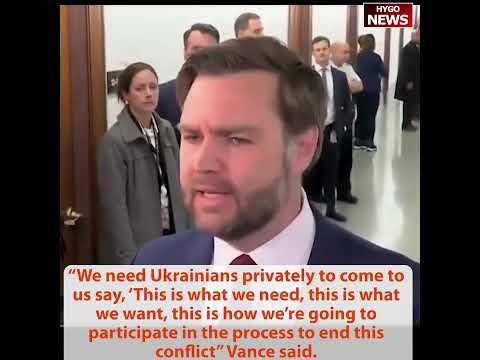
Vance: Zelensky Needs Private Negotiation, Not Public Posturing; “Lack of Private Engagement Most Concerning”
VP JD Vance took questions from reporters on Capitol Hill on March 4, 2025, and provided the clearest roadmap yet for how Ukraine could restart its relationship with the Trump administration. The critical message: “We need the Ukrainians privately to come to us and say, ‘This is what we need, this is what we want, this is how we’re going to participate in the process to end this conflict.’ That is the most important thing, and that lack of private engagement is what is most concerning to us.” Vance pushed back on claims the U.S. was not pressuring Russia, said the minerals deal could “certainly” still be reached, and argued that neither public apologies nor public statements mattered as much as “meaningful engagement on what a peaceful settlement would look like."
"The Public Stuff Doesn’t Matter”
A reporter asked what the administration needed to see from Zelensky to restart negotiations. Vance’s answer reframed the conversation away from the public drama.
“A lot of people have made this about public statements,” Vance said. “‘President Zelensky needs to say he’s committed to the peace.’ Or ‘President Zelensky needs to apologize to the President.’”
Then the shift: “The public stuff doesn’t matter nearly as much as what are the Ukrainians doing to meaningfully engage on what a peaceful settlement would look like.”
Vance described what the administration actually wanted. “We need the Ukrainians privately to come to us and say, ‘This is what we need, this is what we want, this is how we’re going to participate in the process to end this conflict,’” he said.
He identified the core problem: “That is the most important thing, and that lack of private engagement is what is most concerning to us.”
The distinction between public and private was strategically important. The media had been focused on whether Zelensky would publicly apologize for the Oval Office confrontation. Vance was saying the apology was irrelevant — what mattered was whether Ukraine would engage substantively, behind closed doors, on the terms of a peace settlement. Public contrition without private engagement was meaningless. Private engagement without public contrition was acceptable.
The Minerals Deal: “I Certainly Do”
A reporter asked whether Vance still believed the minerals deal could be completed despite the Oval Office blowup.
“Do you still have hope for the mineral deal? Do you believe that the mineral deal can still be reached with Ukraine?” the reporter asked.
“I certainly do,” Vance said. “And I think the President is still committed to the mineral deal. I think we’ve heard some positive things, but not yet, of course, a signature from our friends in Ukraine.”
Vance explained the dual purpose of the deal. “Number one, the American people have got to get some payback for the incredible financial investment we’ve made in this country,” he said. “A lot of the aid that the Europeans have sent has come in the form of money that is getting repaid to them.”
He delivered the argument with fresh sharpness: “It’s really ridiculous, and frankly an insult to the American people, that the Europeans are getting a better deal than the American people.”
The second purpose: “The President is just trying to assure that the American people get a fair deal, while simultaneously ensuring we have access to some minerals and resources that are very important for the economy of the future.”
The confirmation that the minerals deal was still alive — despite the confrontation and expulsion — was significant. It meant the administration viewed the deal as in its own interest regardless of the diplomatic friction with Zelensky. The deal would proceed when Zelensky was ready to sign, not as a reward for good behavior but because both sides benefited.
Pressuring Russia: “I Don’t Think That’s Right”
A reporter suggested the administration was applying pressure only to Ukraine while leaving Russia unpressured. Vance rejected the framing.
“Well, I don’t think that’s right, actually,” Vance said. “We still have a number of sanctions that are placed on the Russians. We do believe that the Russians economically are struggling because of this conflict.”
He framed the pressure as universal. “We do believe that it’s in Russia’s best interest, but also Ukraine and the United States’ best interest, to bring this conflict to a close,” Vance said. “We believe in applying pressure to everybody to stop the killing. That’s what the President’s policy is.”
The response addressed a common criticism — that Trump was being “soft on Russia” — by pointing to the sanctions regime that remained in place and to the economic damage Russia was suffering from the conflict. The administration’s position was that pressure on Russia took the form of continued sanctions and the economic incentive of ending a war that was bleeding the Russian economy, while pressure on Ukraine took the form of conditioning American support on engagement in peace negotiations.
The Ukraine Policy Framework
Vance provided the most comprehensive statement of the administration’s Ukraine position since the Oval Office incident.
“What the President has said very clearly about our Ukraine policy is that he wants the Ukrainians to come to the negotiating table,” Vance said. “We want the Ukrainians to have a sovereign and independent country. We think the Ukrainian troops have fought very bravely.”
He then stated the reality constraint: “But we’re at a point here where neither Europe nor the United States nor the Ukrainians can continue this war indefinitely. So it’s important that everybody come to the table, and the President is trying to send a very explicit message: the Ukrainians have got to come to the table and start negotiating with President Trump.”
When asked about resuming aid, Vance said: “When the Ukrainians come to the negotiating table, everything is on the table.”
The formulation — “everything is on the table” once Ukraine engages — suggested that the administration was willing to resume military and financial support as part of a comprehensive package that included the minerals deal, a ceasefire, and substantive peace negotiations. The aid pause was not a permanent cutoff but a conditional suspension designed to compel engagement.
European Peacekeepers
A reporter asked whether European peacekeepers were a non-starter for Russia.
“I won’t speak for the Kremlin. I don’t know what is a non-starter or not for the Kremlin,” Vance said. “I know that obviously, and we appreciate this, the British and the French have offered to step up in a big way. That’s very, very important.”
He placed the peacekeeping question within the broader negotiation framework: “But fundamentally, the question of what’s a non-starter for this or that party — that’s part of the negotiated settlement we have to come to.”
Vance concluded by returning to the central point: “We can’t even really start that negotiated process in earnest until the Ukrainians, led by President Zelensky, come to the table."
"Can’t Continue Forever”
Vance addressed Zelensky’s public characterization of the deal being “a long way away.”
“President Zelensky said that, but what I think the President has said is that we can make a deal here,” Vance said. “The Russians can’t continue this thing forever. The Ukrainians can’t continue forever. And most importantly, the United States can’t continue it forever.”
He acknowledged the complexity ahead. “There are a lot of details to be worked out. There are a lot of questions about territory, about everything else. We want to have that conversation,” Vance said. “We’re not saying that we’re committed to one pathway or another. We’re just saying you can’t even bring the peace to the forefront if the Ukrainians aren’t willing to negotiate in good faith.”
He concluded: “And right now, they haven’t been willing to. Hopefully that changes.”
Key Takeaways
- Vance said “the public stuff doesn’t matter” — what matters is whether Ukraine will “privately come to us” with “what we need, what we want, how we’re going to participate in the process to end this conflict.”
- He confirmed the minerals deal could “certainly” still be reached, calling it “really ridiculous” that Europeans were getting “a better deal than the American people.”
- Vance rejected claims the U.S. wasn’t pressuring Russia: “We still have sanctions, we believe Russia is economically struggling, we believe in applying pressure to everybody.”
- He said “when the Ukrainians come to the negotiating table, everything is on the table” — including resumed aid — but “that lack of private engagement is what is most concerning.”
- On European peacekeepers, Vance said the British and French offers to “step up in a big way” were “very important” but that the details were “part of the negotiated settlement.”