 HYGO News
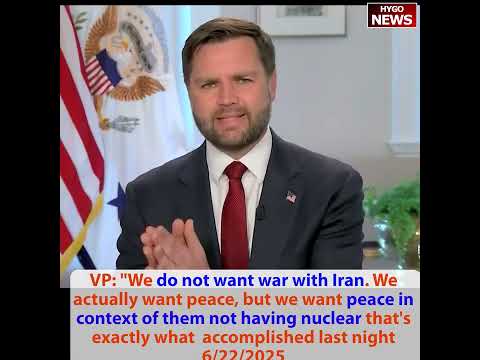
 VP: We do not want war with Iran, not regime change. incredible We destroyed Iranian nuclear program
VP: We do not want war with Iran, not regime change. incredible We destroyed Iranian nuclear program
Vice President JD Vance’s continued Meet the Press appearance produced what will be the most quoted single line of the week: “We’re not at war with Iran. We’re at war with Iran’s nuclear program.” The distinction is doing heavy lifting in the administration’s framing. America is not fighting a country. America is fighting a program. The country can continue to exist — under its current leadership, even — if it chooses to end the program. The Vice President also delivered one of the most specific and striking details of the operation: American B-2 pilots flew from Missouri, did not land once, dropped 30,000-pound bombs on a target the size of a washing machine, and returned home safely without landing in the Middle East. Vance laid out the two pathways available to Iran — pathway one leading to overwhelming force, pathway two leading to integration into the international community — and told Tehran the choice was theirs.
”We Do Not Want War With Iran”
Vance’s opening was a direct statement of American objective. “What we’ve said to the Iranians is we do not want war with Iran, we actually want peace. But we want peace in the context of them not having a nuclear weapons program. And that’s exactly what the President accomplished last night.”
The formulation is the cleanest expression of the administration’s preferred framing. The United States is not seeking war. The United States is seeking peace. Peace, however, has a precondition — no Iranian nuclear weapons program. The strikes removed the program. The precondition for peace is now achieved. What remains is for Iran to accept the new reality.
”Two Big Questions For The Iranians”
Vance then laid out the decision structure facing Tehran. “I really think there are two big questions for the Iranians here. Are they going to attack American troops or are they going to continue with their nuclear weapons program?”
The two questions are the two forms of Iranian behavior that would trigger continued American action. Attack on American troops is the immediate provocation. Continued pursuit of the nuclear program is the structural provocation. If Iran avoids both, the path to de-escalation opens.
”We Can Have A Good Relationship”
Vance extended the offer. “And if they leave American troops out of it and they decide to give up their nuclear weapons program once and for all, then I think the President has been very clear we can have a good relationship with the Iranians, we can have a peaceful situation in that region of the world.”
The offer is substantial. “A good relationship” with Iran is a formulation that would have been politically controversial a year ago. Conservative critics of engagement with Iran often argue that the regime is fundamentally incompatible with American interests. Vance is rejecting that framing. The regime can be compatible with American interests if it makes the required changes. The nuclear program and the attacks on American troops are the obstacles, not the regime itself.
”We Negotiated Aggressively”
Vance walked through the diplomatic history. “We have to step back a little bit, Kristen, and remind ourselves that we negotiated aggressively with the Iranians to try to find a peaceful settlement to this conflict. It was only when the President decided that the Iranians were not negotiating in good faith that he took this action.”
“Negotiated aggressively” is the characterization of the diplomatic effort. Multiple rounds, direct and indirect, extended periods, meaningful offers. The American side made a genuine effort. The Iranian side did not respond in kind. That failure of good-faith engagement is what justified the strikes.
”He Didn’t Take It Lightly”
Vance emphasized the weight of the decision. “He didn’t take it lightly, but I actually think it provides an opportunity to reset this relationship, reset these negotiations and get us in a place where Iran can decide not to be a threat to its neighbors, not to be a threat to the United States. And if they’re willing to do that, the United States is all ears.”
The “didn’t take it lightly” framing is important. Presidents who authorize strikes face genuine moral weight. Servicemembers are placed at risk. Adversary forces are killed. Civilian collateral effects, however minimized, are possible. Trump’s decision was made with full awareness of those stakes, not in a moment of impulse.
“The United States is all ears” is the open posture for the moment Iran chooses to engage. The door is open. The terms are clear. The decision is Tehran’s.
”Not At War With Iran. We’re At War With Iran’s Nuclear Program”
The interview’s most memorable line came next. “Is the United States now at war with Iran? No, Kristen, we’re not at war with Iran. We’re at war with Iran’s nuclear program.”
The distinction is diplomatically important and politically significant.
Diplomatically, the distinction preserves the space for post-strike engagement with Iran. “War with Iran” is a formal state that typically requires congressional declaration and that carries substantial international legal implications. “War with Iran’s nuclear program” is a framing that targets a specific capability without implicating the broader bilateral relationship.
Politically, the distinction answers the concerns of Americans who worry about being drawn into another Middle East war. The administration is not initiating such a war. It is executing a targeted action against a specific program. The difference matters.
The Missouri Flight
Vance then provided the operational detail that will be quoted for decades. “And let me just say, Kristen, that we’re incredibly grateful and proud of the American Air Force pilots who did an incredible job last night. The operation was really extraordinary. These guys flew from Missouri. They didn’t land a single time. They dropped 30,000-pound bombs on a target the size of a washing machine and then got back home safely without ever landing in the Middle East or ever stopping other than to briefly refuel. And of course, they did that in the air.”
Each element of the account is remarkable.
“Flew from Missouri” — Whiteman Air Force Base in Missouri is the home of the B-2 Spirit bomber fleet. The decision to fly directly from Missouri — rather than pre-positioning aircraft closer to the target — preserved operational surprise. No satellites tracked B-2s moving from American bases to forward locations in the days before the strike.
“Didn’t land a single time” — the mission was flown in a single sortie from Missouri to Iran and back. Depending on the exact route, that is a flight of roughly 35-40 hours. Two pilots take turns sleeping and flying during such a mission.
“30,000-pound bombs” — the GBU-57 Massive Ordnance Penetrator weighs 30,000 pounds and is designed specifically for hardened underground targets. Each B-2 can carry two of these weapons.
“A target the size of a washing machine” — the specific entry point of the bunker-buster at Fordow is small. Hitting a washing machine-sized target from a high-altitude bomb release requires GPS-guided precision.
The Mission’s Historical Significance
The operational profile — B-2s from Missouri, non-stop to Iran, GBU-57s on Fordow, safe return — is the kind of mission that will be taught in military academies for the next century. Nothing like it has been executed at this scale. The capability exists only in the United States Air Force. The mission’s success demonstrated that the capability is real, operational, and deployable on presidential authority.
”A Testament To The Power Of American Military”
Vance’s summary was direct. “So it’s really an incredible operation. A testament to the power of American military shows what can happen when you have that great American military in the hands of capable presidential leadership.”
The framing pairs two elements — American military capability and presidential leadership. Either alone is insufficient. The military can be capable but poorly directed. The president can be capable but lack capable forces. The combination of both — capable military plus capable presidential direction — is what produces results like the overnight operation.
”Without Endangering The Lives Of The American Pilots”
Vance returned to the human outcome. “What we did is we destroyed the Iranian nuclear program. I think we set that program back substantially. And we did it without endangering the lives of the American pilots. That’s an incredible thing. And I think we all should be proud.”
The American pilots returned home safely. That outcome is not automatic. It is the result of mission planning, execution discipline, weather cooperation, Iranian defensive failures, and a dozen other factors that could have gone wrong but did not. Vance is drawing attention to the outcome because the political stakes of any American combat loss would have been enormous. Losses would have transformed the political narrative. Safe return preserved the clean outcome.
”Whatever Our Politics”
Vance made the non-partisan appeal. “Whatever our politics, we should be proud of what these guys accomplished, a very, very high-impact mission under a lot of pressure.”
The appeal to non-partisan pride is the kind of move administrations make after successful military operations. American pilots are Americans first. Their success is the country’s success. Political differences over the underlying policy should not extend to pride in the competence of the servicemembers who executed the mission.
Whether American politics actually responds with non-partisan pride is the question. The administration is making the appeal. Americans will decide individually whether to accept it.
”Not A Regime Change”
Vance returned to the framing that has defined the public posture. “Our view has been very clear that we don’t want a regime change. We do not want to protract this or build this out any more than it’s already been built out. We want to end their nuclear program, and then we want to talk to the Iranians about a long-term settlement here.”
The consistency of the “not regime change” messaging across the Vice President, Secretary of Defense, and presidential statements is deliberate. The administration is speaking with one voice on this specific point. The objective is limited. The escalation is not pre-planned. The reset is available.
The Two Pathways
Vance then laid out the choice architecture. “We believe very strongly that there are two pathways. There’s a pathway where Iran continues to fund terrorism, continues to try to build a nuclear program, attacks American troops. That’s the bad pathway for Iran, and it will be met with overwhelming force.”
Pathway One: continued Iranian aggression. Terrorism funding. Nuclear program rebuilding. Attacks on American troops. The response to Pathway One is “overwhelming force.” Vance has said those words repeatedly. They are the operational commitment.
The Integration Pathway
“There’s another pathway on the table here. There’s a pathway where Iran integrates itself into the international community, stops funding terrorism, and stops trying to pursue a nuclear weapon. This is a reset. This is an opportunity for the Iranians to take the smart path. We certainly hope that they will.”
Pathway Two: integration. Iran gives up the nuclear program. Iran stops funding terrorism. Iran normalizes its international relationships. In exchange, Iran joins the international economic system, its sanctions are lifted, its leaders are welcomed at international forums, its people begin experiencing the economic benefits that integration would bring.
Why The Pathways Matter
The explicit articulation of Pathway Two is significant because it tells Tehran that a constructive resolution is available. If the administration had presented only Pathway One — escalation if Iran misbehaves — it would have trapped Tehran in a corner with no exit. Iran might have concluded that it had nothing to lose by continuing to escalate.
By articulating Pathway Two — integration if Iran chooses it — the administration has given Iranian decision-makers a rational option. A rational Iranian calculation, faced with the choice between overwhelming force and economic integration, should tilt toward integration. That is the bet the administration is making.
”The Smart Path”
Vance’s closing framing was direct. “This is an opportunity for the Iranians to take the smart path. We certainly hope that they will.”
The “smart path” framing is designed to work on Iranian decision-makers directly. It does not appeal to their principles. It does not require them to concede ideological ground. It appeals only to their rational self-interest. The smart choice is integration. The non-smart choice is continued destruction.
Whether Iranian decision-making apparatus is capable of making the smart choice, given the theological and ideological commitments of the regime, is the question Tehran now has to answer. The administration is betting that even revolutionary regimes eventually do the math.
Key Takeaways
- Vance’s signature line: “We’re not at war with Iran. We’re at war with Iran’s nuclear program.”
- The offer: “If they leave American troops out of it and they decide to give up their nuclear weapons program once and for all, then…we can have a good relationship with the Iranians.”
- The B-2 operation: “These guys flew from Missouri. They didn’t land a single time. They dropped 30,000-pound bombs on a target the size of a washing machine and then got back home safely without ever landing in the Middle East.”
- “Not a regime change…We want to end their nuclear program, and then we want to talk to the Iranians about a long-term settlement here.”
- The two pathways: “overwhelming force” for continued aggression vs. “this is a reset…an opportunity for the Iranians to take the smart path.”