 HYGO News
 VP: We didn't even attack military targets outside of nuclear, Iranians clearly not good at war
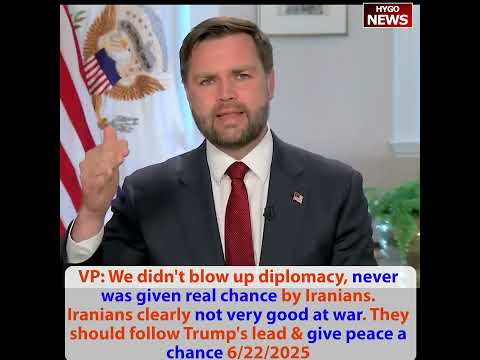
VP: We didn’t even attack military targets outside of nuclear, Iranians clearly not good at war
Vice President JD Vance’s appearance on Meet the Press with Kristen Welker produced the most operationally detailed public explanation of the Iran strikes yet delivered. Vance laid out the precision of the American action — no attack on the nation of Iran, no attack on civilian targets, not even attacks on military targets outside the three specific nuclear facilities. He pushed back on the Iranian foreign minister’s claim that the strikes “blew up diplomacy,” arguing that Iran had been stringing the administration along and that diplomacy never had a real chance. He closed with the assessment that will carry the week: “The Iranians are clearly not very good at war. Perhaps they should follow President Trump’s lead and give peace a chance.” And he highlighted the operational security of the mission — “14,000-30,000-pound bombs” delivered by “multiple B-2s” without a single leak — as a testament to the coherent team operating behind Trump.
”Maximum Defensive Posture”
Vance opened with the operational reality. “What we’re prepared for is if they attack us in a maximal direction, first of all, we have got maximum defensive posture. I think that we’re going to be able to defend as many of our people as possible.”
The “maximum defensive posture” is the force protection framework. American assets in the region — bases, ships, aircraft, personnel — are at heightened readiness. Air defense systems are active. Counter-UAS capabilities are positioned. Intelligence collection is elevated. The goal is to intercept whatever Iran sends before it reaches American personnel.
”Pray For Our Guys”
Vance’s call for prayer was direct. “And of course, I’d encourage Americans to pray for our guys in the Middle East, because, yes, they are under a significant amount of duress and a significant amount of threat right now.”
The acknowledgment that American forces are under threat is candid. The operational benefit of prayer, if any, is separate from the political benefit of the acknowledgment. Americans who have family members or friends serving in the Middle East — and the many Americans who have a broader emotional connection to the military — heard the Vice President of the United States acknowledge the risk their loved ones are facing.
”Overwhelming Force”
Vance then delivered the deterrent threat. “But then, of course, John, if the Iranians attack us, they’re going to be met with overwhelming force. And I don’t think the president could be clear about this.”
“Overwhelming force” is the military term of art for disproportionate response. Measured, proportional response is one posture. Overwhelming force is another — aimed at ending the exchange rather than matching it. Vance is signaling that Iranian retaliation will not be matched. It will be crushed.
”We Did Not Attack The Nation Of Iran”
Vance then delivered the most important diplomatic distinction of the interview. “If you look at what we did yesterday, John, we did not attack the nation of Iran. We did not attack any civilian targets. We didn’t even attack military targets outside of the three nuclear weapons facilities that we thought were important to accomplish our goal of preventing Iran from having a nuclear weapon.”
The triple distinction is important.
First, “we did not attack the nation of Iran.” American military action was against specific facilities of the Iranian nuclear program, not against Iran as a country. The strikes were not a declaration of war against the Iranian state.
Second, “we did not attack any civilian targets.” No population centers were hit. No dual-use infrastructure was damaged. The strikes were precision operations against military-scientific facilities.
Third, “we didn’t even attack military targets outside of the three nuclear weapons facilities.” The restraint extends even to conventional Iranian military assets. Iranian ballistic missile sites, air defense installations, IRGC bases — none of these were struck. The operation was surgically limited to the three specific nuclear targets.
Why The Precision Argument Matters
The precision argument matters for several audiences simultaneously. For Tehran, it signals that the American posture is calibrated and limited — not an opening move in a broader war. For the international community, it establishes that the strikes were proportionate and narrowly targeted. For American audiences, it provides reassurance that the country is not entering an expanding Middle East conflict.
”The Ball Is In Their Court”
Vance delivered the conditional. “So how Iran responds, I think, is ultimately the ball is in their court. But if you look at what we did, it was very precise, very narrowly tailored to our objective. And if the Iranians decide to expand this, then that’s ultimately their decision, and the president of the United States will respond in kind.”
The “ball is in their court” framing places Iran in the position of deciding whether the conflict escalates. The American action is complete. The American objective was achieved. If Iran accepts the outcome and turns to diplomacy, the exchange ends. If Iran retaliates, the American response — which Vance has described as “overwhelming force” — will follow.
”We Didn’t Blow Up Diplomacy”
Vance then addressed the Iranian foreign minister’s public claim. “Well, I think the foreign minister is exactly wrong. We didn’t blow up diplomacy. We only took this action, Kristen, when it was clear, as the president said that the Iranians were tapping us along.”
The Iranian foreign minister had characterized the American strikes as having destroyed any possibility of diplomacy. Vance is rejecting that characterization flatly.
The March Starting Point
Vance walked through the diplomatic timeline. “I think it’s important for the American people to appreciate here that if you go back to March of this year, we had the entire administration engaged in this diplomatic effort. And frankly, in March of this year, we had some optimism.”
The March starting point is significant. The administration had, in March, been engaged in substantive diplomatic engagement with Iran. Optimism existed. A deal seemed possible. The trajectory from optimism in March to strikes in late June is the trajectory Vance needs to explain.
”Stonewalling Us”
Vance laid out the diagnosis. “We felt very strongly that the Iranians were stonewalling us. They weren’t taking this seriously. They were trying to draw this process out as long as possible so that they could rebuild their nuclear weapons program without the threat of American action.”
The accusation is specific. Iran was using the diplomatic process as cover for accelerated nuclear development. The longer the negotiations continued, the more progress Iran could make toward weapons-grade capability without American interference. The diplomatic process, in Iran’s telling, was not a serious attempt to resolve the dispute. It was a delaying tactic.
”A Limited Window”
Vance then addressed the timing question. “We had a limited window in which we could take out this Fordow nuclear facility in particular. The president decided to take it, but we didn’t blow up the diplomacy. The diplomacy never was given a real chance by the Iranians.”
The “limited window” framing is operational. Specific military operations have specific windows of viability. Intelligence, weather, operational tempo, and adversary behavior all affect when a given operation can be executed effectively. The Fordow strike had a window. That window was closing. The president, facing the closing window, chose to execute.
The Choice Ahead
Vance laid out the Iranian decision point. “And our hope, Kristen, as the president said repeatedly, is that this maybe can reset here. The Iranians have a choice. They can go down the path of peace or they can go down the path of this ridiculous brinksmanship of funding terrorism, of trying to build a nuclear weapon, and that’s just not something the United States can accept.”
The “reset” framing is the administration’s best-case scenario. The strikes have established the cost of continued Iranian aggression. If Iran uses the moment to recalibrate toward peace, the overall trajectory improves for both sides. If Iran chooses continued confrontation, the recalibration will be forced rather than voluntary.
Direct Message To Iranian Leadership
Vance then addressed Tehran directly. “I want to say something, Kristen, just to the Iranian leadership. They have tried to build a nuclear weapons program. That program is now destroyed. They tried to build a conventional missile program to attack neighbors in the region. That missile program has shown to be a failure. They have funded terrorism aggressively in the region, and now most of their terrorism proxies are destroyed.”
The inventory Vance delivers is devastating. Three Iranian strategic projects — nuclear weapons, conventional missiles, proxy terrorism networks — have each failed or been destroyed over the course of the recent conflict. Hezbollah is degraded. Hamas is degraded. The Houthis are degraded. Iran’s proxy war strategy is no longer producing the results it did a decade ago.
”The Iranians Are Clearly Not Very Good At War”
Vance’s most memorable line was the assessment of Iranian military competence. “The Iranians are clearly not very good at war. Perhaps they should follow President Trump’s lead and give peace a chance. If they’re serious about it, I guarantee you the president of the United States is too.”
The observation — “clearly not very good at war” — is cutting. It is also, on the evidence of the past month, defensible. Iranian missile attacks have been intercepted at rates that surprised observers. Iranian air defenses have failed to protect high-value targets. Iranian proxy forces have taken devastating losses. Iranian strategic deterrence has been shown not to exist against the combined Israeli-American posture.
“Give peace a chance” is Vance’s offer. If Iran is serious about peace, the American president is serious too. The offer is on the table. The Supreme Leader has to decide whether to take it.
The Operational Security Achievement
Vance closed with the remarkable operational security achievement. “I really am proud of all of our guys that the senior team is. In operation of this magnitude, multiple B-2s, 14,000-30,000-pound bombs, and even an hour after the attack, the entire media, some of our enemies all over the world, they had no idea this was happening.”
The operational security claim is extraordinary. A multi-aircraft, multi-ordnance strike executed across global distances with no public or intelligence community leaks until well after execution is a significant achievement in the modern information environment. Every member of the administration involved in the planning process could have leaked. No one did.
”A Coherent Team”
Vance’s credit to the administration was direct. “And that’s because you had a coherent team that was aligned behind the president’s vision. There weren’t any leaks. I think that made our troops safer as they carried out this mission. It’s really a testament to the entire team. We were able to do something like this at this scale without anybody noticing it.”
The “coherent team” claim is politically significant. Through much of Trump’s first term, leaks from the administration were a constant feature. Dissension within the cabinet and White House staff resulted in regular disclosures that affected operational and political outcomes. The absence of leaks around the Iran operation is a meaningful indicator that the second-term team is operating differently.
”Made Our Troops Safer”
The operational benefit of the security discipline was also clear. Leaks about upcoming military operations put American servicemembers at risk by alerting adversaries. The absence of leaks meant that Iranian air defenses were not on heightened alert at the precise moment of the strikes. Aircraft that might have been detected and engaged were not. Lives that might have been lost were not.
Vance’s point — that operational security “made our troops safer” — is the human consequence of administrative discipline. Every person in the planning cycle who kept silent contributed to the safe return of American aviators.
Key Takeaways
- Vance’s precision argument: “We did not attack the nation of Iran. We did not attack any civilian targets. We didn’t even attack military targets outside of the three nuclear weapons facilities.”
- The deterrent threat: “If the Iranians attack us, they’re going to be met with overwhelming force.”
- The diplomatic diagnosis: “The Iranians were stonewalling us…trying to draw this process out as long as possible so that they could rebuild their nuclear weapons program without the threat of American action.”
- The assessment: “The Iranians are clearly not very good at war. Perhaps they should follow President Trump’s lead and give peace a chance.”
- Operational security: “multiple B-2s, 14,000-30,000-pound bombs, and even an hour after the attack, the entire media, some of our enemies all over the world, they had no idea this was happening.”