 HYGO News
 VP: Trump hit reset 12 Day War, without single American casualty, obliterated Iranian nuclear
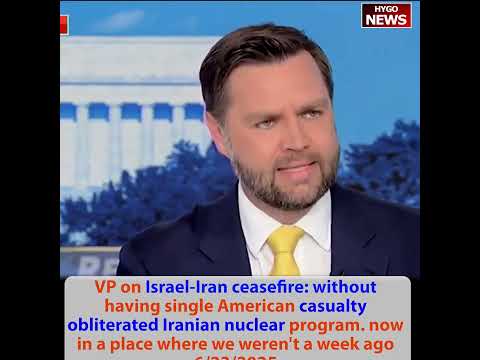
VP: Trump hit reset 12 Day War, without single American casualty, obliterated Iranian nuclear
Vice President JD Vance appeared on Bret Baier’s show on Fox News in the minutes after President Trump announced the complete and total ceasefire between Israel and Iran. The conversation captured the administration’s interpretation of what the last 12 days actually accomplished: the obliteration of the Iranian nuclear program, the destruction of Iran’s conventional missile capability, and a reset of the regional security environment. Vance used the Baier interview to announce publicly, for the first time, the phrase that the administration will use to name this moment in the historical record — “the 12 Day War.” He credited Trump’s direct negotiations with both sides, characterized the Iranian regime’s strategic failures across nuclear, conventional, and proxy warfare dimensions, and laid out what he believes the ceasefire opens up: a long-term regional peace process that Gulf Arab states are prepared to participate in.
”Working The Phones Constantly”
Vance opened by describing the behind-the-scenes presidential activity. “Look, he’s been working the phones constantly. Frankly, before the 12-day war started, but certainly over the past 12 days, the president’s been extremely clear about America’s national objective here. It is to create a world where Iran cannot build a nuclear weapon.”
The “working the phones” image captures what most Americans did not see during the 12 days. Trump was not just giving speeches. He was on the phone with Netanyahu, with Arab leaders, with European counterparts, with military commanders. The diplomatic tempo was intense, and the president personally was at the center of it.
”We Destroyed The Nuclear Program”
Vance’s assessment of the mission outcome was direct. “We, of course, destroyed the nuclear program that they had, and the president told the entire team, we’re gonna work to make sure that they don’t try to rebuild that nuclear capability in the future.”
Two claims sit in this sentence. First, the existing program has been destroyed. Second, the administration is committed to preventing its reconstitution. The second commitment matters because nuclear programs, once broken, do not necessarily stay broken. Iran has resources, scientific expertise, and technical knowledge that could, over time, rebuild what was destroyed. The administration is signaling that it will not permit that reconstruction.
Israel’s Three Objectives
Vance gave credit to Israel for three distinct accomplishments. “For Israel, think about this. They’ve accomplished an important military objective. They’ve helped us destroy the Iranian nuclear program. They’ve also destroyed the conventional missile capability of Iran that threatened the country of Israel.”
The three objectives are worth parsing. Israel’s participation in the nuclear facilities strikes, while less extensively reported than the American B-2 operation, included substantial Israeli Air Force operations. Israel’s degradation of Iran’s conventional missile capability is arguably as strategically important as the nuclear destruction — Iran’s missiles had been positioned as the threat that would deter American and Israeli action. With that deterrent degraded, Iran’s regional leverage is substantially reduced.
”New Opportunity To Pursue Peace”
Vance offered Iran the framing. “For the Iranians, I think this is a new opportunity to actually pursue the path of peace.”
The framing casts the Iranian defeat as an opportunity. If Iran accepts the new reality — no nuclear program, degraded conventional forces, degraded proxies — the regime can pivot toward integration into the regional economy. That pivot would open access to markets, investment, technology, and the prosperity that Iran’s younger population has long demanded.
”Not Very Good At War”
Vance repeated the assessment he had made on Meet the Press. “As I said yesterday, what the Iranians have showed through their support of terror networks, through their now failed effort to build a nuclear weapon, is that they’re just not very good at war.”
The verdict covers three dimensions. Iranian terror networks have been degraded by Israeli operations in Lebanon, Syria, Gaza, and Yemen. Iran’s nuclear weapons program has been destroyed by American and Israeli strikes. Iran’s conventional missile program has been degraded by Israeli and American defensive operations that intercepted most Iranian salvos.
The cumulative picture is of a regime that has lost most of what it has been building for decades. “Not very good at war” is the compressed description of that collapse.
”The Reset Button”
Vance then introduced the frame that will define the moment. “And I think the president really hit the reset button and said, look, let’s actually produce long-term peace for the region. That’s always been his goal. I actually think when we look back, we will say the 12-day war was an important reset moment for the entire region.”
“The 12 Day War” is the name Vance is introducing for the period between the start of major Iran-Israel hostilities and the ceasefire that Trump announced. The analogy is to the 1967 Six-Day War — a compressed period of transformative military action that reshaped the region’s strategic architecture for decades after.
The Ceasefire Announcement
Baier asked about the substance of Trump’s ceasefire post. “It has been fully agreed by and between Israel and Iran that there will be a complete and total ceasefire. Complete and total ceasefire is what he typed. What does that mean? How did it come about? What’s the development?”
Vance’s response was revealing about the pace. “Well, we were actually working on that just as I left the White House to come over here. So that’s good news that the president was able to get that across the finish line.”
The timing detail is significant. The ceasefire was finalized while Vance was traveling to the interview. The president personally closed the deal. Whatever diplomatic engagement was required — with Netanyahu, with the Iranian foreign minister, with intermediaries in the Gulf — happened in the minutes before the announcement.
”A Week Ago”
Vance then offered the week-over-week comparison. “I think what it means, Brett, is quite simple. First of all, the president, without knock on wood, having a single American casualty, obliterated the Iranian nuclear program. We are now in a place where we weren’t a week ago. A week ago, Iran was very close to having a nuclear weapon. Now Iran is incapable of building a nuclear weapon with the equipment they have because we destroyed it.”
The week-over-week framing is the cleanest way to communicate the shift. Seven days ago, Iran was on the threshold of weapons capability. Today, Iran has no weapons capability. The distance between those two states is enormous. It is the entire point of the 12 Day War.
”Not Going To Try To Rebuild”
Vance then addressed the durability question. “While we have obliterated the Iranian nuclear program, our hope and our expectation is that they’re not gonna try to rebuild that program. And I think that’s what the president is really trying to figure out here, is to build a long-term settlement here to where we can have peace in the region, where our regional allies, and of course, the American people most importantly can be secured, but where we can ensure that the destruction of the Iranian nuclear program that has already happened is not something they try to rebuild.”
The long-term settlement is the second phase of the mission. The first phase — destroying the existing program — is complete. The second phase — preventing reconstitution — requires a durable political architecture. That architecture is what Trump is now negotiating.
The Six-Hour Window
Baier asked about the ceasefire’s opening hours. “They talked about the next six hours finalizing the attacks. I mean, I think what he’s talking about is right now for the American people watching, it’s dark over there. That’s typically when the Israelis and the Iranians have been shooting at each other. I think there’s some recognition that that might continue for another few hours.”
Vance’s framing is realistic. Ceasefires do not typically stop ongoing kinetic activity instantly. Aircraft in the air have to return home. Missile systems with targets acquired have to stand down. Operational commanders have to be notified. The six-hour window acknowledges that some residual activity might occur before the ceasefire fully takes hold.
”Tomorrow Really Is A New Day”
Vance’s framing of the moment was sweeping. “And tomorrow really is a new day. The end of the 12-day war, the end of the Iranian nuclear program, and I really do believe the beginning of something very big for peace in the Middle East.”
The three-part closing is the administration’s interpretation of what has been accomplished. End of war. End of nuclear program. Beginning of peace. The compressed reality is that the outcome the administration set out to achieve was achieved in 12 days.
”Up To The Iranian People”
Vance returned to the regime question with clarification. “If the Iranian people want to do something about their own leadership, that’s up to the Iranian people. What the American national security interest here is very simple. It’s to destroy the nuclear program. That’s what we’ve done.”
The clarification is important. American national security interest is limited. It is not regime change. It is not democratization. It is the specific objective of preventing Iranian nuclear weapons. That objective has been achieved. Whatever else happens in Iran — whether the regime survives, whether it adapts, whether the population chooses to change it — is a matter for the Iranian people to decide.
”Restart A Real Peace Process”
Vance then opened the broader regional vision. “And now that the 12-day war appears to be effectively over, we have an opportunity, I think, to restart a real peace process.”
The phrase “restart a real peace process” acknowledges that previous peace processes — the JCPOA, various normalization efforts — did not produce durable peace. The administration is arguing that the current conditions, post-war, create opportunity for a more serious process than earlier attempts.
”All Of These Gulf Arab States Want Peace”
Vance expanded to the regional picture. “And Brett, this is not just about two countries Iran and Israel. All of these Gulf Arab states, they want peace, they want to invest, they want to build artificial intelligence hardware, they want to sort of come into the new economy.”
The Gulf Arab states — Saudi Arabia, the UAE, Bahrain, Qatar, Kuwait, Oman — have been building economic transformation strategies that depend on regional stability. Saudi Arabia’s Vision 2030, the UAE’s AI and technology investments, Qatar’s infrastructure development — all of these require an environment without an Iranian threat to the regional commercial lanes and energy infrastructure.
”Acting Like A Bully Across The Middle East”
Vance quoted Trump’s earlier framing. “And that was impossible when you had Iran that was, as the president said, acting like a bully across the Middle East.”
The “bully” framing captures the practical reality the Gulf states faced. Iranian proxies, Iranian missile threats, Iranian maritime harassment — all of these have been operational facts of doing business in the region. With those threats degraded, the Gulf states can pursue the economic agenda they have been working toward.
”A New Dawn Of An Economic Age”
Vance’s closing framing was expansive. “We really think that if the Iranians are smart about the path forward, this could be a new dawn of an economic age of prosperity. Of course, for our Gulf Arab allies, for us, for the Israelis, for everybody, but it’s gonna require the Iranians play it smart from here.”
The vision is Iranian integration into the regional economic transformation. Iran’s population is young, educated, and ambitious. Its geography is strategically positioned. Its resource base is substantial. If Iran steps into the regional economic architecture, the country could participate in the prosperity the Gulf states are building.
That outcome requires Iranian strategic choices consistent with it. The administration is offering the choice. The regime has to make it.
”The Biggest Testament To The President’s Leadership”
Vance closed the interview with the political frame. “What I’d encourage my fellow Americans to think about here is that a week ago, the Iranians were quite close to achieving a nuclear weapon. Now, they cannot build a nuclear weapon. That is the biggest testament to the president’s leadership and to the success of our mission in one week. Without, thank God, so far, not losing a single American casualty, we have taken what was a threatening nuclear program that could have destabilized the entire world. Now that program is gone. We did it through effective presidential leadership and also some very, very competent work from our troops.”
The political claim is substantial. One week ago, Iran had a nuclear program. Today, Iran does not. The cost was zero American lives. The operation was executed by competent American forces operating under effective presidential leadership. That is the administration’s case for the second Trump term. Whatever else the country thinks of the administration, the 12 Day War is an accomplishment that will carry political weight.
Key Takeaways
- Vance introduces the historical frame: “the 12 Day War” — comparable to 1967’s Six-Day War.
- “The President without…having a single American casualty obliterated the Iranian nuclear program.”
- “Tomorrow really is a new day — the end of the 12 Day War, the end of the Iranian nuclear program, and I really do believe the beginning of something very big for peace in the Middle East.”
- On regime change: “If the Iranian people want to do something about their own leadership, that’s up to the Iranian people. What the American national security interest here is very simple — it’s to destroy the nuclear program.”
- Gulf Arab states want “to invest, they want to build artificial intelligence hardware, they want to sort of come into the new economy” — post-war regional architecture opening up.