 HYGO News
 VP Vance: 'Hope Is Not a Strategy' -- Biden Threw Money at Ukraine; 'The Only Guy With a Strategy Is Trump'
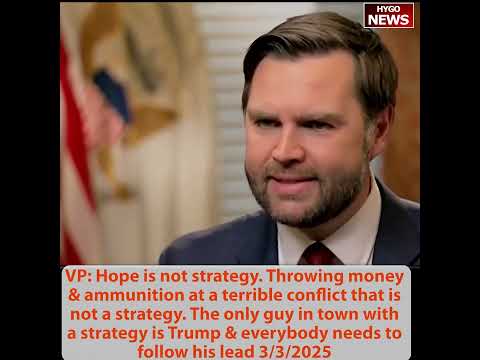
VP Vance: “Hope Is Not a Strategy” — Biden Threw Money at Ukraine; “The Only Guy With a Strategy Is Trump”
Vice President JD Vance provided the most detailed post-mortem of the Zelensky confrontation in a March 2025 interview, revealing that Friday’s meeting “was supposed to be ceremonial” — sign the minerals deal, credit Ukrainian fighters, “have a rah-rah moment, and then get to the tough talk of negotiating peace.” Instead, “we couldn’t even get the Ukrainians to a point where they could talk about a peaceful settlement.” Vance delivered the indictment of Biden’s approach that framed the entire administration’s position: “Hope is not a strategy. Throwing money and ammunition at a terrible conflict — that is not a strategy. The only guy in town with a strategy is the President of the United States, and everybody needs to follow his lead."
"It Was Supposed to Be Ceremonial”
Vance opened by describing what the White House had planned for the Zelensky visit — and how dramatically it diverged from what actually happened.
“When the Ukrainians came to Washington on Friday, it was supposed to be ceremonial,” Vance said. “There had been some public back and forth, some disagreements, some words spoken in public, and the President was like, let’s have this moment.”
He described the intended sequence: “We give some credit to the brave Ukrainian fighters — and of course, it’s a very brave army that they have there in Ukraine. Let’s sign this minerals deal, which importantly does two things: it allows the American people to get some of their money back, but it also shows the Ukrainian people that America has a long-term investment in their sovereignty.”
The plan had been simple: “You do those things, we’ll sign this thing, we’ll have a rah-rah moment, and then we’ll get to the tough talk of negotiating peace.”
Then the punchline: “We couldn’t even get the Ukrainians to a point where they could talk about the peaceful settlement.”
The revelation that the meeting was designed as a celebration that would transition into substantive peace talks — rather than the confrontation it became — reframed the blame. The White House had prepared a positive event. Zelensky’s refusal to engage constructively had destroyed it.
”Hope Is Not a Strategy”
Vance then delivered the most concise and devastating critique of the Biden Ukraine policy that any administration official had offered.
He described what Biden officials had said privately when asked about their plan. “When you ask them, what’s the plan? Okay, we’re going to spend tens of billions of dollars, hundreds of billions of dollars in Ukraine. What is your plan?” Vance said. “And they would honestly tell you, ‘Well, we’re just going to send them weapons for as long as we can, and hope eventually they can turn the tide.’”
Then the line that crystallized everything: “Hope is not a strategy. Throwing money and ammunition at a terrible conflict — that is not a strategy.”
Vance concluded: “The only guy in town with a strategy is the President of the United States, and everybody needs to follow his lead.”
The “hope is not a strategy” formulation was borrowed from military planning doctrine, where it was used to criticize commanders who lacked a defined objective and relied on optimistic assumptions instead. By applying it to the Biden Ukraine policy, Vance was saying that three years and $350 billion of American spending had been guided by wishful thinking rather than strategic planning. Trump, by contrast, had a defined objective (peace), a timeline (weeks, not years), and a mechanism (diplomacy backed by leverage). Whether one agreed with Trump’s approach or not, it was at least a strategy — something Biden had never had.
The Minerals Deal as the Real Security Guarantee
Vance made an argument about security guarantees that reframed the debate over Ukraine’s post-war protection.
“The President knows that if you want real security guarantees, if you want to actually ensure that Vladimir Putin does not invade Ukraine again, the very best security guarantee is to give Americans economic upside in the future of Ukraine,” Vance said.
He compared this to the alternative that European leaders had been discussing: “That is a way better security guarantee than 20,000 troops from some random country that hasn’t fought a war in 30 or 40 years.”
The argument was that American investment in Ukrainian mineral resources would create a permanent American interest in Ukraine’s survival and sovereignty. A country where American companies had billions invested in mines, processing facilities, and infrastructure was a country that the United States would defend — not out of altruism or treaty obligation but out of economic self-interest. That kind of security guarantee was more durable than any paper commitment because it was backed by money, not promises.
“The security guarantee, and also the economic guarantee for Ukraine, is to rebuild the country and ensure that America has a long-term interest,” Vance said. “You’re not going to do that if you come to the Oval Office, insult the president, and refuse to follow his plan for peace."
"The Door Is Open”
Vance emphasized that despite the dramatic confrontation and expulsion, the administration was not closing the door on Zelensky permanently.
“What President Trump has said clearly and consistently is, of course, the door is open so long as Zelensky is willing to seriously talk peace,” Vance said.
He defined what “seriously talk peace” meant in practical terms: “You can’t come into the Oval Office or anywhere else and refuse to even discuss the details of a peace deal.”
Vance acknowledged the difficulty of the negotiations ahead. “This is not going to make anybody happy,” he said. “The Russians are going to have to give up stuff. The Ukrainians are going to have to give up stuff.”
He identified the specific behavior that needed to change: “You can’t come to the Oval Office and say, ‘Give us security guarantees. We won’t even engage with you about what we’re willing to give up.’ That’s been the Ukrainian posture.”
Vance concluded with confidence: “When that posture changes, as President Trump said, when they’re willing to talk peace, I think President Trump will be the first person to pick up the phone.”
Private vs. Public Postures
Vance revealed a telling disconnect between what leaders said publicly and what they admitted privately.
“When you talk to leaders in private, whether they’re Ukrainian or European, when you talk to people in private, they will tell you this cannot go on forever,” Vance said.
The admission that even Ukrainian and European officials acknowledged privately that the war was unsustainable — while continuing to resist peace negotiations publicly — exposed the gap between diplomatic posturing and reality. Leaders who told Trump’s team privately that the war had to end were publicly criticizing Trump’s peace efforts because their domestic politics required it.
Vance was calling out this hypocrisy: the people resisting peace in public were the same people admitting its necessity in private.
Key Takeaways
- Vance revealed the Zelensky meeting “was supposed to be ceremonial” — sign the minerals deal, credit fighters, “have a rah-rah moment” — but “we couldn’t even get them to talk about a peaceful settlement.”
- He delivered the defining critique of Biden’s Ukraine policy: “Hope is not a strategy. Throwing money and ammunition at a terrible conflict — that is not a strategy.”
- Vance argued the minerals deal was “a way better security guarantee than 20,000 troops from some random country that hasn’t fought a war in 30 or 40 years.”
- He said “the door is open so long as Zelensky is willing to seriously talk peace” but that Ukraine’s posture of demanding guarantees while refusing to discuss concessions had to change.
- Vance revealed that Ukrainian and European leaders privately admitted “this cannot go on forever” while publicly resisting the peace process.