 HYGO News
 Vance to Protesters: 'It's Friday Afternoon -- Don't You All Have Jobs?'; Tariffs Protect 'Who We Are as a People'
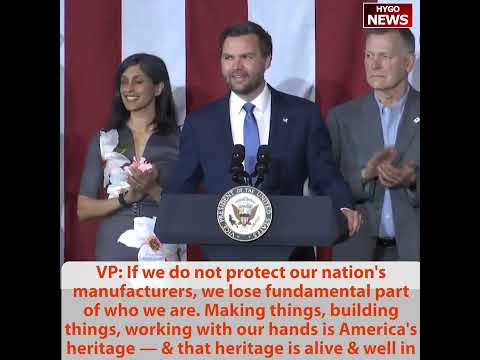
Vance to Protesters: “It’s Friday Afternoon — Don’t You All Have Jobs?”; Tariffs Protect “Who We Are as a People”
VP JD Vance visited Vantage Plastics, a manufacturing facility, on March 14, 2025, and opened with a quip about the protesters outside: “It’s a little after noon on a Friday — don’t you all have jobs? That’s one of the reasons we’ve got to rebuild American manufacturing. We want those people to get off the streets and back to work.” He delivered a passionate defense of tariffs as essential to preserving “who we are as a people,” saying “making things, building things, working with our hands is America’s heritage.” Vance laid out the administration’s deal to manufacturers: “If you invest in America, you’re going to be rewarded. If you try to undercut us and build outside our borders, President Trump’s administration has got nothing for you."
"Don’t You All Have Jobs?”
Vance opened the event at Vantage Plastics with the kind of off-the-cuff humor that had become his signature.
“We’ve got this great event, this great facility, great business, and of course great workers,” Vance said. “And I’m sure all of us saw there were a few protesters outside.”
He delivered the line: “I can’t be the only person wondering — it’s a little after noon on a Friday. Don’t you all have jobs?”
The crowd laughed. Vance turned the joke into policy substance: “And I think that’s one of the reasons why we’ve got to rebuild American manufacturing and support great companies like Vantage Plastics, because we want those people to get off the streets and back to work. It’d be good for them, and it’d be good for everybody else too.”
The “don’t you have jobs” quip worked because it carried a serious point beneath the humor. The administration’s manufacturing agenda was designed to create the kind of employment that gave people purpose, income, and community — the very things that protestors, in Vance’s framing, appeared to lack. The solution to social dysfunction was not more protests but more factories.
”Unless You Use American Power to Fight Back”
Vance then delivered his most muscular defense of tariffs, connecting trade policy to national identity.
“You hear people saying, ‘How dare Donald Trump impose tariffs on foreign countries that have been taking advantage of us for 40 years,’” Vance said. “And the answer is: unless you’re willing to use American power to fight back against what those countries have been doing for a generation, you are never going to rebuild American manufacturing, and you’re never going to support American workers.”
He drew the contrast between the administration and its predecessors: “President Trump is done with leaders who talk, talk, talk. We are an administration that is going to do things for the American people and for American workers.”
Vance then elevated the argument from economics to identity. “If we do not protect our nation’s manufacturers, we lose a fundamental part of who we are as a people,” he said. “Making things, building things, working with our hands is America’s heritage — and that heritage is alive and well in this facility.”
The “who we are as a people” framing echoed Trump’s own statement that tariffs were about “protecting the soul of our country.” Vance was making the same argument in his own voice: manufacturing was not just an economic sector but a cultural foundation. Communities built around factories had values — hard work, craftsmanship, mutual dependence — that were essential to the American character. When those communities died, something irreplaceable was lost.
The Biden Inheritance
Vance provided the economic contrast that set up the administration’s solution.
“The last administration left us with a terrible economy,” Vance said. “They left us with sky-high prices. They left us with home values that had doubled in just four short years, meaning a lot of American families couldn’t afford to buy or rent a home.”
He cited the fiscal dimension: “Did you know that in the history of the United States of America, we have never had deficits and debt so high as we had under Joe Biden’s leadership?”
Vance posed the accountability question: “And what did all that peacetime debt and deficit — what did all that spending, what did all that waste and fraud — get us? It got us an economy where Americans couldn’t afford to buy a home, our families couldn’t afford to buy groceries, and our people felt like the American dream was slipping away.”
The framing was effective because it connected the abstract fiscal numbers to the concrete experiences of ordinary Americans. Trillions in deficit spending had not produced prosperity; it had produced inflation, unaffordable housing, and a sense that the American dream was dying. The spending had been worse than useless — it had been actively harmful.
The Deal: “Build in America or Be Penalized”
Vance concluded with the clearest articulation of the administration’s industrial policy since taking office.
“Now that is the bad news, but now we can talk about the good news, because I’m proud to say that thanks to all of you, on January 20, 2025, we started a great American comeback,” Vance said.
He described the framework: “President Trump has been clear about our administration’s plan. Our goal is to make it easier and more affordable to make things again in the United States of America.”
Then the deal, stated in the simplest possible terms: “If you invest in America, in American jobs, in American workers, and in American businesses, you’re going to be rewarded. We’re going to cut your taxes. We’re going to slash regulations. And we’re going to reduce the cost of energy to build things right here in this country.”
The counterpart: “But if you try to undercut us and build outside of our borders, President Trump’s administration has got nothing for you.”
Vance reduced it to its essence: “If you want to be rewarded, build in America. If you want to be penalized, build outside of America. It’s as simple as that.”
The binary — reward or penalty, domestic or foreign — was the administration’s industrial policy in its most distilled form. There was no complexity, no ambiguity, no bureaucratic maze to navigate. Build in America and the government was your ally. Build abroad and the government was your adversary. The simplicity was the point.
Key Takeaways
- Vance quipped to protesters: “It’s noon on a Friday — don’t you all have jobs? That’s why we need to rebuild manufacturing — get those people off the streets and back to work.”
- He called tariffs essential because “unless you use American power to fight back, you’re never going to rebuild manufacturing.”
- Vance said protecting manufacturers meant preserving “who we are as a people — making things, building things, working with our hands is America’s heritage.”
- He indicted Biden’s economy: “Never in history have we had deficits and debt so high,” producing an economy where “families couldn’t afford groceries” and “the American dream was slipping away.”
- The administration’s deal: “Invest in America and be rewarded — taxes cut, regulations slashed, energy costs reduced. Build outside our borders and President Trump’s administration has got nothing for you.”