 HYGO News
 VP on serving as VP under Trump: Tom Brady backup notwithstanding, it's pretty much best job
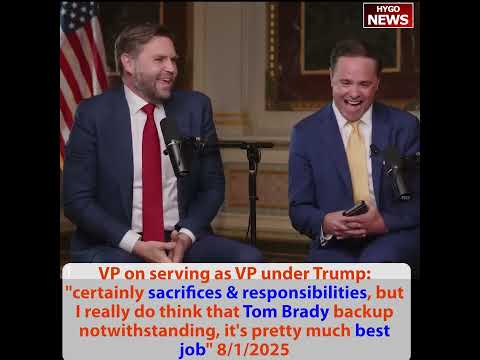
VP on serving as VP under Trump: Tom Brady backup notwithstanding, it’s pretty much best job
Vice President JD Vance offered a rare personal reflection on the vice presidency. The VP residence at the Naval Observatory — “40 or so acres of completely private space” combined with the broader 130-acre Naval Observatory grounds — provides space for his three young children. Vance described taking his 8-, 5-, and 3-year-olds out in a golf cart to catch “lightning bugs at 8:30 at night.” Summer thunderstorms from the residence’s porch. The private and normal moments the position preserves. And the self-aware framing: “Tom Brady backup notwithstanding, it’s pretty much the best job.” Then NEC Director Kevin Hassett delivered the economic win: “3% growth … 3% income growth and inflation only at 2.1%. This is how supply-side economics works.” Hassett on the Fed: “The Fed still, as Chairman Powell kept saying today, is obsessed on the idea that tariffs are going to cause inflation. But they’ve been saying that really since January and it keeps not happening."
"130 Acres of Just Our Own Space”
Vance described the VP residence. “So the vice president’s residence, which is on the old Naval Observatory, is about 40 or so acres of completely private space. Outside of business hours, the Naval Observatory is empty, so we’ve got probably 130 acres of just our own space.”
The Number One Observatory Circle, the official residence of the VP, sits within the grounds of the United States Naval Observatory — the government facility responsible for time-keeping and celestial observation. The residence itself has 40 acres. The broader Observatory grounds add another ~90 acres that become effectively private after working hours.
For security reasons, the Observatory is closed to the public. The Observatory’s research staff work during daylight hours. Evenings, weekends, and holidays find the entire 130 acres essentially empty except for the VP and family.
“It’s amazing for the kids, so an eight-year-old, five-year-old, and then a three-year-old. They’ve got plenty of room to run around.”
Ewan (8), Vivek (5), and Mirabel (3) Vance. Three young children with more private outdoor space than almost any other American children.
Lightning Bugs
The vignette. “For example, a couple weeks ago, there’s like a running track there that’s really nice, and I was running. It was sort of later in the day, just lightning bugs everywhere. It kind of hit me like, oh, when was the last time the kids were just able to catch lightning bugs? See nature, right? Or fireflies. I think it’s a regional thing. I think if you’re further west, you call it fireflies.”
Lightning bugs or fireflies. Southern Ohio (where Vance grew up) uses “lightning bugs.” The regional distinction reflects American linguistic variation.
“Anyway, I take the kids out there in a golf cart, and they’re just running around catching lightning bugs at 8.30 at night. And my wife’s like, ah, it’s time for bed. I’m like, ah, but they’re having such a good time.”
That is the personal moment. The Vice President, his wife Usha, and their three young children, in a golf cart on the Naval Observatory grounds, catching lightning bugs at 8:30 PM. That is not typical American family life. It is, in its own way, remarkably ordinary American family life — the kind that urban families often cannot provide for their children.
“You know, just like moments like that that you think you sort of have to give up, but you’re on such a private area that it actually preserves a lot of normal things.”
The specific insight. Public service at the vice-presidential level is typically imagined as an experience of giving up normal life — privacy, routine, family time. The Observatory’s private grounds actually preserve the opposite. The VP residence is, in some ways, more conducive to normal family moments than most urban professionals experience.
Summer Thunderstorms
“Yeah, that’s what I was going to say. I mean, I think it’s like, who should I go outside and have a beer and just sit on the porch and watch? Like my favorite thing growing up in Southwestern Ohio, absolute favorite thing is like a summer thunderstorm. Yeah, DC’s got a lot of those. We’ve got this beautiful porch. We just go out, have a beer, watch it rain. The dog’s hanging out. There are a lot of perks to this.”
Summer thunderstorms. Sit on the porch. Have a beer. Watch the rain. The dog hanging out. That is pastoral suburban life — the kind that most middle-class Americans can relate to. For the Vice President of the United States to describe this as his domestic reality is striking.
Southwestern Ohio summers — Vance’s native region — produce classic Midwestern thunderstorms. Warm humid days building into afternoon or evening storms. Lightning splitting the sky. Heavy rain. The porch as the viewing platform. That memory-pattern Vance carries from childhood is being replicated, on a different property, with his own children.
”Tom Brady Backup Notwithstanding”
“And yeah, there are certainly sacrifices and responsibilities, but I really do think that Tom Brady back up notwithstanding. It’s pretty much the best job.”
That is the line. “Tom Brady backup notwithstanding.” Tom Brady, the 7-time Super Bowl champion quarterback, is the standard for greatest-athlete-in-American-sports. Being Tom Brady’s backup would be one of the most extraordinary jobs in America — paid millions to back up the greatest quarterback of all time, without the pressure of having to actually play.
Vance is saying: even compared to that, the vice presidency under Trump is a better job. That is a specific kind of self-aware humor. Vance is positioning the VP role as the second-best job in America, acknowledging only one comparably extraordinary position.
“Because the flip side of that is, like the president encourages me to be involved in everything. And I’ve never felt like he’s, you know, shut me out or that I haven’t been part of the core team. And that’s, that makes the job very cool.”
That is significant for VP role reading. Many vice presidents have been sidelined. George H.W. Bush under Reagan had an active VP role. Al Gore under Clinton had substantive portfolio. Dick Cheney under George W. Bush arguably had more power than any VP in history. Mike Pence under Trump 1.0 had active role on specific issues. Kamala Harris under Biden had a more constrained VP role.
Vance’s framing: Trump includes him in everything. The VP role under Trump 2.0 is substantive, not ceremonial. Vance is part of the core team.
”He Bears More of the Weight”
“But fundamentally, the honest truth is he bears more of the weight of responsibility. Right. He’s the one who ultimately has to make these big decisions. He delegates and involves everybody, but that’s an incredible burden.”
That is the candid acknowledgment. The presidency is different from the vice presidency in one fundamental way: the president makes the call. Trump ultimately decides. Vance participates, advises, represents, executes — but Trump decides.
“I just get to hang out and take all the credit when things go well. And then my kids have this beautiful house with a wonderful swimming pool in the middle of Washington, DC. It’s not a bad gift.”
Self-deprecating framing. Take the credit. Kids in the swimming pool. Good job. That framing acknowledges the VP’s favorable position — high prestige, substantial influence, real quality of life, without the ultimate burden of the decisions.
Hassett on GDP
The segment pivoted to National Economic Council Director Kevin Hassett. “Great news today because we had a blockbuster GDP report that really blew through expectations, gave us 3% growth, which by the way, we delivered in President Trump’s first term as well, but 3% income growth and inflation only at 2.1%.”
Q2 GDP at 3%. Income growth at 3%. Inflation at 2.1%. Those are the specific data points. All three simultaneously strong is the unusual combination.
“This is how supply side economics works, that if you have a big increase in supply, then you get lots of growth and you don’t get inflation.”
Supply-side economics. The theory associated with Reagan-era economic policy — cut taxes, deregulate, encourage investment. The result: expanded economic supply (more production capacity, more workers, more output). With supply expanding, demand can grow without driving prices up.
Hassett is arguing the current economy vindicates supply-side theory. Expanded supply from tariff-driven reshoring, tax-cut-driven investment, and deregulation-driven capacity growth produces 3% growth without producing inflation.
”The Fed Was Wrong”
“Now the problem with the Fed when we were there in the first term was that they kept thinking that the Trump tax cuts were going to cause inflation. They were hiking rates, so they were wrong about that.”
That is a specific historical criticism. During Trump’s first term, the Fed repeatedly hiked rates in response to tax cuts and deregulation, based on the theory that those policies would produce inflation. The inflation did not materialize until 2021-2022 under Biden, years after the Fed had predicted it.
“And I think that right now, if you look at central banks around the world, they have a night where inflation is around the world that’s quite different from the feds.”
Other central banks have read the inflation environment differently. The ECB has cut rates 11 times. The Bank of England has cut. Other central banks have cut. The Fed has held.
”They’ve Been Saying That Since January”
“And the Fed still, as Chairman Powell kept saying today, is obsessed on the idea that tariffs are going to cause inflation. But they’ve been saying that really since January and it keeps not happening.”
That is the specific critique. Since January 2025, the Fed has been forecasting tariff-driven inflation. Through January, February, March, April, May, June — through the subsequent months — the predicted inflation has not materialized. The Fed continues to forecast inflation that does not occur.
“And in today’s GDP release, as you mentioned, only 2.1% inflation. And again, the inflation numbers, the consumer price index, have surprised on the downside in the sense of good numbers, low inflation numbers, five months in a row.”
Five consecutive months of downside surprises on inflation. That is not noise. That is a pattern. Whatever the Fed’s model is forecasting, the data is consistently coming in below those forecasts.
“And so at some point, the idea that the tariffs are going to cause an explosion in inflation is something that people are going to have to give up.”
“At some point, the idea … is something that people are going to have to give up.” That is Hassett’s prediction. The forecasting error — tariffs causing inflation — has persisted for too long. Sooner or later, the analytical community has to abandon the forecast and accept the empirical reality.
”Safe Now to Cut Rates”
“And if an independent federal reserve is data-driven and looking at the data, that our expectation is that they’re going to recognize what the ECB has already recognized, that it’s okay, it’s safe now to cut rates.”
That is the policy call. The ECB has already concluded it is safe to cut rates. 11 cuts. The Fed is holding. Hassett is arguing the Fed’s data-driven mandate requires reaching the same conclusion the ECB reached.
The “independent federal reserve” qualifier is pointed. An independent Fed would, in theory, follow the data regardless of political pressure. If the Fed is data-driven, it cuts. If the Fed is not data-driven — if it is being guided by factors other than data — then its independence is a polite fiction rather than an operational reality.
Two Dimensions
Vance on family life. Hassett on the economy. Two different dimensions of the Trump administration. Both describe a presidency that is producing specific, positive outcomes: a family-friendly VP residence that preserves normal American life for the Vances’ young children, and an economy that is producing strong growth without the inflation the experts predicted.
The contrast with the opposition messaging is stark. While Democrats are characterizing ICE as “Gestapo” and calling strong GDP a “mirage,” the administration is documenting specific positive outcomes at both personal and national levels.
Key Takeaways
- VP Vance described the VP residence as “40 or so acres of completely private space” with 130 acres when counting the broader Naval Observatory grounds — “amazing for the kids.”
- Personal moments: lightning bugs at 8:30 PM, summer thunderstorms from the porch with a beer — “moments like that that you think you sort of have to give up, but … actually preserves a lot of normal things.”
- Vance on the VP role: “Tom Brady backup notwithstanding, it’s pretty much the best job” — with the acknowledgment that “fundamentally, the honest truth is [the president] bears more of the weight of responsibility.”
- NEC Director Hassett on Q2: “3% growth … 3% income growth and inflation only at 2.1% … This is how supply side economics works.”
- Hassett on the Fed: “Obsessed on the idea that tariffs are going to cause inflation. But they’ve been saying that really since January and it keeps not happening” — with five consecutive months of downside surprises on inflation.