 HYGO News
 Vance: Zelensky Showed 'Entitlement' and 'Unwillingness' to Talk Peace; DOD DOGE Finds $80M in Woke Waste
Vance: Zelensky Showed “Entitlement” and “Unwillingness” to Talk Peace; DOD DOGE Finds $80M in Woke Waste
VP JD Vance provided his assessment of the Zelensky breakdown in March 2025, saying there was “a lack of respect, a certain sense of entitlement” and that Zelensky “showed a clear unwillingness to engage in the peace process that President Trump has said is the policy of the American people.” Vance blamed European allies for “puffing up” Zelensky by telling him to “keep fighting forever — fighting forever with what? With whose money, whose ammunition, and whose lives?” Separately, the Department of Defense announced preliminary DOGE findings of $80 million in wasteful spending, including $1.9 million for Air Force “holistic DEI transformation,” $6 million to the University of Montana to “strengthen American democracy,” and $1.6 million to study “climate hazards in the African Sahel."
"Entitlement” and the “Real Breakdown”
Vance described the dynamics that had led to the confrontation and expulsion.
“There was a lack of respect, there was a certain sense of entitlement,” Vance said of Zelensky’s Oval Office behavior. “And most importantly, look, we can look past all of that stuff, but the President has set a very clear goal for his administration. He wants it to stop.”
Vance identified both leaders’ obligations. “It’s very important that President Zelensky and, of course, President Putin too — they’ve both got to come to the negotiating table,” he said. “And that’s ultimately where things broke apart.”
He then drew the distinction between personal insults and policy substance. “I really don’t care what President Zelensky says about me or anybody else,” Vance said. “But he showed a clear unwillingness to engage in the peace process that President Trump has said is the policy of the American people and of their president. That’s the real breakdown.”
The “real breakdown” was not the heated words or the body language or the personal friction. It was Zelensky’s refusal to engage with the peace process itself. Trump and Vance could tolerate disagreement, even public disagreement. What they could not tolerate was a foreign leader refusing to accept the fundamental premise that the war needed to end through negotiation.
Vance’s prediction was patient but firm: “I think Zelensky wasn’t yet there. And I think, frankly, now still isn’t there. But I think he’ll get there eventually. He has to.”
Europeans “Puffing Him Up”
Vance directed some of his sharpest criticism at European allies, accusing them of encouraging Zelensky’s intransigence.
“Our European friends, frankly, are being really, really — they’re doing a disservice to the Ukrainians,” Vance said. “Because their own populations are saying, ‘We’re not going to fund this war indefinitely.’ The American people are saying, ‘We don’t want to fund the war indefinitely.’”
He identified the specific problem: “What happened is you have Zelensky, he goes to Europe, and a lot of our European friends puff him up. They say, ‘You’re a freedom fighter, you need to keep fighting forever.’”
Then the question that deflated the rhetoric: “Well, fighting forever with what? With whose money, with whose ammunition, and with whose lives?”
The three questions — whose money, whose ammunition, whose lives — cut through the moral posturing that had characterized European support for Ukraine. European leaders who urged Zelensky to fight on were spending American money, depleting American ammunition stockpiles, and sacrificing Ukrainian lives. Their own contributions, as Trump had repeatedly noted, were structured as recoverable loans rather than the outright grants the United States had been sending.
”A Much More Realistic Perspective”
Vance described Trump’s approach as the only honest assessment of the situation.
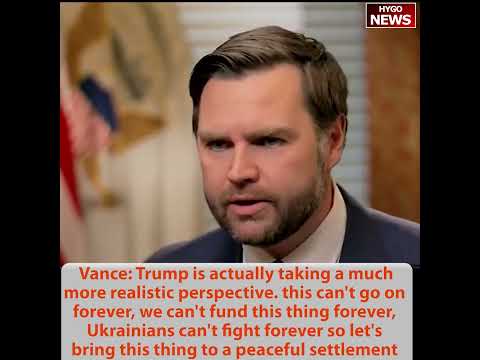
“The President is actually taking a much more realistic perspective and saying, ‘This can’t go on forever. We can’t fund this thing forever. The Ukrainians can’t fight forever,’” Vance said. “‘So let’s bring this thing to a peaceful settlement.’”
The word “realistic” was chosen deliberately. Vance was positioning the administration not as pro-Russia or anti-Ukraine but as the only party in the negotiation willing to confront reality. The reality was that the war was unsustainable for all parties. The reality was that neither side could achieve total military victory. The reality was that a negotiated settlement, however imperfect, was better than continued killing with no endgame.
DOD DOGE: $80 Million in Wasteful Spending
The compilation then shifted to a DOD announcement that provided concrete examples of military spending that the administration characterized as wasteful and mission-irrelevant.
A DOD official introduced the findings with a commitment to transparency. “We promised you transparency at this Department of Defense and America. That is exactly what you’re going to get because you deserve it,” the official said. “At the DOD, we’ve been working hand in hand with the DOGE team.”
He framed the cuts positively: “We welcome that process because that process will make us more lethal. And that means that our warfighters on the battlefield will be more successful.”
The specific findings included:
- Air Force: $1.9 million for “holistic DEI transformation and training”
- University of Montana: $6 million to “strengthen American democracy by bridging divides”
- Defense Human Resources Activity: $3.5 million for “support to DEI groups”
- University of Florida: $1.6 million to study “social and institutional detriments of vulnerability and resilience to climate hazards in the African Sahel”
The official delivered the assessment: “This stuff is not a core function of our military. This is not what we do. This is a distraction from our core mission.”
He quantified the initial savings: “We believe that these initial findings will probably save $80 million in wasteful spending. Again, $80 million in wasteful spending just right here.”
The promise of more to come: “Today’s actions are just the start. More to come this week. We are working hand in glove with DOGE. Stay tuned in the weeks ahead as we trim the fat, preserve the muscle, make the DOD more mission-capable and more lethal."
"Trim the Fat, Preserve the Muscle”
The “trim the fat, preserve the muscle” formulation captured the administration’s approach to military reform. The goal was not to weaken the Department of Defense but to redirect resources from non-military activities — DEI programs, climate studies, democracy-strengthening grants to universities — toward the military’s core mission of warfighting readiness.
Each of the specific examples was chosen for maximum public impact. A $1.9 million Air Force expenditure on “holistic DEI transformation” was the kind of spending that most Americans — including most veterans and active-duty service members — viewed as a waste of defense dollars. The $1.6 million climate study in the African Sahel was geographically and thematically so far from military readiness that it needed no commentary to appear absurd.
The $80 million in initial findings was described as preliminary. The DOD’s total budget exceeded $800 billion, meaning the initial DOGE findings represented a tiny fraction of the potential savings. The official’s promise that “more is coming this week” suggested that the $80 million was merely the first installment in a much larger audit.
Key Takeaways
- Vance said Zelensky showed “a lack of respect” and “entitlement” and that “the real breakdown” was his “clear unwillingness to engage in the peace process.”
- He accused European allies of “puffing up” Zelensky by urging him to fight forever, asking: “With whose money, whose ammunition, and whose lives?”
- Vance described Trump as taking “a much more realistic perspective” in saying “this can’t go on forever — let’s bring this thing to a peaceful settlement.”
- DOD DOGE findings identified $80 million in wasteful spending, including $1.9M for Air Force DEI, $6M to University of Montana, and $1.6M for a climate study in the African Sahel.
- The DOD official said “this stuff is not a core function of our military” and promised to “trim the fat, preserve the muscle, make the DOD more lethal.”