 HYGO News
 VP Vance Introduces Army Secretary Driscoll: 'If You Can Get an 8 and 6-Year-Old to Listen, You Can Lead'
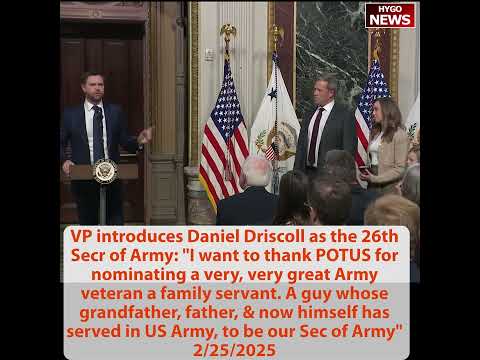
VP Vance Introduces Army Secretary Driscoll: “If You Can Get an 8 and 6-Year-Old to Listen, You Can Lead”
Vice President JD Vance introduced and swore in Daniel Driscoll as the 26th Secretary of the Army on February 26, 2025, delivering warm personal remarks about his longtime friend and fellow Yale Law School graduate. Vance thanked Trump for nominating “a very, very great Army veteran — a family servant — a guy whose grandfather, father, and now himself has served in the United States Army.” He noted that military recruiting had surged under the Trump administration and joked that if Driscoll could get his 8-year-old son and 6-year-old daughter to listen to him, “you can sure as hell be the Secretary of the Army, because these guys are a lot tougher than a lot of the soldiers.” The Senate had confirmed Driscoll 66-28 in one of the administration’s smoother confirmation processes.
The Live Swearing-In: “No Pressure”
Vance opened with a humorous note about the ceremony’s stakes. “Sometimes when you do the swearing-in, you actually do them formally beforehand and then you do the one on camera, just in case you screw something up in front of the cameras — it still counts,” he explained. “We have not done that with Dan.”
He turned to Driscoll with a grin: “So number one, that puts him under a lot of pressure. He actually has to say the words correctly.”
The joke — that Driscoll’s oath would only count if he got it right on camera — lightened the mood while underscoring the friendship between the two men. Vance’s humor was warmer and more personal than the typical vice presidential ceremony, reflecting a relationship that predated politics.
“And number two, that gives me an opportunity,” Vance continued. “Dan, this is the last minute here. Anything, you know, anything you can promise me to ensure that we swear you in properly, because the Senate’s done its job. And now it’s time for me to do mine."
"A Family Servant” — Three Generations of Army Service
Vance then shifted to the substance of the introduction, highlighting the generational military commitment that distinguished Driscoll’s nomination.
“First of all, of course, I want to thank the President for nominating a very, very great Army veteran, a family servant, a guy whose grandfather, father, and now himself has served in the United States Army to be our Secretary of the Army,” Vance said.
The three-generation lineage — grandfather, father, and son all serving in the Army — was central to the administration’s argument for Driscoll. At 38 years old and having served fewer than four years on active duty, Driscoll was younger and less experienced than many previous Army secretaries. But his family’s multigenerational commitment to the institution, combined with his combat deployment to Iraq and his subsequent legal and policy career, gave him a connection to the Army that transcended individual rank or tenure.
Vance connected the nomination to the military’s most pressing challenge. “If you look at our recruiting numbers just the last month, you see a massive increase in the number of people who have decided to volunteer and enlist and sign up for the United States Army,” Vance said.
He attributed the turnaround directly to the administration’s leadership. “Under the Trump administration, under Secretary Hegseth, and now under Secretary Driscoll, we have people proud to join the United States military again,” Vance said. “Thank God for that, because we need good people in our armed forces. We need great people in the United States Army.”
The recruiting improvement was one of the administration’s earliest and most tangible military accomplishments. The Army had fallen thousands short of its recruiting goals in fiscal years 2022 and 2023 under the Biden administration, a crisis attributed to a combination of low unemployment, competition from the private sector, and cultural issues including the perception that the military had become more focused on DEI programs than warfighting. The Trump administration’s immediate reversal of DEI policies and restoration of a warrior ethos appeared to be producing measurable results within weeks.
“I’m proud that under President Trump’s leadership, we have turned what was a recruiting shortfall into, I think, a recruiting boon, because people are proud to serve the United States military as they should be,” Vance said.
The Kids Who Listen: “Tougher Than a Lot of Soldiers”
Vance then delivered the personal tribute that produced the ceremony’s most memorable moment.
“I want to say something about Dan and his wonderful family,” Vance said. “Dan has been a dear friend of mine for a long time.” He acknowledged Driscoll’s wife: “His beautiful wife Cassie, who’s also an incredible physician.”
Then he turned to the children, 8-year-old Daniel and 6-year-old Lila, who were present at the ceremony. “Two beautiful kids who are the — I think the most well-behaved kids I’ve ever seen of a secretary nominee,” Vance said. “You guys do a really good job. You actually listen to your parents, which is amazing.”
The punchline followed: “And I think it speaks well. If Dan can get — how old are you, Daniel? You’re eight, okay? Lila, how old are you? You’re six. If you can get an 8 and a 6-year-old to listen to you, then I think you can sure as hell be the Secretary of the Army, because these guys are a lot tougher than a lot of the soldiers that Dan will now lead.”
The joke worked because every parent in the room understood the truth behind it: managing young children was, in its own way, one of the most demanding leadership challenges anyone faced. The comparison of well-behaved children to military discipline was humorous but also touching, connecting Driscoll’s family life to his professional qualifications in a way that resonated beyond the political setting.
”Meritorious Service Rewarded”
Vance outlined the vision for Driscoll’s leadership in terms that connected to the administration’s broader military reform agenda.
“He’s a man of integrity. He’s a man of character. He’s a man of great leadership,” Vance said. “And I think that he will bring the Army to a place where we can be proud of it, where we can have meritorious service rewarded and commended in the United States Army.”
He articulated the specific goals: “Where we make sure that we’re promoting the best and brightest, we’re enlisting the best and brightest, and when, God forbid, we have to send the best and brightest to America’s wars, we do it with competence, with effectiveness. We do the job, and then we bring everybody home safely.”
The emphasis on “meritorious service rewarded” was a direct contrast to the DEI-focused promotion culture that the administration argued had taken hold under Biden. Under the new framework, advancement would be based on capability and performance rather than demographic characteristics. The shift from identity-based to merit-based promotion was one of Defense Secretary Hegseth’s core mandates, and Driscoll’s appointment signaled that the Army would implement it aggressively.
The 66-28 Confirmation
Vance acknowledged the senators who had shepherded the confirmation, including Senators Budd, Britt, McCormick, and Ernst.
“We’ve had some tough confirmations. We’ve had some easier confirmations, and Dan has been on the easier side,” Vance said. “And I think that is a great testament both to his character and leadership, but also to the United States Senate and what they’re able to do.”
The 66-28 vote meant that 15 or more Democrats had crossed the aisle to support Driscoll, making it one of the most bipartisan confirmations of the Trump second term. The margin reflected the uncontentious nature of Driscoll’s hearing, which had focused on practical questions about Army modernization, recruiting, and the industrial base rather than partisan flashpoints.
The bipartisan support was notable given the intense polarization surrounding other Trump nominees. While Patel, Gabbard, and Kennedy had all been confirmed on party-line or near-party-line votes, Driscoll’s broad support suggested that when the administration nominated candidates whose qualifications were difficult to dispute, even Democratic senators were willing to vote yes.
Key Takeaways
- VP Vance introduced Driscoll as “a family servant” whose grandfather, father, and he himself all served in the U.S. Army, highlighting three generations of military commitment.
- Vance joked that if Driscoll could get his 8-year-old and 6-year-old to listen to him, “you can sure as hell be the Secretary of the Army, because these guys are tougher than a lot of the soldiers.”
- He reported a “massive increase” in Army recruiting under the Trump administration, saying “people are proud to join the United States military again.”
- Vance outlined the Army’s mission under Driscoll: “promoting the best and brightest, enlisting the best and brightest” and ensuring that “meritorious service” was “rewarded and commended.”
- Driscoll was confirmed 66-28 with significant bipartisan support, which Vance called “a great testament both to his character and leadership.”